

Ljubljana Audio Tour: Echoes of Heroes and Halls
Ljubljana wears a facade of emerald peace, but beneath the quiet surface of its manicured parks lie echoes of violent political ruptures and forgotten scandals. This self-guided audio tour peels back the layers of the capital to reveal the buried narratives that most tourists walk past without a second glance. Explore the corridors of power and the shadows of the city’s most iconic landmarks on your own schedule. Did a secret rebellion once hatch within the quiet trees of Tivoli City Park? What haunted decision led to the chaotic political clashes outside the National Assembly? Why does the architecture of Tivoli Hall hide a bizarre legacy of lost prestige? Trace the pulse of the city as you navigate from grand halls to hidden retreats. Experience the thrill of unmasking a capital defined by drama and revolution. Plug in your headphones and begin the descent into the real Ljubljana.
Tour preview
About this tour
- scheduleDuration 40–60 minsGo at your own pace
- straighten3.7 km walking routeFollow the guided path
- location_on
- wifi_offWorks offlineDownload once, use anywhere
- all_inclusiveLifetime accessReplay anytime, forever
- location_onStarts at Cankar Centre
Stops on this tour
Look for a broad, pale stone facade shaped into sharp, stepped angles, its surfaces cut like folded paper and marked by deep, shadowed seams. You’re standing at Cankar Centre,…Read moreShow less
Open dedicated page →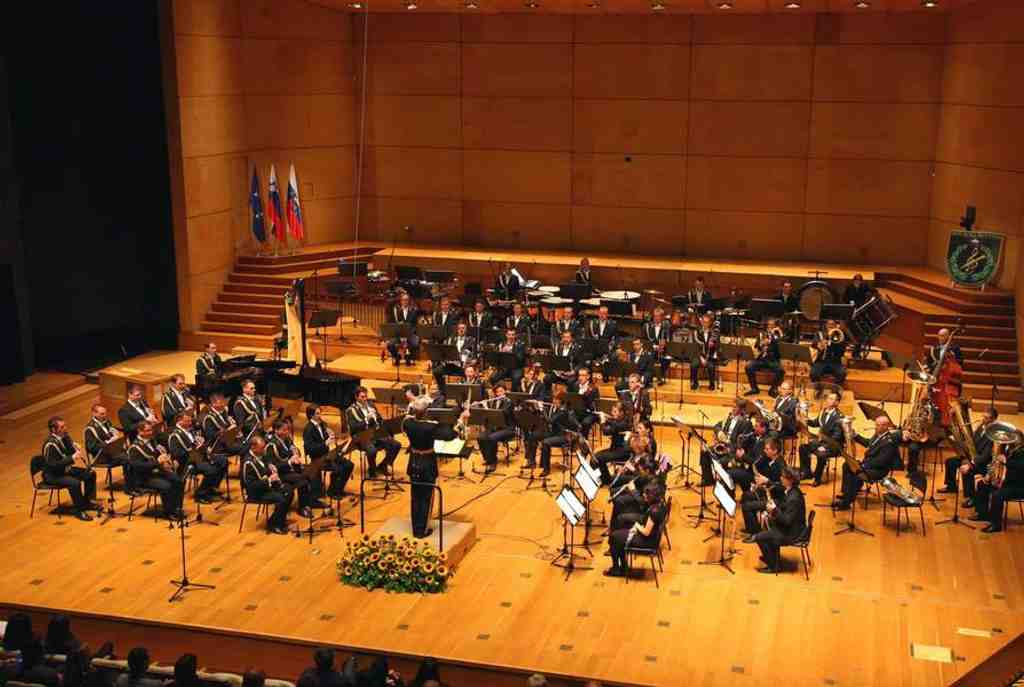
Cankar CentrePhoto: MORS, Wikimedia Commons, CC BY 3.0. Cropped & resized. Look for a broad, pale stone facade shaped into sharp, stepped angles, its surfaces cut like folded paper and marked by deep, shadowed seams.
You’re standing at Cankar Centre, the biggest convention, congress, and cultural hub in Slovenia… and it exists partly because a world-famous conductor couldn’t stand a noisy chair. In the 1970s, Romanian maestro Sergiu Celibidache performed at the Slovenian Philharmonic and then publicly complained about the “squeaking noises” of the old venue’s seats, calling it a national disgrace. Not an easy review to frame and hang on the wall. But it hit a nerve. A local cultural politician named Mitja Rotovnik took the insult seriously enough to push for a hall worthy of symphonic music, and later became this center’s first director.
The irony is that everyone agreed Ljubljana needed a cultural center… and then they argued for more than ten years while the designated site sat as a stagnant pit. The turning point came in 1978, when the Socialist Republic of Slovenia chose to fund construction anyway, ignoring a federal ban from Belgrade on “social activity” investments. In a place where identity had to be negotiated within a larger state, even pouring concrete could become an act of defiance.
The architect was Edvard Ravnikar, the mind that shaped much of this modern Ljubljana. He faced a delicate problem: how do you build something monumental without letting it bully the skyline around Republic Square? His solution was bold and unusual… he hid much of the structure underground. What you see above ground is only part of the mass; the building’s weight and much of its volume sit below your feet, like a cultural iceberg.
Its name also carries a deliberate edge. Ivan Cankar was a Slovene writer and social-democratic politician, once accused of treason by the Habsburg monarchy for his activism. Ravnikar clothed this place in white stone to suggest a “white chrysanthemum,” a nod to Cankar’s poem and an image of purity and resilience. Out front stands Slavko Tihec’s monument to Cankar: thirty vertical lamellae-thin upright slats-of varying thickness. As you shift your angle, the face appears and disappears, as if Cankar is refusing to be pinned down. At the base is his signature and the line: “My work is a premonition of dawn.”
Inside are halls named for Slovenian artists, but Gallus Hall is the showpiece. If you glance at the app image of the stage, notice the scale designed for world-level performers and, towering behind, the Karl Schuke organ from Berlin-nearly 8,000 pipes, four manuals, the largest musical investment in Slovenian history. Legends like Luciano Pavarotti and Martha Argerich praised the acoustics as among Europe’s best.
And there’s more buried here than architecture. In the late 1980s, these lower floors-built to bear heavy loads-became bunker-like meeting rooms where decisions for Slovenian independence could be made with a little more safety… and a little more secrecy.
In a moment, we’ll leave the realm of culture for the quieter theater of international diplomacy: the Italian Embassy is about a 9 minute walk away. For practical planning, Cankar Centre is generally open Monday to Friday, 11:00-1:00 and 3:00-5:00, and closed on weekends.

This image shows the Cankar Centre hosting the Slovenian Book Fair, one of the many cultural events held in its spacious foyer, reflecting its role as a vibrant cultural hub.Photo: Novijan Primus, Wikimedia Commons, CC BY-SA 4.0. Cropped & resized. Look to your left at the stately stone building with its flat pale facade and the official crest of the Italian Republic mounted by the entrance. This is the Italian Embassy, a…Read moreShow less
Open dedicated page →
List of ambassadors of Italy to SloveniaPhoto: F l a n k e r, Wikimedia Commons, Public domain. Cropped & resized. Look to your left at the stately stone building with its flat pale facade and the official crest of the Italian Republic mounted by the entrance. This is the Italian Embassy, a quiet arena where the shifting boundaries of national identity have been carefully negotiated.
When a new country declares its existence, it requires more than just new laws. It needs its neighbors to look across the border and recognize its sovereignty. Fabio Christiani witnessed this delicate rebirth firsthand, transitioning from the last Italian Consul General in the Yugoslav era to the first official representative to the newly independent Republic of Slovenia. He stood alongside Slovenian leaders on the night of June twenty fifth, nineteen ninety one, as they proclaimed independence. It was a moment heavy with uncertainty, punctuated by the roar of a Yugoslav military plane flying menacingly overhead. Christiani developed a deep bond with Ljubljana and spent immense diplomatic capital convincing Rome to move past historical fears and stand in solidarity with the new state.
Yet, establishing a new national narrative often triggers conflicts over physical land and cultural memory. In the years following independence, relations between Italy and Slovenia were deeply tested by the past. After the Second World War, many Italians fled the territory that fell under Yugoslav rule, and their properties were confiscated by the communist government. By the nineteen nineties, the Italian government demanded compensation and restitution for these displaced citizens, even blocking Slovenia's early efforts to integrate with Western Europe. It took years of difficult negotiation to finally reach a compromise allowing European citizens to purchase property here.
You can find echoes of these ideological clashes in unexpected places. The ambassadorial residence itself, located nearby on a different street, holds a fascinating relic of the socialist era. Hidden inside the building is a prominent red star, left over from when the residence was state owned property in Yugoslavia. It is a remarkable architectural survival. A communist emblem preserved within the private quarters of a Western diplomat, quietly witnessing visits from foreign dignitaries. It remains a fixture of the home, proving that history is rarely wiped entirely clean.
Diplomats here learned that to truly engage with this emerging state, they had to understand its cultural battlegrounds. Ambassador Paolo Trichilo immersed himself in local literature, calling it a privileged observatory for diplomacy. He believed that reading Slovenian authors revealed the country's psychological landscape far better than official documents. Similarly, another ambassador brought an exhibition of the designer Ottavio Missoni to Slovenia. By connecting the famous high end Italian brand to Missoni's actual birthplace on the eastern Adriatic coast, she used art to soften old historical borders.
The story of this embassy shows how a nation is recognized from the outside. But to understand how it was built from the inside, we must move toward the physical center of the republic. Please continue on toward Republic Square. It will take about eleven minutes to walk there.
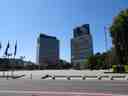
On your right, you will see a vast paved expanse framed by two towering, multifaceted concrete buildings, one of which is topped by a red digital clock. Beneath the heavy…Read moreShow less
Open dedicated page →On your right, you will see a vast paved expanse framed by two towering, multifaceted concrete buildings, one of which is topped by a red digital clock.
Beneath the heavy concrete surface stretching out before you lies a completely different world. This modern plaza was built directly over the northern wall of the ancient Roman city of Emona, hiding an expansive buried landscape of early Christian centers and ancient graves. In the nineteen sixties, the renowned archaeologist Ljudmila Plesničar Gec and her team waged a frantic battle against time and mechanization on this very spot. They dug through the earth by hand with volunteer youth brigades, literally tearing priceless Roman artifacts from the jaws of advancing bulldozers before the massive foundations of the new city erased them forever.
The architect driving this new era, Edvard Ravnikar, layered his grand design directly over that ancient past. If you check your screen, you can see an aerial view of the two stark buildings framing the square. Ravnikar designed them in brutalism, an architectural style defined by its unapologetic use of raw, exposed concrete to project uncompromising strength. He originally intended these two imposing structures to act as a monumental gateway to the city. The locals initially mocked their unusual triangular shape, calling them a pair of poker cards, but Ravnikar deliberately angled them to open up a clear line of sight toward the historic center.
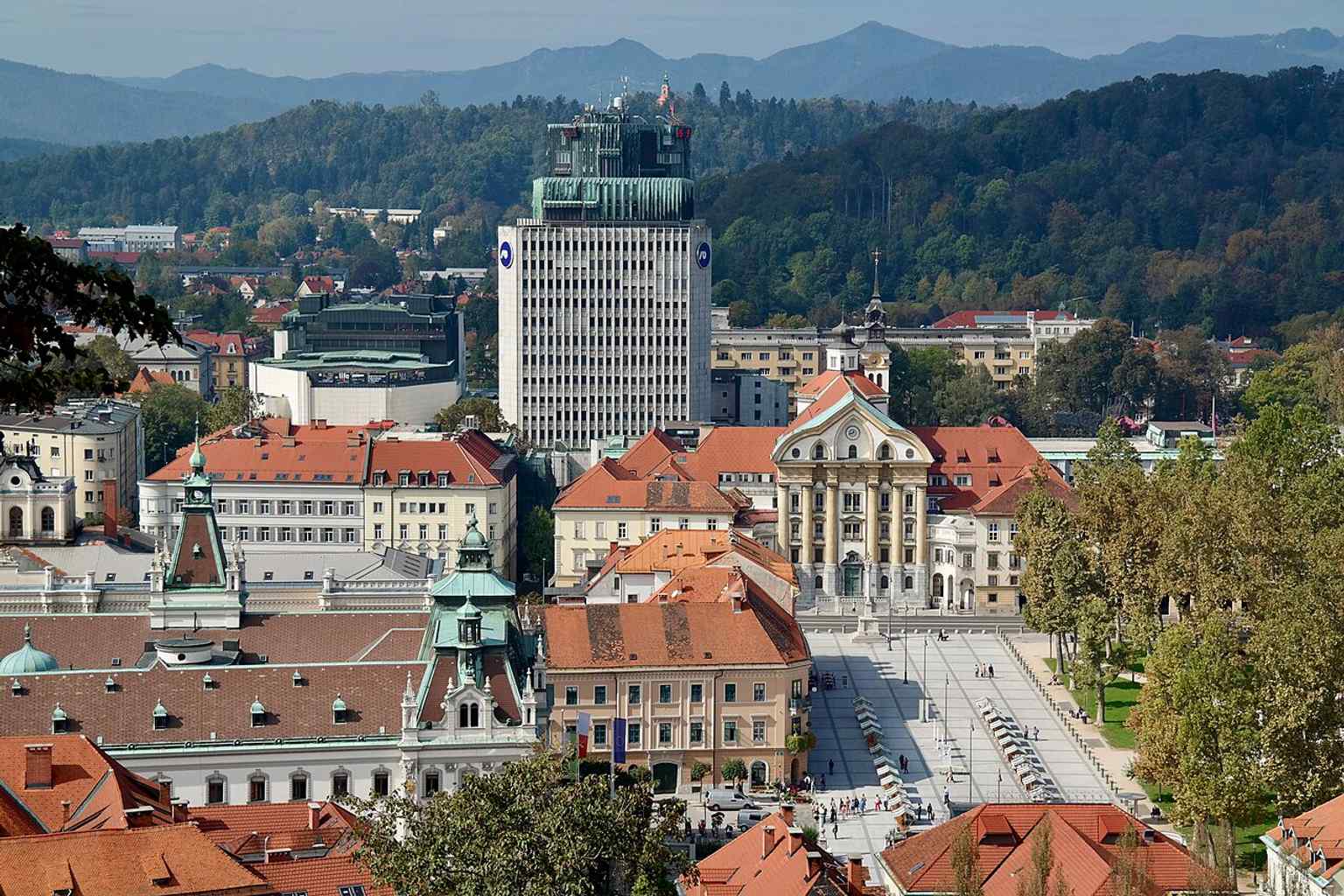
An aerial view of Republic Square from Castle Hill, featuring the distinctive brutalist TR3 and NLB towers. These buildings, part of Edvard Ravnikar's two-decade-long 'open planning strategy,' were originally envisioned as much taller 'Ljubljana gates'.Photo: Choinowski, Wikimedia Commons, CC BY-SA 4.0. Cropped & resized. This monumental space ultimately became the stage for a new nation's birth. It was here, in nineteen ninety one, that Slovenia officially declared its independence. But even that defining ceremony had its behind the scenes drama. Just sixty hours before the event, officials realized the newly manufactured national flags were printed incorrectly, with the coat of arms glaringly misaligned. Disaster was only averted when a local sailmaker frantically sewed a replacement of the proper dimensions, which a former champion skier then rushed through road blockades to deliver right to this square. A linden tree was planted during the ceremony as a symbol of the young state, but the harsh environment of this concrete expanse caused it to wither until it was moved to a nearby park, where it finally thrived.
Even in recent decades, the struggle over this space continued. For years, the city lost control of this very plaza due to an unusual legal loophole. Because there is a parking garage underneath, a private company purchased the garage and successfully argued in court that the entire public square above was legally just the roof of their building. It was not until two thousand eleven that the city reclaimed its rightful center.
Look across the wide pavement and imagine the dual realities resting here. You are standing above ancient Roman graves, looking up at the imposing gates of a modern nation. This open expanse is accessible twenty four hours a day. Now, let us walk further into the plaza as we head to our next view of Republic Square, just a minute away.

Show 9 more stopsShow fewer stopsexpand_moreexpand_less
On your right, Republic Square opens up as a wide granite-and-concrete plaza framed by sharp-edged modernist blocks and two uneven rectangular towers that rise like mismatched…Read moreShow less
Open dedicated page →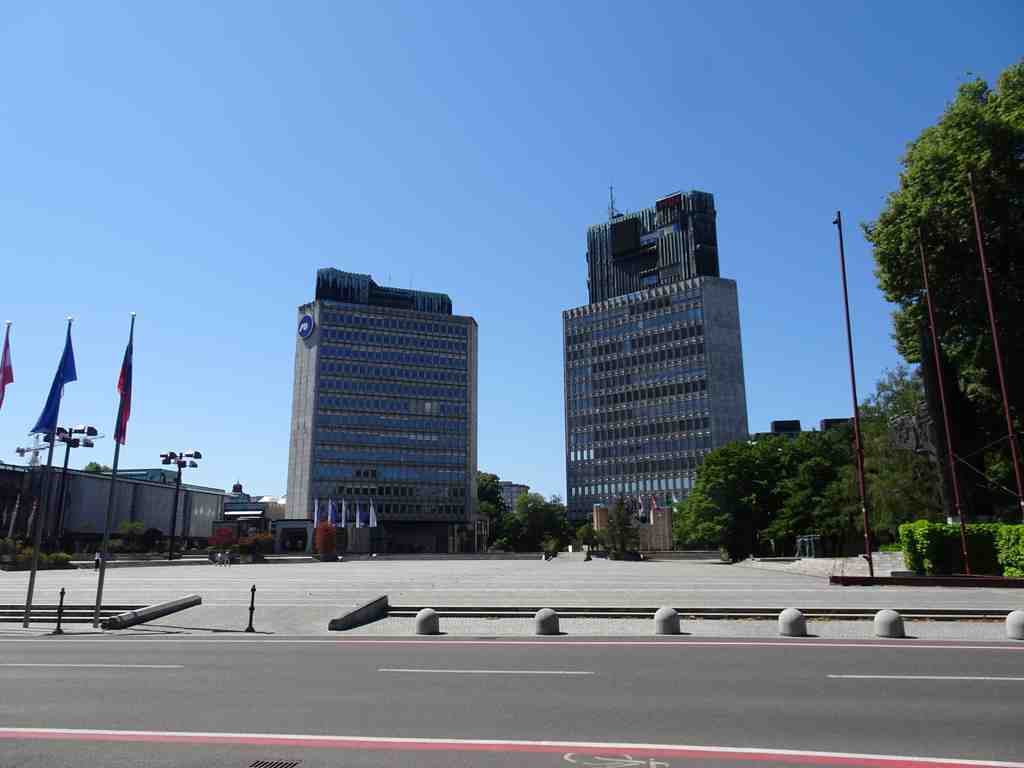
Republic SquarePhoto: Palickap, Wikimedia Commons, CC BY-SA 4.0. Cropped & resized. On your right, Republic Square opens up as a wide granite-and-concrete plaza framed by sharp-edged modernist blocks and two uneven rectangular towers that rise like mismatched bookends.
This is the largest square in Ljubljana, and it was built to feel bigger than the city’s old scale would normally allow. In the second half of the 20th century, architect Edvard Ravnikar designed it not as a cozy urban room, but as a statement. Ravnikar had studied under Jože Plečnik, Ljubljana’s master of classical detail, and also absorbed the bold modern ideas of Le Corbusier. Here, he tried to fuse architecture and city-planning into one stage set for public life.
But Republic Square is also a lesson in Vision vs. Reality. Ravnikar’s 1960 competition entry imagined this space as the “Ljubljana Gate,” a symbolic entrance to the capital. Two identical skyscrapers were supposed to stand here, 26 floors each, over 100 meters tall, like a pair of pillars. Political pressure and Yugoslav economic reforms in 1965 squeezed that dream down to what you see now: two towers, not twins at all, and not nearly as tall. The result was TR2 at about 60 meters and TR3 at about 69, later filled by Ljubljanska Banka and government offices. If you want a clearer sense of how the square reads from above, glance at the image on your screen.
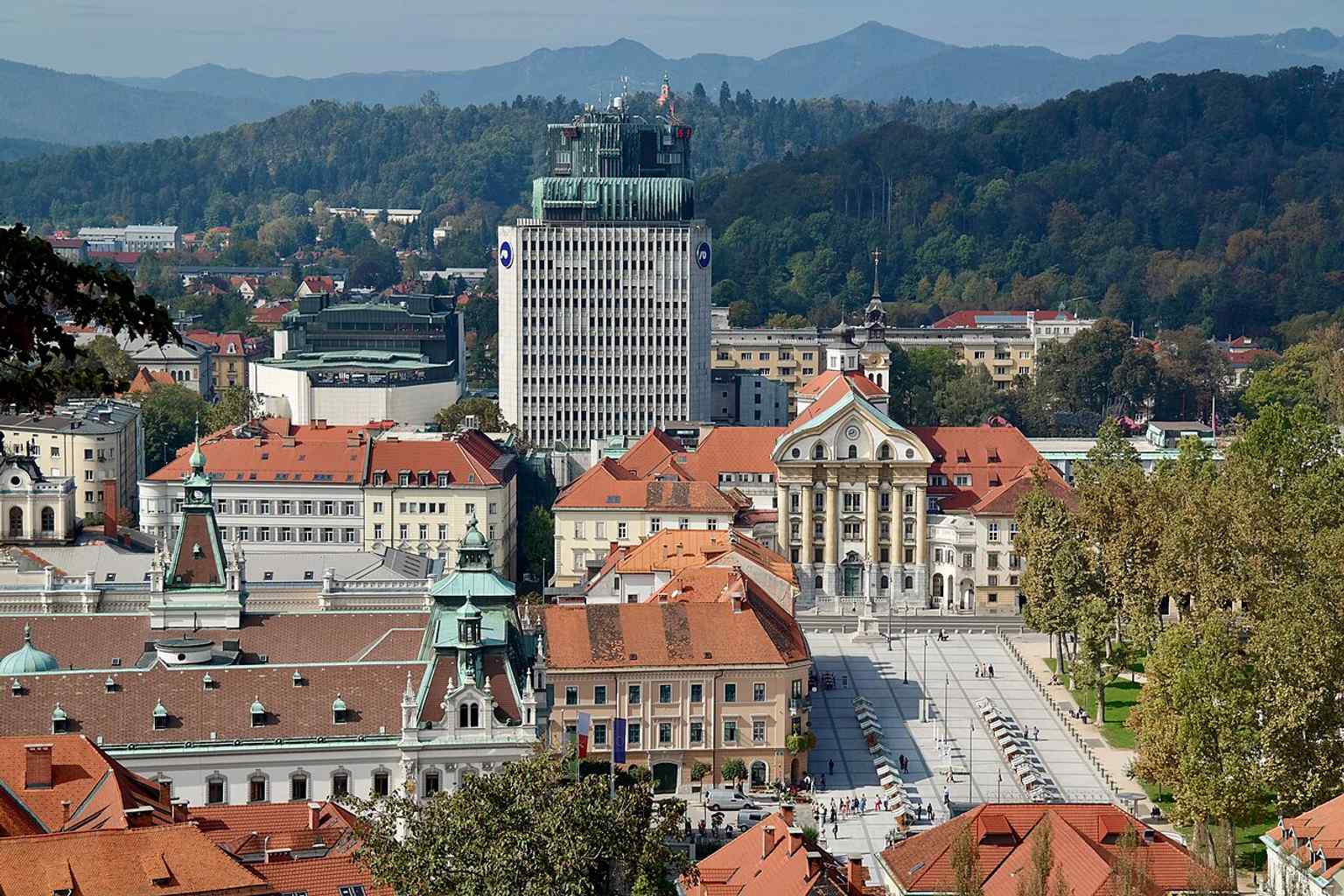
An aerial view of Ljubljana featuring the brutalist TR2 and TR3 towers of Republic Square. Architect Edvard Ravnikar originally envisioned two identical skyscrapers, but political pressure drastically reduced their height.Photo: Choinowski, Wikimedia Commons, CC BY-SA 4.0. Cropped & resized. Before any of this modern geometry, this ground was the Nunski vrt, the Nunnery Garden of the Ursuline Monastery... centuries of quiet green in the center of town. The construction took more than twenty years and replaced that calm with an “open design”: multiple buildings, underground passages, smaller atriums. Ravnikar even tried to soften the severity with small touches-birch trees, and stair details cut in “lace” patterns, like a reminder that human hands still mattered in a concrete world.
Now, take a moment to scan the breadth of the square from where you’re standing. Try to picture those two equal, towering giants Ravnikar wanted-this whole place turned into an actual gate you’d pass through, not just an open field between institutions.
And then there’s the weight at the center of the story: the Monument to the Revolution by sculptor Drago Tršar. Its creation became a grueling ten-year ordeal. Tršar first built a massive 32-ton gypsum model in his studio, then it had to be sliced into 240 sections-each roughly a door-sized slab-so the pieces could be sent to Zagreb for bronze casting. Austerity measures halted the project in 1965; it only reawakened a decade later, and when it finally arrived here in 1975, budget cuts stripped away Ravnikar’s planned water curtains and background elements. The bronze mass was left to speak for itself.
For years afterward, the irony was hard to miss: this symbolic ground became a central car park. Only in 2014 was it renovated into the pedestrian space you’re standing in now, officially protected as a national monument.
When you’re ready, let your eyes settle on the building that anchors the square’s northern edge-the seat of modern power. In about a 2-minute walk, we’ll meet it up close at the National Assembly.
Look to your left at the modernist rectangular structure clad in smooth green stone, anchored by a striking frame of sculpted bronze figures surrounding its main entrance doors.…Read moreShow less
Open dedicated page →
National AssemblyPhoto: User:WhosJan, Wikimedia Commons, Public domain. Cropped & resized. Look to your left at the modernist rectangular structure clad in smooth green stone, anchored by a striking frame of sculpted bronze figures surrounding its main entrance doors. This is the National Assembly.
Behind these heavy walls, the layout of the Great Hall speaks to a much older, wilder form of governance. The interior is arranged in a unique formation known as the Circle of Wise Men. The seats form a continuous ring, evoking the ancient Slavic democratic traditions of Carinthia, intended to represent a community gathering as equals around a central fire. It echoes a time when a newly elected leader would be ceremonially slapped by his peers to remind him of his equality... a ritual of power local lore claims even inspired Thomas Jefferson.
But who commands that circle has rapidly changed. You can check your screen to see the interior and Urška Klakočar Zupančič, the first woman to hold the office of Speaker, appointed in 2022. Her arrival sparked intense scrutiny, though not for her legal mind. Opponents launched a heated debate that became known as the shoe scandal, fixating entirely on the color of her footwear. She fired back, denouncing the distraction as a calculated move to silence women in public life.

Urška Klakočar Zupančič, the incumbent Speaker, whose appointment in May 2022 made her the first woman to hold the office.Photo: Vlada Republike Slovenije, Wikimedia Commons, Public domain. Cropped & resized. The clashes here are not just rhetorical. This building has literally absorbed the anger of a young nation finding its footing. The newly born state eventually had to face its own internal fury. On May 18, 2010, simmering political frustration exploded into massive civil unrest during a student protest against new labor legislation. The crowds tore heavy granite cubes straight from the surrounding pavement and hurled them directly at this building.
The barrage caused extensive damage to the rare green tonalite facade and the historic bronze doors right in front of you. Take a look at those naked bronze figures framing the entrance. Created to symbolize that citizens are born with nothing but their natural talents, they were battered by the very people they were meant to represent. The assault left physical scars on the architecture... a brutal reminder of the ongoing struggle to define this democracy.
If you want to step inside, the building is open Monday through Friday from eight in the morning to four in the afternoon. For now, let us step away from the battlefield of modern politics. Lead yourself toward the quieter, solemn monument hidden in the trees nearby, a one minute walk away.

Speaker Urška Klakočar Zupančič in a consultation, whose tenure was notably marked by the 'shoe scandal' focusing on her personal style rather than legislative agenda.Photo: Vlada Republike Slovenije, Wikimedia Commons, Public domain. Cropped & resized. On your left stands the Tomb of National Heroes. You can see the monument above ground, a granite base supporting a sarcophagus. Take a glance at your app to see a closer view of…Read moreShow less
Open dedicated page →On your left stands the Tomb of National Heroes. You can see the monument above ground, a granite base supporting a sarcophagus. Take a glance at your app to see a closer view of the bronze reliefs covering its eastern and western faces, which depict scenes from the Second World War. Created in 1949 by architect Edo Mihevc and sculptor Boris Kalin, this marker commands a quiet reverence.
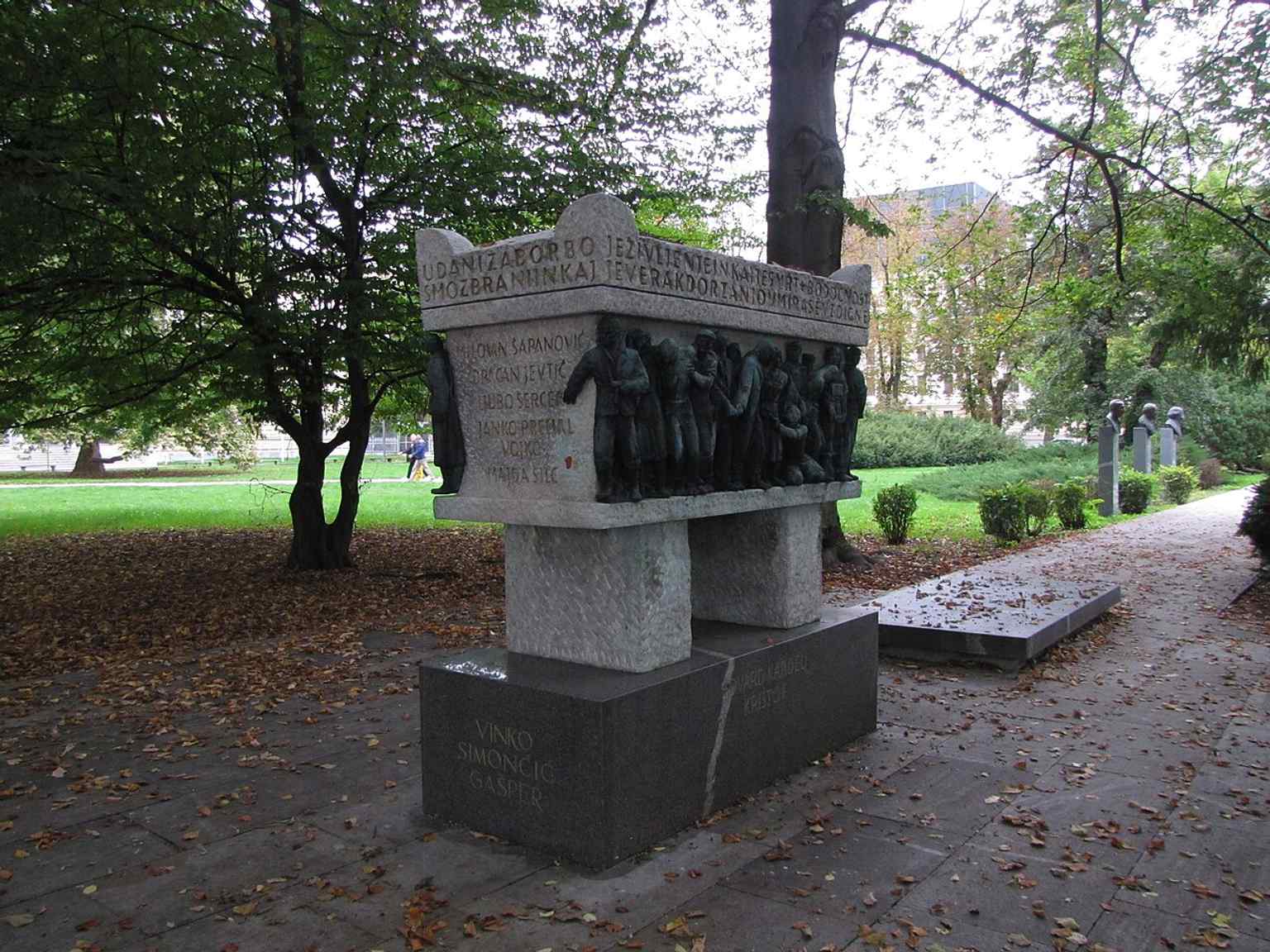
This image captures the stone sarcophagus of the Tomb of National Heroes, designed by architect Edo Mihevc and sculptor Boris Kalin in 1949. Its eastern and western faces are covered by bronze reliefs depicting scenes from the Second World War, and it features a patriotic epitaph by poet Oton Župančič along its top edge.Photo: RocketManForLife, Wikimedia Commons, CC BY-SA 4.0. Cropped & resized. But what you see is only part of the story. The true resting place lies in the hidden layers of an underground tomb built directly into the earth. Transferred here in a solemn ceremony were the remains of legendary partisan commanders. Among them is Franc Rozman, who died tragically when a newly arrived British anti tank weapon exploded during testing. Also resting here is Majda Šilc. A former clerk and nurse who became a resolute partisan soldier, she was killed in battle at just twenty one, becoming the first Slovenian woman proclaimed a National Hero. The tomb later received powerful political figures like Edvard Kardelj in 1979, whose state funeral was so significant that Yugoslav President Josip Broz Tito cut short a diplomatic tour of the Middle East to attend.
Running along the top edge of the sarcophagus is a patriotic epitaph. This was written by Oton Župančič, a deeply revered Slovenian poet. In December 1948, the architect visited the ailing poet to request a verse that could serve as a moral anchor for the new monument. Despite his failing health, Župančič penned the lines specifically for the tomb, marking one of his very last literary contributions. His opening line translates to, One homeland is assigned to us all.
For decades, those words served as a simple tribute to the fallen. Yet, the meaning of public memory rarely stays still. In 2017, that exact line by Župančič was inscribed on a new Monument to All War Victims nearby, intended for national reconciliation. This reuse sparked sharp backlash. Right wing politicians and victims of communist persecution argued that lifting a quote originally written for a partisan tomb was inappropriate, claiming it forced old partisan ideology onto a monument meant to heal historical divides. It became a profound struggle, fought with words and memory instead of weapons.
Today, the monument exists in a state of political irony. Originally a communist shrine integrated into the post war leaderships daily environment, it now stands right next to the modern National Assembly. During recent years, protests have frequently been held within meters of the sarcophagus, often by groups standing in direct ideological opposition to those buried below.
As you stand before the tomb, consider how an epitaph meant for unity became a source of sharp political debate. How does history change when we re read it decades later? You can return to reflect on this space anytime, as it remains open twenty four hours a day, all week long. Let the weight of those words linger as we move toward a space of deep historical preservation. The National Museum of Slovenia is just a two minute walk away.
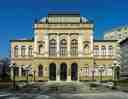
On your left, look for a pale stone Neo-Renaissance block with a long, symmetrical facade, arched windows, and a central pediment that reads as a formal civic “front door” to…Read moreShow less
Open dedicated page →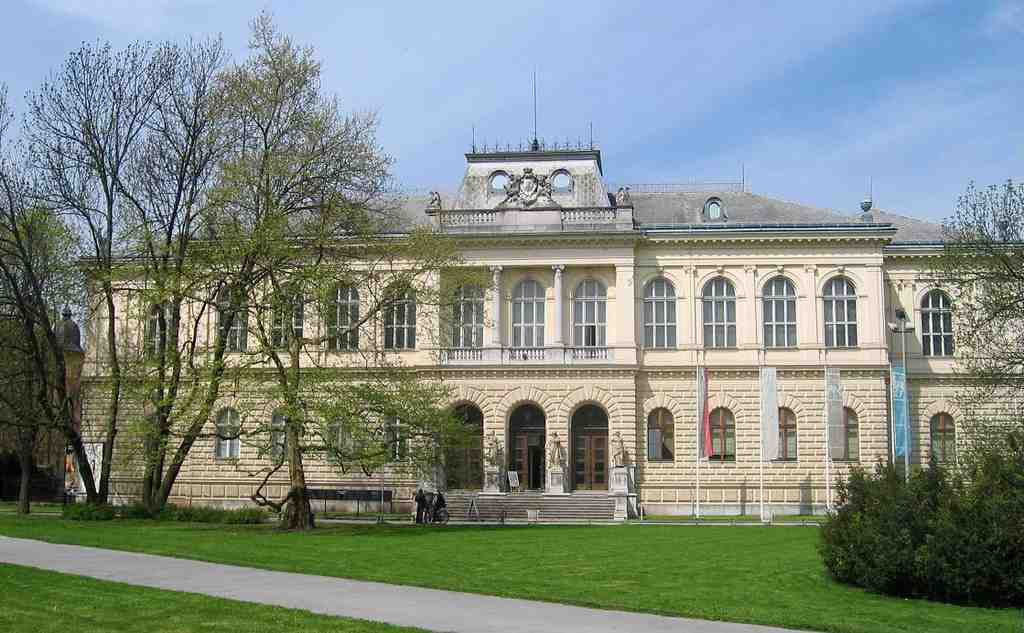
National Museum of SloveniaPhoto: Žiga, Wikimedia Commons, Public domain. Cropped & resized. On your left, look for a pale stone Neo-Renaissance block with a long, symmetrical facade, arched windows, and a central pediment that reads as a formal civic “front door” to culture.
This is the National Museum of Slovenia, and it began as an act of national preservation before the nation-state even existed. In 1821, local leaders founded it as the “Estate Museum of Carniola,” trying to keep Carniolan heritage from being scattered, sold off, or simply forgotten. Five years later, Emperor Francis I stepped in as sponsor and renamed it the “Provincial Museum of Carniola,” a reminder that even preservation can come with a label attached. What gets protected… and what story it serves… often depends on who pays.
The building itself makes that argument in stone. The cornerstone was laid on July 14, 1883, for what would become the first purpose-built cultural building in the Slovene Lands. There was pride in that, and tension too: master builder Wilhelm Treo led the work, but the aesthetic vision leaned heavily on plans by Viennese architect Wilhelm Rezori. The Carniolan Building Company, dominant in its era, pushed to turn this whole zone near parliament into a grand cultural quarter-architecture as a kind of public curriculum. If you glance at the photo in the app, you can see how confidently the facade presents itself: orderly, official, and built to last.
Inside, the museum is also a museum of choices. One pillar is numismatics-coins and currency-down on the ground floor. And that collection owes a great deal to a merchant, Jože Repežič, who in 1831 donated more than 2,000 coins, including a rare core of 367 Roman Republican silver coins. A merchant’s private passion became a public inheritance. But the story isn’t tidy. For decades, the museum had no dedicated numismatic curator, so the coins sat under archaeology’s care, poorly documented, and in some cases damaged by mismanagement. Even when a society decides something matters… it still has to do the daily work of caring for it.
If you want a glimpse of how the museum tried to elevate local identity into something formal, pull up the ceiling image. Those medallions were painted in 1885 by Janez and Jurij Šubic: an allegory of Carniola as protector of arts and sciences, and portraits of famous Carniolans like Valvasor and Vodnik-history turned into a kind of civic sky.
Out front, since 1903, a bronze Valvasor stands watch-Alojz Gangl’s monument to a polymath whose curiosity helped define what “our knowledge” could mean.
When you’re ready, turn your attention across the square toward the opera house-where culture stops being archived and starts projecting itself aloud. The museum is generally open daily 10 to 6, with a later closing at 8 on Thursdays.
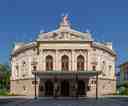
On your left, the Ljubljana Opera is a pale stone, Neo-Renaissance block with a columned entrance portico and a triangular pediment crowned by a sculptural group. Stand where…Read moreShow less
Open dedicated page →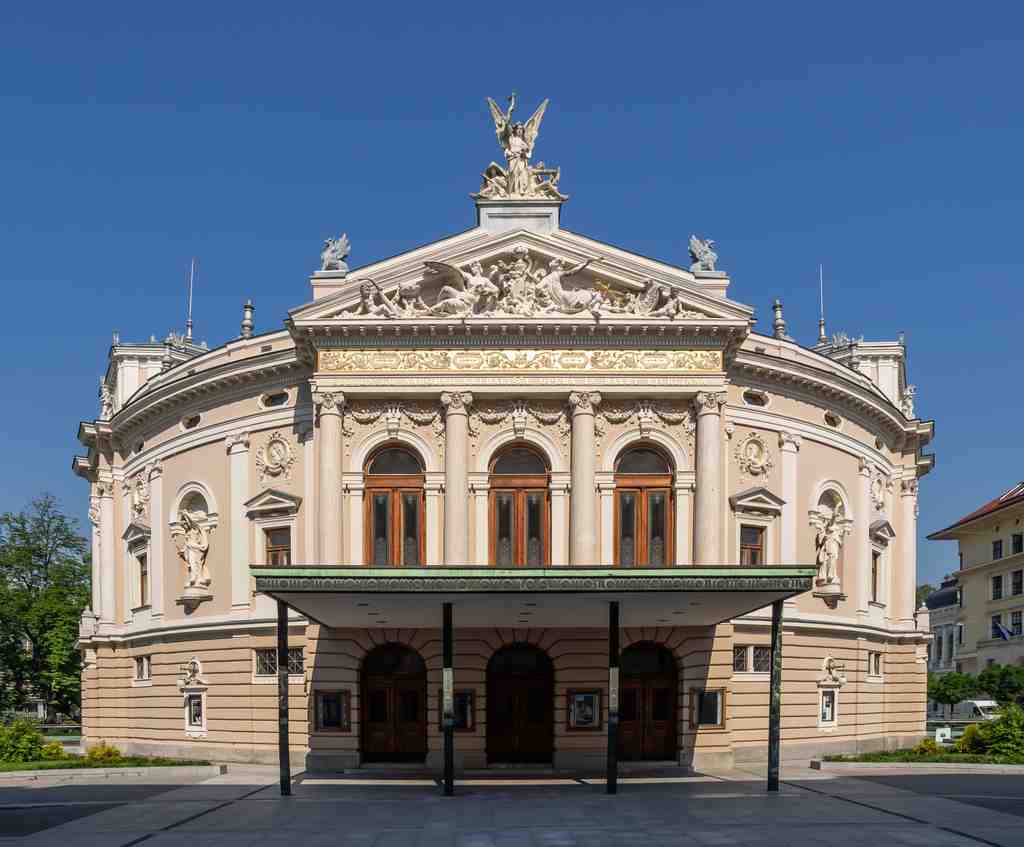
Ljubljana OperaPhoto: Petar Milošević, Wikimedia Commons, CC BY-SA 4.0. Cropped & resized. On your left, the Ljubljana Opera is a pale stone, Neo-Renaissance block with a columned entrance portico and a triangular pediment crowned by a sculptural group.
Stand where you are and let the façade do what it was designed to do: persuade. Those Ionic columns - the ones with the curled, scroll-like capitals - lift your gaze up to the pediment, and above it a “genius” figure stands with Opera and Drama, as if culture itself has taken the roofline. If you glance at the image in the app, you can pick out the allegories more clearly: Tragedy and Comedy set into the entrance niches, and the figures above, all part of the same theatrical argument in stone.
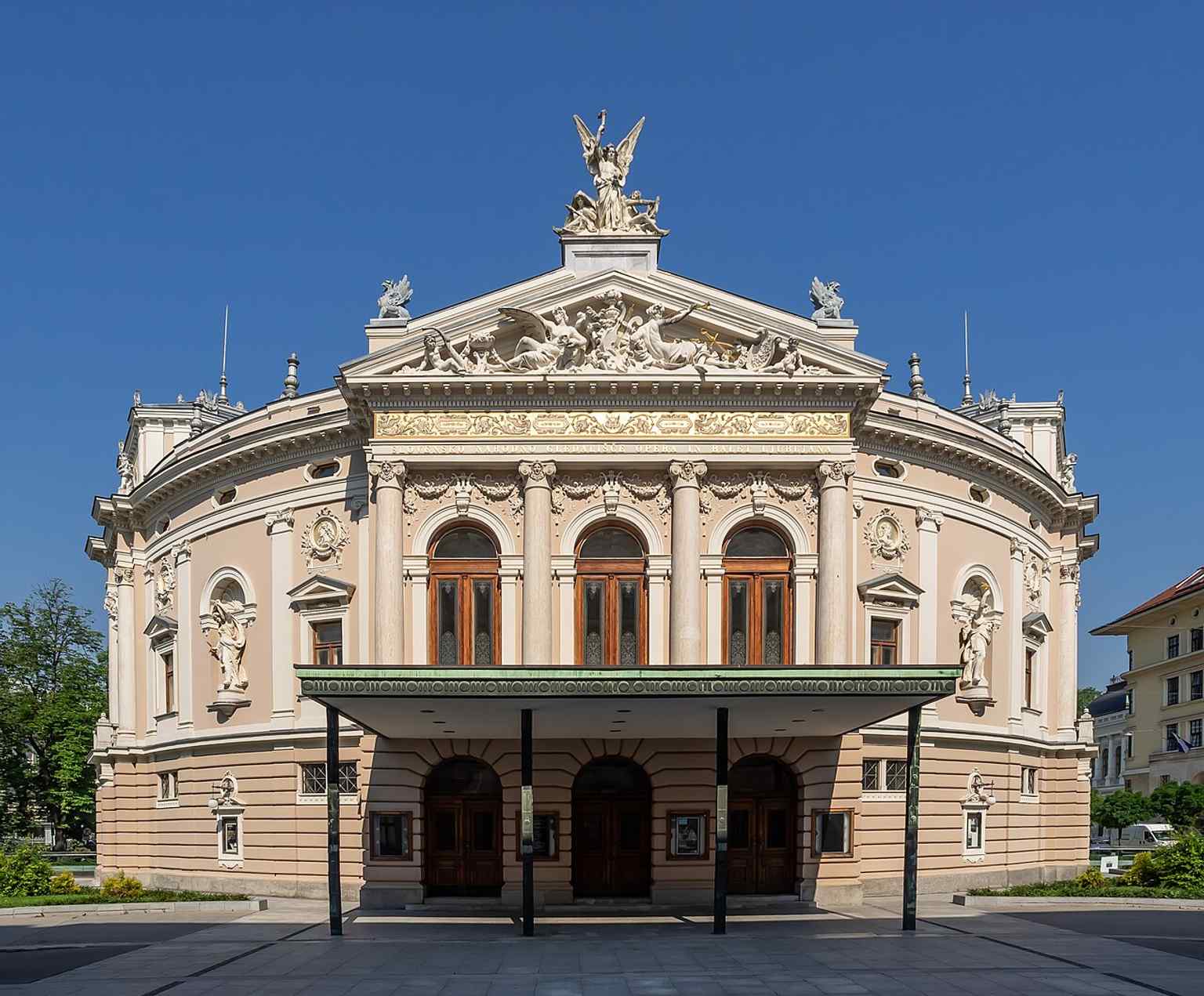
This image showcases the grand Neo-Renaissance facade of the Ljubljana Opera House, built between 1890 and 1892. Above the entrance, sculptures by Alojzij Gangl represent allegories of Tragedy and Comedy.Photo: Petar Milošević, Wikimedia Commons, CC BY-SA 4.0. Cropped & resized. This building opened on September 29, 1892… and the date matters. Five years earlier, Ljubljana’s old Stanovsko Theatre burned to the ground. For three years the city had no central stage at all - and that absence created pressure. The provincial government had to deliver something safer than the old wooden hall, something that wouldn’t go up like a torch. So this house rose quickly, full of compromise, and still it arrived like a declaration.
The first performance was Smetana’s The Bartered Bride. Not just entertainment - a public signal. For Slovenes hungry for cultural dignity, that opening night became a turning point in the Slovenian Awakening: a moment when language, music, and presence on a major stage began to feel like a people claiming their own reflection.
But identity here was never simple. In the early decades, Slovenian artists had to share this very stage with a German ensemble. And it wasn’t polite sharing. The fights were constant: over scheduling, prestige, and the language spoken and sung from the boards. Even the building’s name - “Provincial Theatre” - hints at a time when Ljubljana was still negotiating who it was allowed to be.
Look again at the structure and you’ll see the same tension baked into the bricks. The architects, Jan Vladimír Hráský and Anton Hruby, were Czech, working in a Neo-Renaissance style between 1890 and 1892. The provincial building office demanded a “rational” solution, and critics complained it should be more representative, less practical. Hráský kept redrawing to meet strict budgets… and yet the finished house was among the most modern in the region, fitted with advanced electric lighting. It’s a familiar story of big visions trimmed down under budget pressure.
Out front, the busts of pioneers like Ignacij Borštnik and Anton Verovšek watch the entrance. Nearby on Cankarjeva cesta stands Julij Betetto - a Slovenian bass who sang in over 3,000 performances and taught with strict European standards, turning a small ensemble into something internationally credible.
And this stage carried risk. In 1929, Marij Kogoj’s Črne maske premiered here - an 800-page score so complex it bewildered audiences and strained musicians. Three years later, Kogoj was hospitalized with severe schizophrenia, and never returned to composing.
The myth of that opera has lived here ever since.
In a moment, follow the promenade toward a monument raised entirely by citizens’ hands… then we’ll continue to Narodni dom, about a 6-minute walk away. The opera’s box office hours are weekdays 10 to 1 and 2 to 5, and it’s closed Saturdays and Sundays.
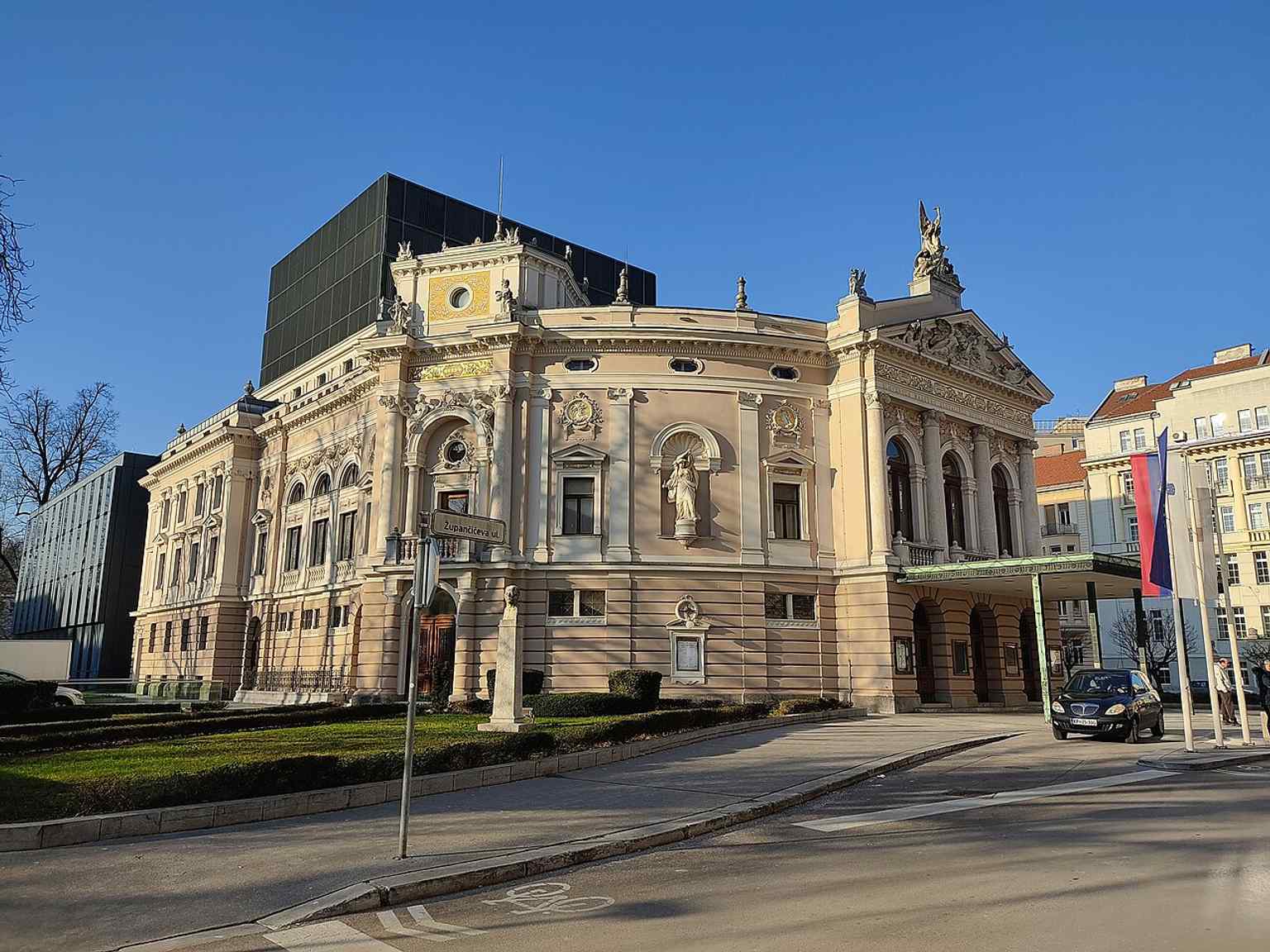
The Ljubljana Opera House as it stands today, after its extensive 1998-2011 renovation. The project, though marred by delays and controversy, significantly expanded the building and added a modernist annex to the rear.Photo: Viktar Palstsiuk, Wikimedia Commons, CC BY-SA 4.0. Cropped & resized. On your right, Narodni dom is a pale stone, three-part palace with a balanced neoclassical front, arched ground-floor openings, and statue-filled niches set into a neo-Renaissance…Read moreShow less
Open dedicated page →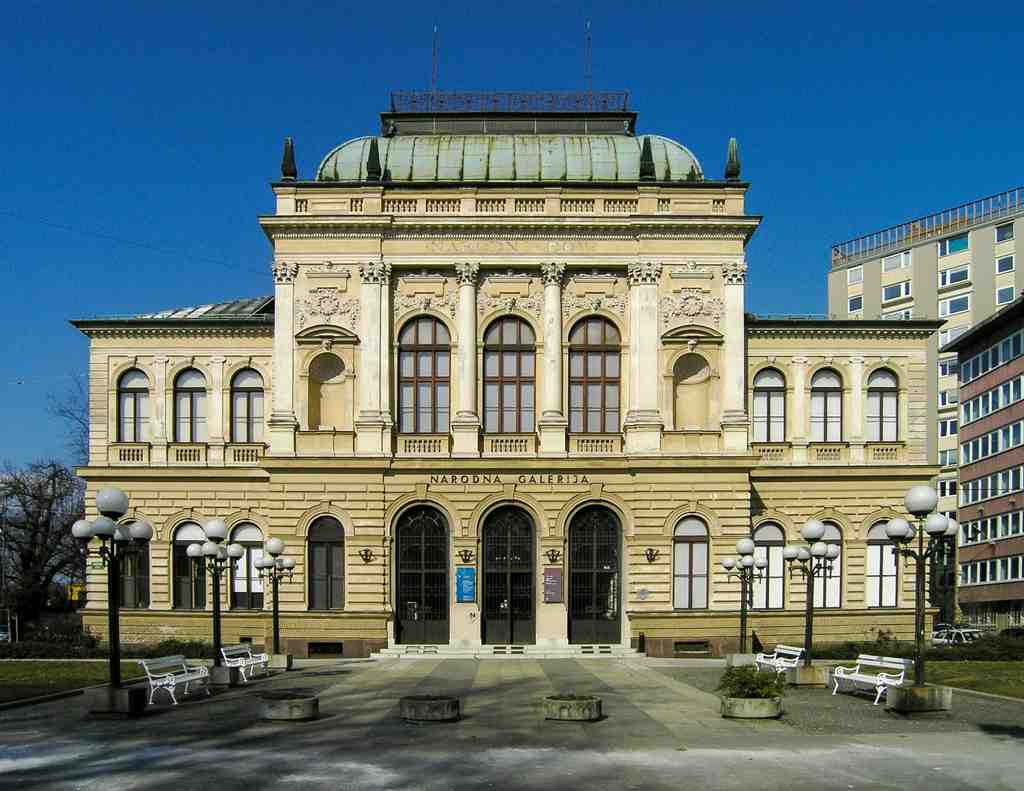
Narodni dom, LjubljanaPhoto: Petar Milošević, Wikimedia Commons, CC BY-SA 3.0. Cropped & resized. On your right, Narodni dom is a pale stone, three-part palace with a balanced neoclassical front, arched ground-floor openings, and statue-filled niches set into a neo-Renaissance façade.
This building was finished in 1896, planted right along Cankarjeva cesta-the promenade that stitches Ljubljana’s old center to Tivoli’s open green. And it wasn’t raised by a single patron with a deep pocket. It was willed into existence by what people proudly called an “All-Slovenian Action”: a sweeping, nationwide fundraising push organized by the Narodni dom society, founded in 1881. They ran lotteries, held veselice-community parties-and dances, and even placed little donation boxes, “puščice,” in inns and shops so ordinary citizens could drop in coins. It’s hard to miss what that meant: this wasn’t just a building project. It was a vote, repeated thousands of times, for whose language and culture would be at home in the city.
The architect was František E. Škabrout from Prague. Seventeen architects competed, and Škabrout won for a very practical reason: his design had more modest ornament, so it was cheaper and faster to build. But “modest” doesn’t mean timid. The plan is a three-part layout, like a basilica-a church-like arrangement with a strong central axis-translated here into a civic palace meant for gathering, debating, celebrating. Construction ran from 1893 to 1896 under Adolf Wagner, who also worked on the Philharmonic and the Tabor complex, and he refined Škabrout’s plans as the walls went up.
Narodni dom quickly became a social engine. Inside were club rooms for different societies, spaces for theater performances, a café, a restaurant, even a beer hall with its own cooling room. Out back there was a large garden with a dance floor, and at street level a sizable gym. If you pull up the interior photo on your screen, the grand staircase gives you a sense of the confidence of the place-built to carry crowds upward, not just a few dignitaries.
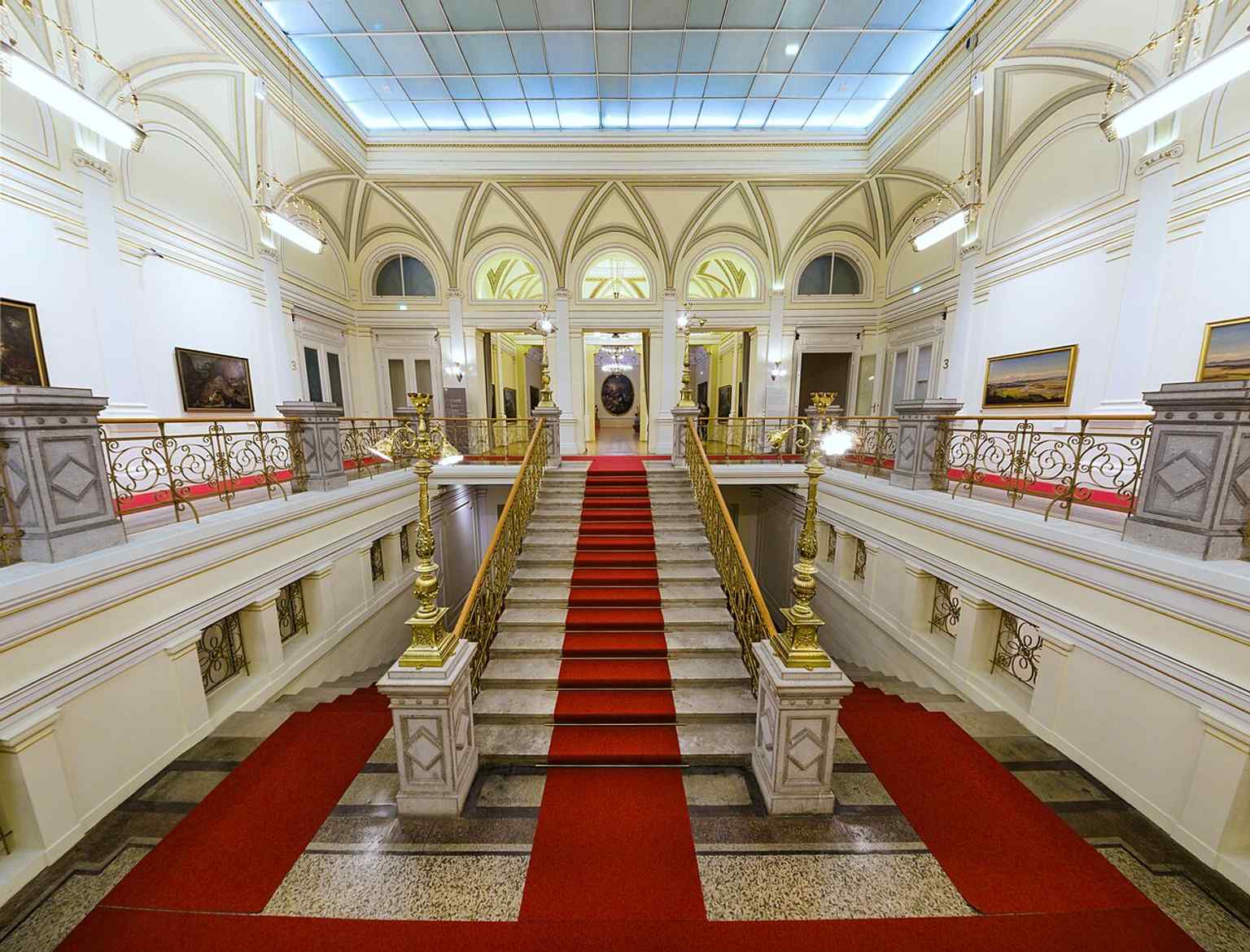
The grand staircase is part of the Narodni dom's interior, which was originally a lively social hub with a restaurant, dance hall, and even a gymnasium, now home to the National Gallery of Slovenia.Photo: Petar Milošević, Wikimedia Commons, CC BY-SA 4.0. Cropped & resized. It also carried symbols. Narodni dom was Ljubljana’s first public building with electric lighting-and the first to bear an inscription exclusively in Slovene. In a city pressured by germanization, that single choice was a bright, public line in the sand.
Even an earthquake tested it: in April 1895 a devastating quake stopped work temporarily, yet this structure held firm, nearly unscathed, and the builders pushed on until the palace opened in October 1896.
Later, the National Gallery made its home here, opening its first exhibition in 1933. But the building never lost its double life-“high” art above, athletic energy below-because Sokol gymnasts kept training here until 2015. Only in Ljubljana would a gallery share a heartbeat with a gym for almost a century.
As you look at the façade in the app image, notice the niches-finally filled with symbolic statues during the 2016 renovation, completing what Škabrout had wanted from the start. A crowd-funded palace, finished at last.
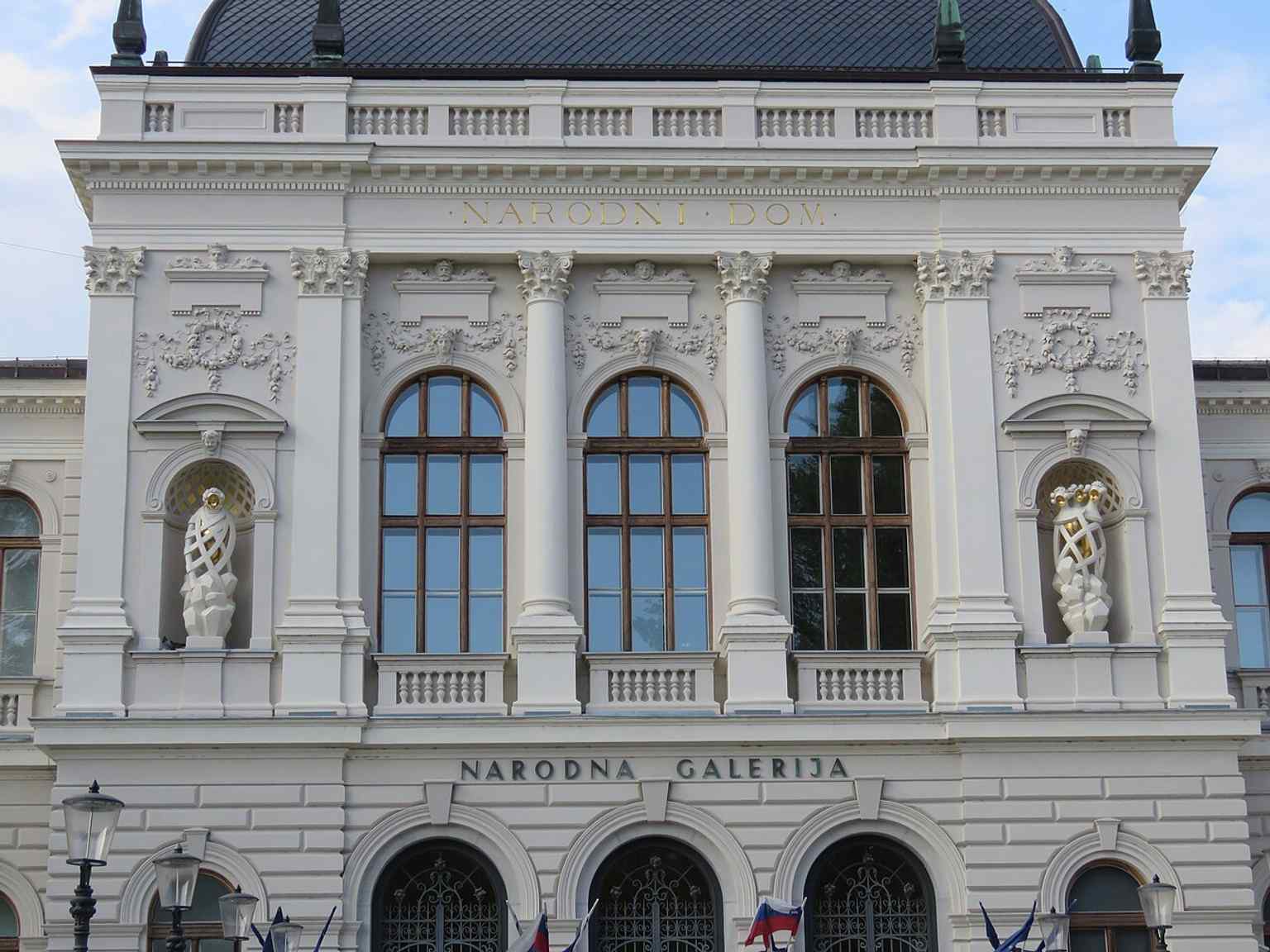
This image showcases the neoclassical facade of Narodni dom, whose niches were finally adorned with symbolic statues during the 2016 renovation, fulfilling architect Škabrout's original plans from 1896.Photo: G-Cup, Wikimedia Commons, CC BY-SA 4.0. Cropped & resized. The National Gallery here is generally open Tuesday and Thursday 3 to 5 PM, and Wednesday 10 AM to 12 PM. When you’re ready, let the city’s stone give way to Tivoli’s broad paths-Tivoli City Park is about a 7-minute walk from here.
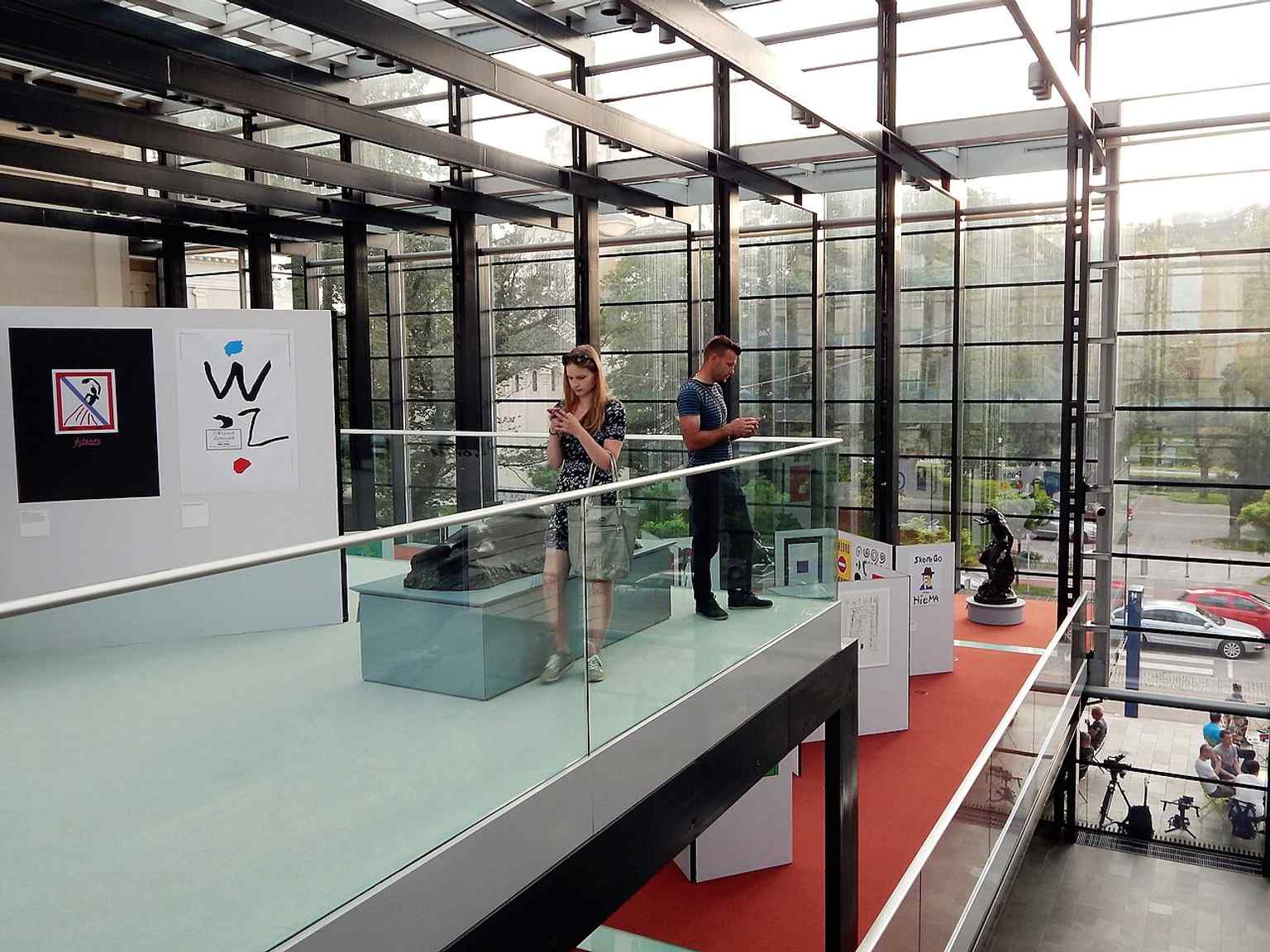
This image shows the modern connecting tract, designed by architects Sadar + Vuga, built between the historic Narodni dom palace and the later Edvard Ravnikar annex to expand the National Gallery's exhibition space.Photo: G-Cup, Wikimedia Commons, CC BY-SA 4.0. Cropped & resized. 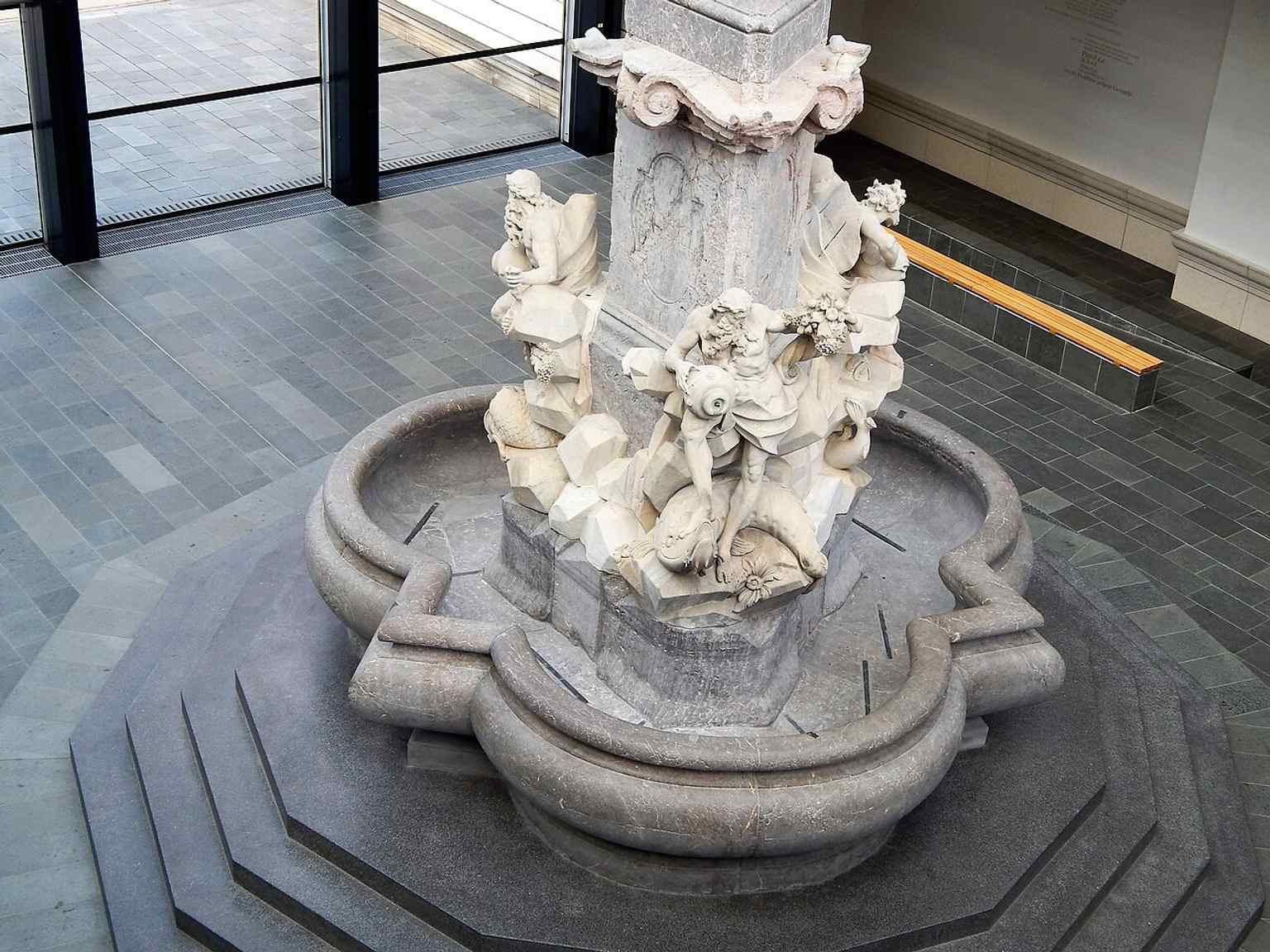
Displayed within the National Gallery, Robb's Fountain was controversially relocated here between 2005 and 2008 from its original location in front of the Town Hall to protect the baroque monument from decay.Photo: G-Cup, Wikimedia Commons, CC BY-SA 4.0. Cropped & resized. Looking to your left, you will find the sprawling entrance to Tivoli City Park, marked by a wide gravel path, sculpted white stone planters, and a curving black wrought-iron…Read moreShow less
Open dedicated page →Looking to your left, you will find the sprawling entrance to Tivoli City Park, marked by a wide gravel path, sculpted white stone planters, and a curving black wrought-iron railing that frames the descent into the greenery.
Take a look at the historical engraving on your screen to see how this space looked around 1855, when an Austrian governor planted grand rows of poplars and chestnuts. These pathways became the stage where the high society of the Austro-Hungarian Empire would parade their fashion and status. This world of aristocratic leisure stands in sharp contrast to the fierce, grassroots cultural movements we explored earlier in the city. The park, much like the streets of Ljubljana, was a space where local identity had to be carved out over time.
At the end of the promenade sits Tivoli Castle, an elegant mansion guarded by four massive cast-iron dogs. For over a century, a dark urban legend has haunted these hounds. If you check the photo on your app, you might notice a strange flaw in their design. The dogs do not have tongues. The story goes that their creator, Austrian sculptor Anton Dominik Fernkorn, was so devastated by this mistake that he took his own life. The truth, however, is equally tragic but far less theatrical. Fernkorn did not shoot himself over the missing tongues. He actually suffered a severe mental collapse shortly after finishing the dogs and vanished into an asylum. The citizens of Ljubljana, unable to explain his sudden disappearance from public life, crafted the myth of the perfectionist's suicide to make sense of the eerie, silent gaze of his creations.
Over the decades, this park transitioned from a playground for the elite into a vibrant, bohemian sanctuary. Just behind the castle is an alpine-style building called the Švicarija. Originally a luxury hotel, it evolved into a creative haven that the famous Slovenian writer Ivan Cankar affectionately dubbed a refuge for sinners. It became the ultimate gathering place for local intellectuals. Later, in the 1930s, it served as a sanctuary for Russian war refugees who converted the hotel rooms into modest apartments, filling the halls with the sound of chisels as they lived alongside a burgeoning community of post-war sculptors.
Even the wide walking path stretching before you was initially a site of cultural friction. When local architect Jože Plečnik redesigned this promenade to create a direct visual line straight to Ljubljana Castle, locals resisted the change. They mockingly called the wide, treeless path the Sahara. It took years of growth for the townspeople to finally embrace it as the visionary link between nature and the city it is today.
This beautiful green space is completely open twenty four hours a day, every day of the week. Go ahead and follow the promenade deeper into the park toward the hilltop castle, and we will pick up the trail at our next stop, Tivoli Castle, just a four minute walk away.
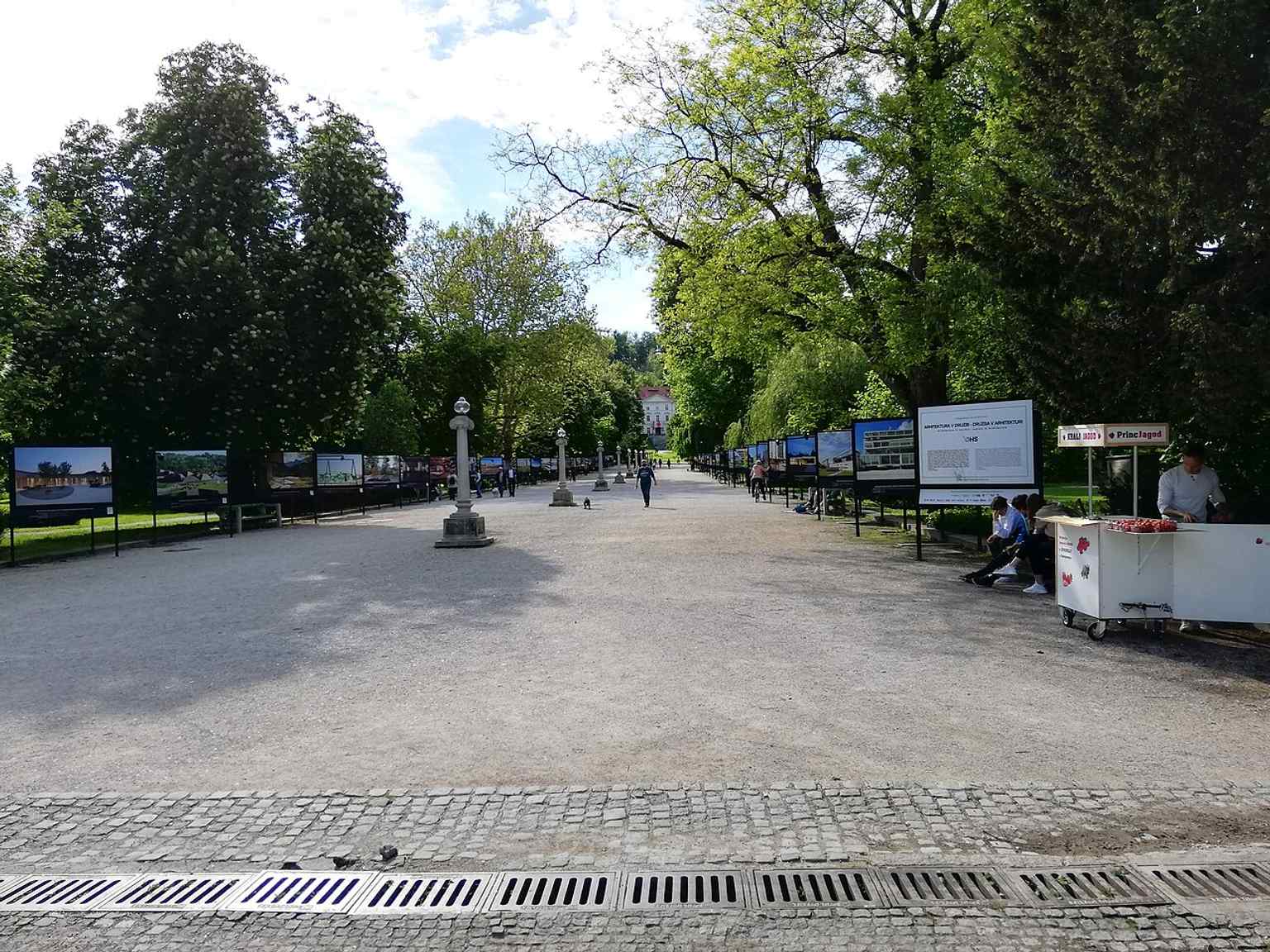
A wide view of Tivoli City Park, Ljubljana's largest park, spanning from the Center to Šiška and Vič districts.Photo: Dedo70, Wikimedia Commons, CC BY-SA 4.0. Cropped & resized. 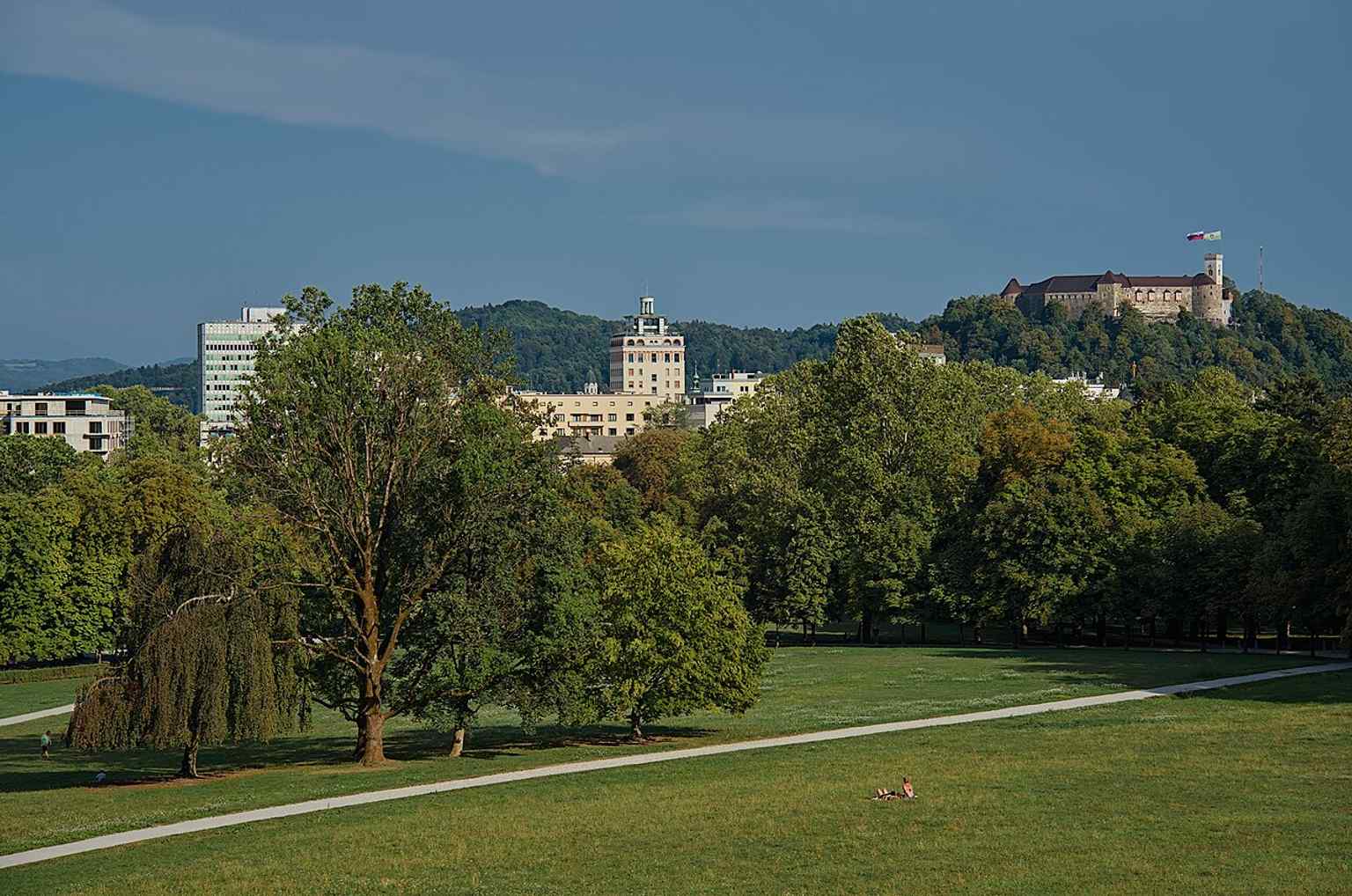
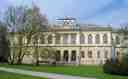
An expansive summer view of Tivoli City Park, a protected nature park since 1984, with Ljubljana Castle visible in the background.Photo: This Photo was taken by Miha Peče. Feel free to use my photos, but please mention me as the author. I would much appreciate if you send me an email [email protected] or write on my talk page, for my information. Please do not upload an edited image here without consulting me. I would like to make corrections only at my own source to ensure that the changes improve the image and are preserved.Otherwise you may upload an edited image with a new name. Please use one of the templates derivative or extract., Wikimedia Commons, CC BY-SA 4.0. Cropped & resized. Look to your left at the sweeping white facade of this rectangular mansion, anchored by a heavy stone retaining wall with an arched tunnel, and topped with a classic triangular…Read moreShow less
Open dedicated page →Look to your left at the sweeping white facade of this rectangular mansion, anchored by a heavy stone retaining wall with an arched tunnel, and topped with a classic triangular pediment beneath a red tiled roof.
It looks incredibly serene. But the polished neoclassical surface we see today masks a turbulent past, burying hidden layers of old conflicts. This exact spot was once a medieval fortress. In the thirteenth century, a defensive stone structure known as the Turn tower stood here, guarding the territory of Carinthian dukes, a powerful line of regional nobility. It stood firm until it was reduced to rubble by a rival family during a bitter siege for control over the city.
From those ashes, a new structure eventually emerged. By the early sixteen hundreds, the land was acquired by the Jesuits, a highly influential Catholic religious order. It was the Bishop Tomaž Hren who finally transformed the lingering ruins into a magnificent mansion. He consecrated the new building in sixteen eleven, purposefully turning a site of ancient bloodshed into an elegant recreational retreat.
Under the Jesuits, this estate became an intellectual stronghold. The grounds were reshaped into a hub where students performed ambitious theatrical plays in a natural amphitheater out back. Young poets gathered around a nearby spring they named Hippocrene, after the mythological Greek fountain of artistic inspiration. The physical conflicts of the Middle Ages had evolved into a clash of ideas, where a distinct local consciousness was actively shaped through art, language, and poetry.
If you pull up the app on your screen, an aerial view shows how the estate sits perfectly at the foot of the forested hill, bridging the wild landscape and the built environment.
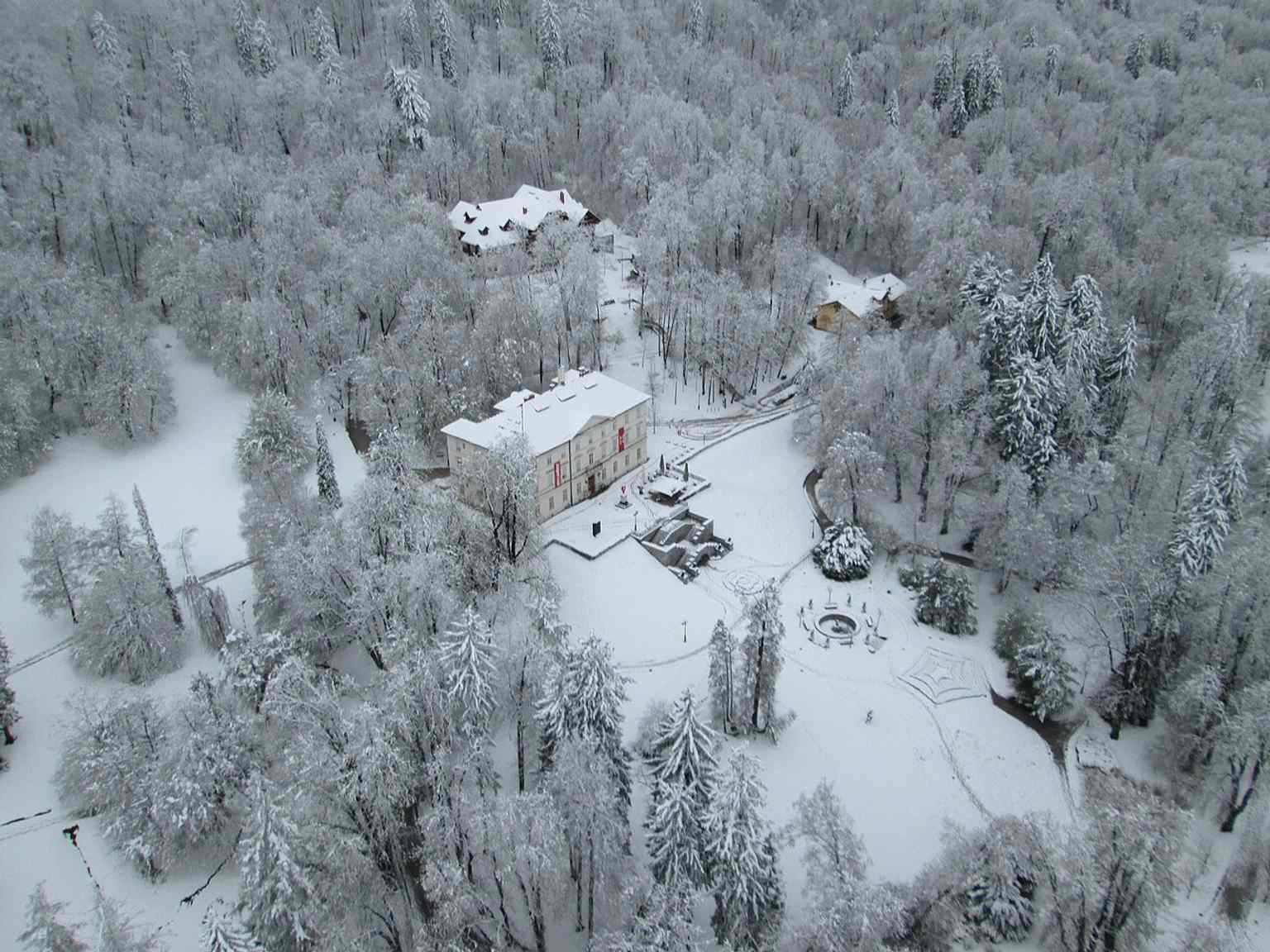
An aerial view of Tivoli Castle, also showing Švicarija (the former Hotel Tivoli) behind it, nestled at the foot of Rožnik hill, as the castle is prominently visible from the city center.Photo: KAP Jasa, Wikimedia Commons, CC BY-SA 4.0. Cropped & resized. Over the following centuries, the building mirrored the changing rulers of the land. It served as a summer palace for bishops, a military hospital, and eventually a gift to an Austrian military commander who finally opened the private gardens to the public.
Every era has left its mark on this ground, claiming it for war, for faith, for the people, and today, for art. Now, we will leave the quiet gardens. Our final stop is an eight minute walk away, where historic passion meets modern sports at Tivoli Hall.
On your right, Tivoli Hall reads as a low, wide concrete-and-glass complex, its broad slanted rooflines stepping back from the path and a long horizontal facade that makes it feel…Read moreShow less
Open dedicated page →On your right, Tivoli Hall reads as a low, wide concrete-and-glass complex, its broad slanted rooflines stepping back from the path and a long horizontal facade that makes it feel partly tucked into the earth.
Stand here for a moment and notice what that shape is doing. This isn’t a monument that tries to dominate Tivoli Park. Architect Marjan Božič knew he was placing two large arenas inside a landscape that Ljubljana treats almost like shared heritage, so he made a bold compromise: he sank parts of the structure into the ground. The idea was simple, and quietly radical for 1965... let the park keep the skyline, and let the hall do its roaring mostly from within.
If you glance at the photo on your screen, you can see that “sunken” strategy clearly, with the building’s mass held low against the greenery.
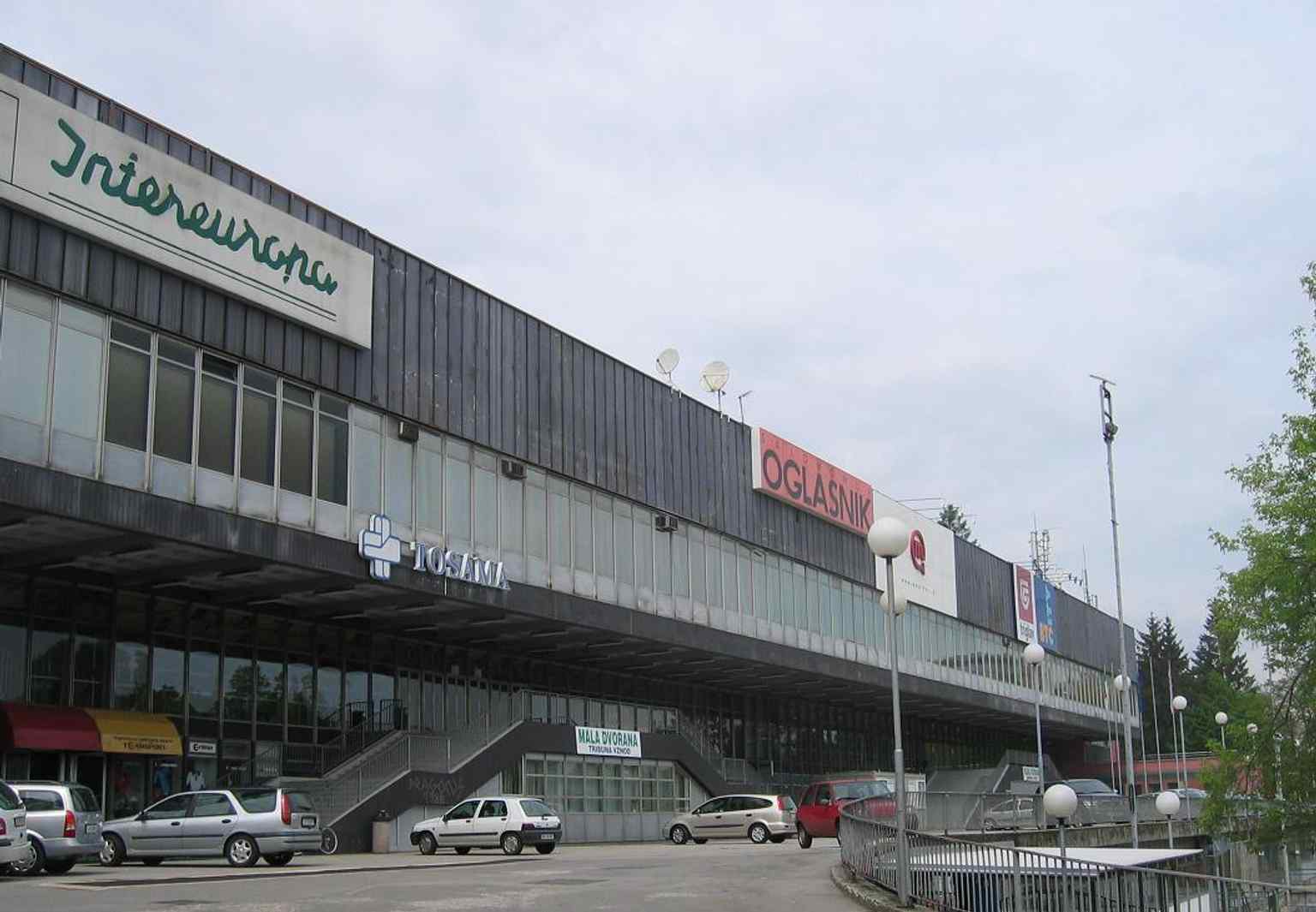
The multi-purpose Tivoli Hall, designed by architect Marjan Božič, was partially sunken into the ground to ensure its large volumes did not overwhelm the surrounding Tivoli City Park.Photo: No machine-readable author provided. Žiga assumed (based on copyright claims)., Wikimedia Commons, Public domain. Cropped & resized. But the real miracle here is speed. Tivoli Hall was completed in a record eight months, because Ljubljana had promised the world the 1965 World Table Tennis Championships. Eight months to pour concrete, solve engineering, and still make something that belonged in a treasured park. It’s one of those rare cases where the city’s vision and the on-the-ground reality actually matched-deadline, design, and ambition arriving together.
Inside this complex are two very different stages. The larger arena, nicknamed the “Ice Hall,” seats about 6,800 for ice hockey and has long been home to HK Olimpija. When their fiercest rivals, HK Jesenice, come to town for the “eternal derby,” the building doesn’t just host a game; it concentrates a kind of national conversation-who belongs, who endures, who can out-sing the other side with traditional hockey chants until the sound turns physical.
Then there’s the smaller hall, seating around 4,500, a secondary home for KK Cedevita Olimpija and, since 2017-18, also Ilirija. Locals call it the Temple of Slovenian Basketball-and that’s not marketing. It’s earned. The seating is tight, the ceiling is low, and those two facts create an atmosphere visiting teams have dreaded for decades. In the 1970s and 80s, Slovenian basketball legends became household names on that hardwood, and the building trained people to believe that their voices could change outcomes.
One night in particular sealed the myth. In 1970, the final round of the FIBA World Championship was played here, and Yugoslavia beat the United States 70-63 for gold. The slogan that followed-“Luna vaša, zlata naša,” “The Moon is yours, the gold is ours”-was a sharp little needle, a joke aimed at America’s recent moon landing. Sports as identity, humor as defiance. Captain Ivo Daneu, a Ljubljana native, pushed through a painful muscle injury to lead, and when it was done, fans carried him off on their shoulders. Celebrations spilled straight out from these doors into the streets.
If you want a quick sense of how game night evolved, take a look at the before-and-after slider-1964 to 2009-when you have a second.
Even beyond sport, this hall helped Ljubljana feel bigger: Louis Armstrong played here in 1965, a kind of cultural baptism for a new venue. Later, the BOOM Festival in the early 1970s gave Yugoslav rock a home to grow louder, bolder, more self-assured.
And that’s how Tivoli Hall closes our walk: a building made fast, built carefully into a beloved park, and filled-again and again-with the sound of people discovering who they are together.
Stay here as long as you like…and let the park hold the energy.
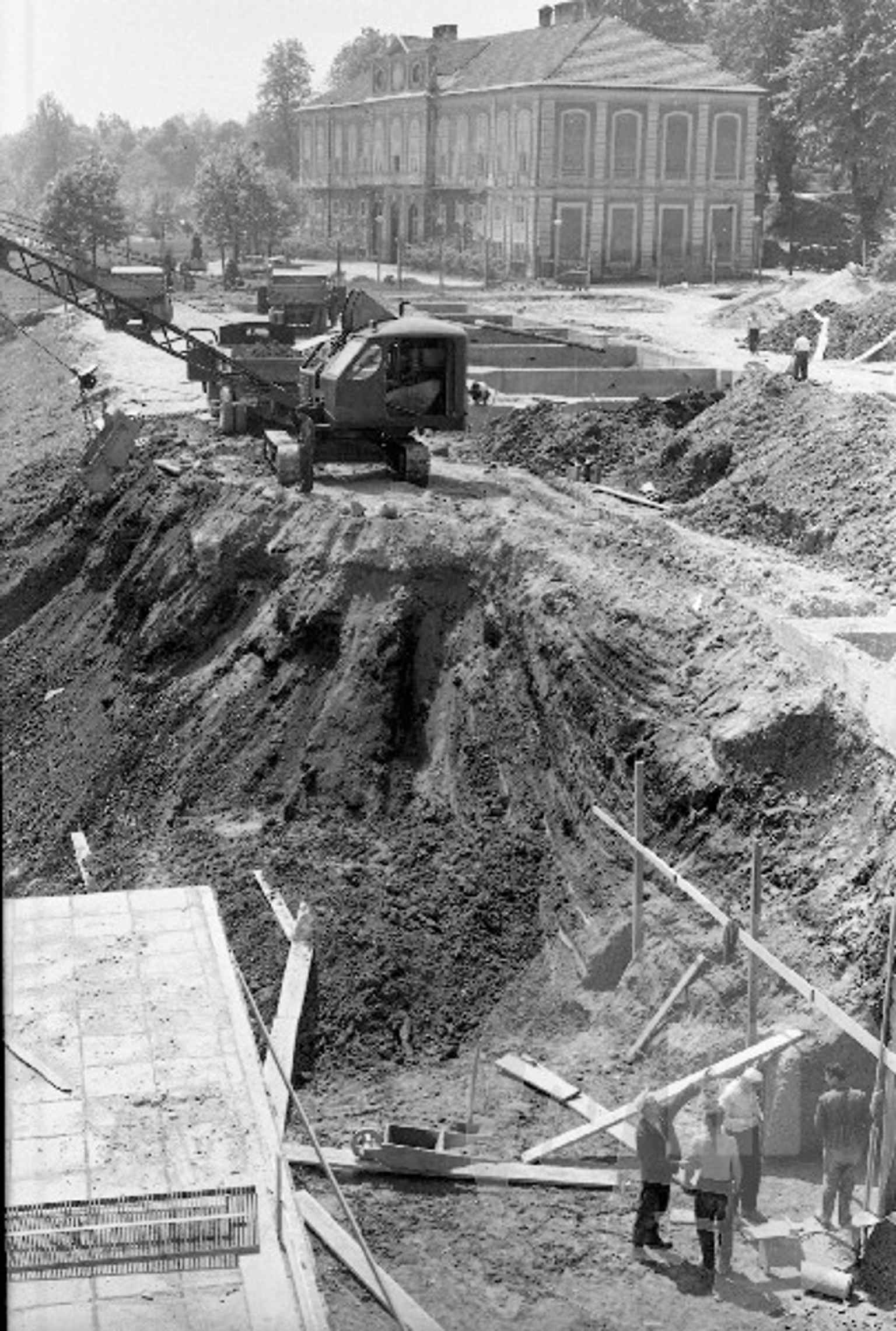
This 1964 image shows Tivoli Hall under construction, completed in a record-breaking eight months to meet the strict deadline for the 1965 World Table Tennis Championships.Photo: Marjan Ciglič, Wikimedia Commons, Public domain. Cropped & resized. 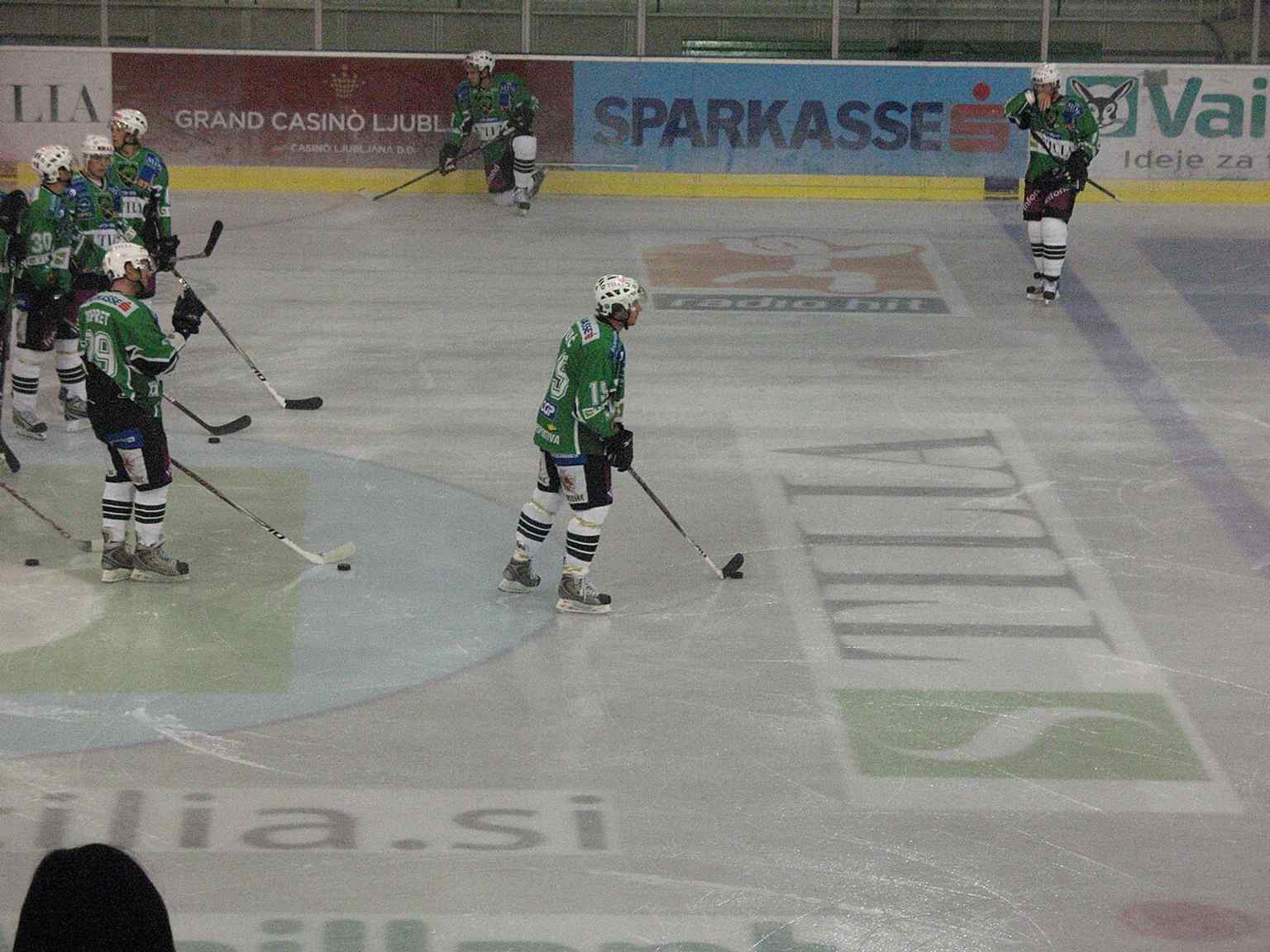
An American All-Stars basketball game in Tivoli Hall in 1964, a year before its official opening, showcasing the early sporting significance of the venue.Photo: Marjan Ciglič, Wikimedia Commons, Public domain. Cropped & resized. 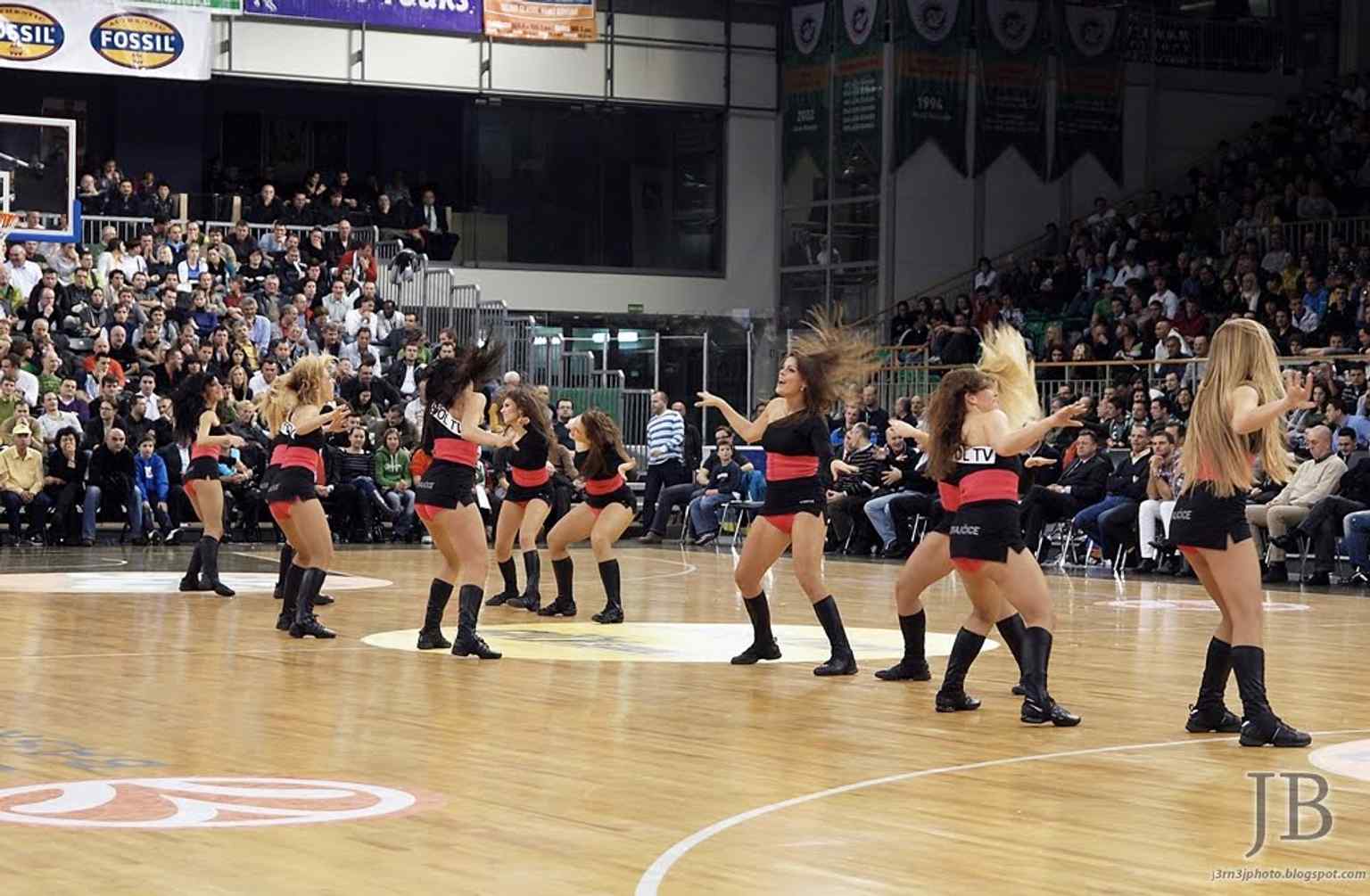
Legendary Ljubljana native Ivo Daneu, captain of the Yugoslav team, shown here in 1969; he famously led his team to gold in the 1970 FIBA World Championship at Tivoli Hall despite an injury.Photo: Marjan Ciglič, Wikimedia Commons, Public domain. Cropped & resized. 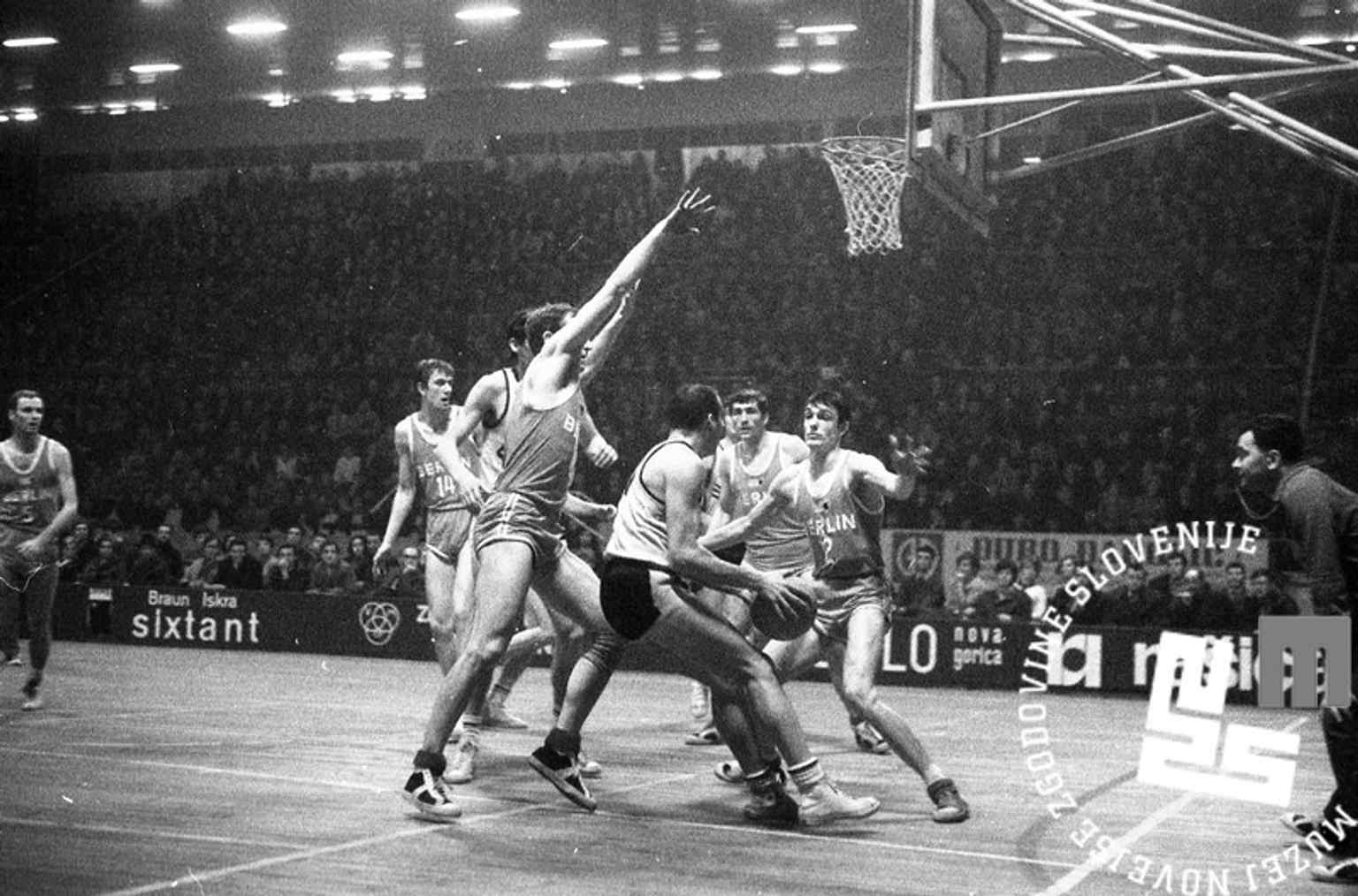
A 1966 postcard from the IIHF World Championship held at Tivoli Hall, which regularly hosted international ice hockey events, including multiple World Championships.Photo: Unknown authorUnknown author, Wikimedia Commons, Public domain. Cropped & resized. 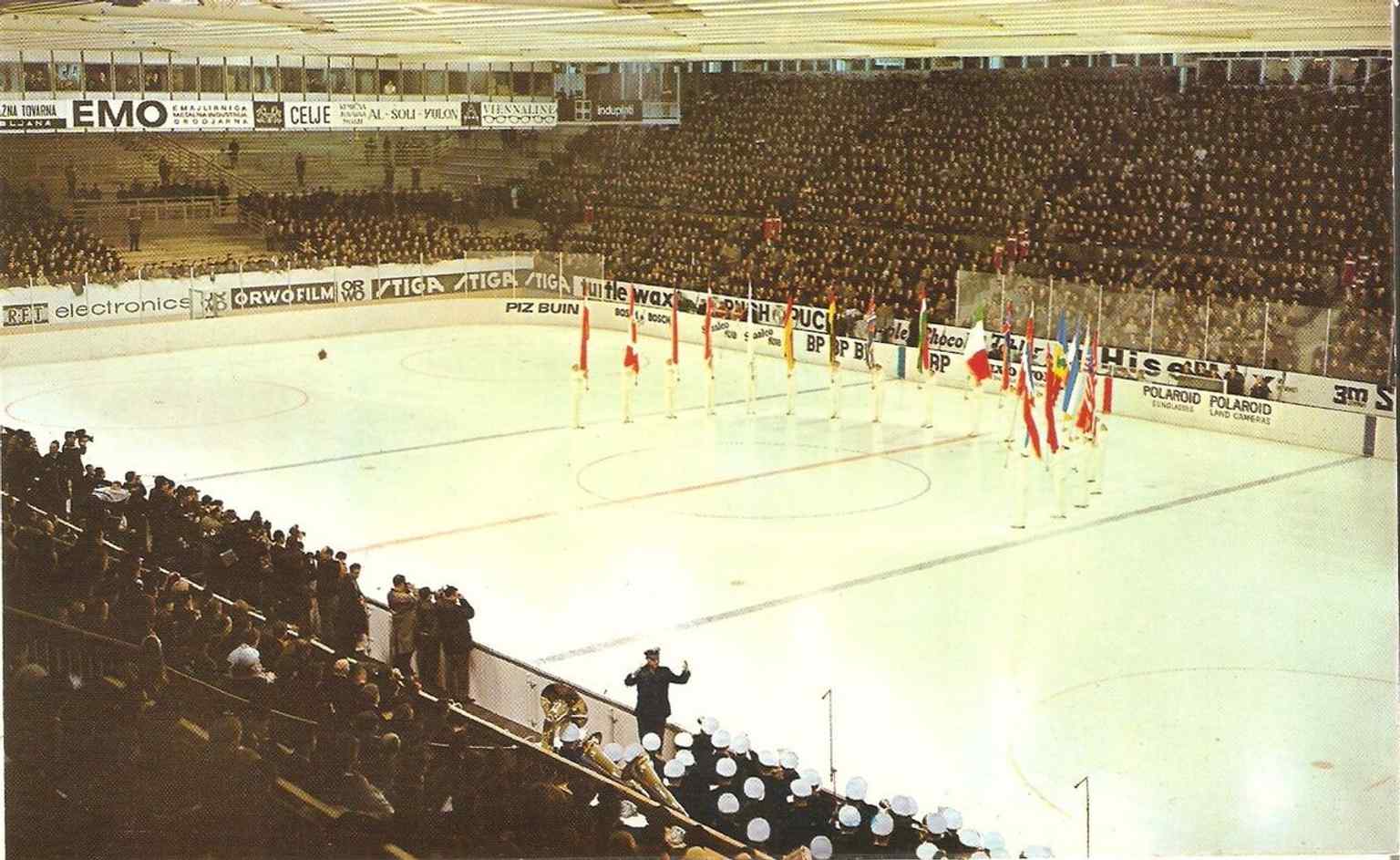
The larger arena, affectionately nicknamed the 'Ice Hall', is home to HK Olimpija ice hockey club and known for passionate crowds during games like this one in 2013.Photo: katjakajamejac, Wikimedia Commons, CC0. Cropped & resized. 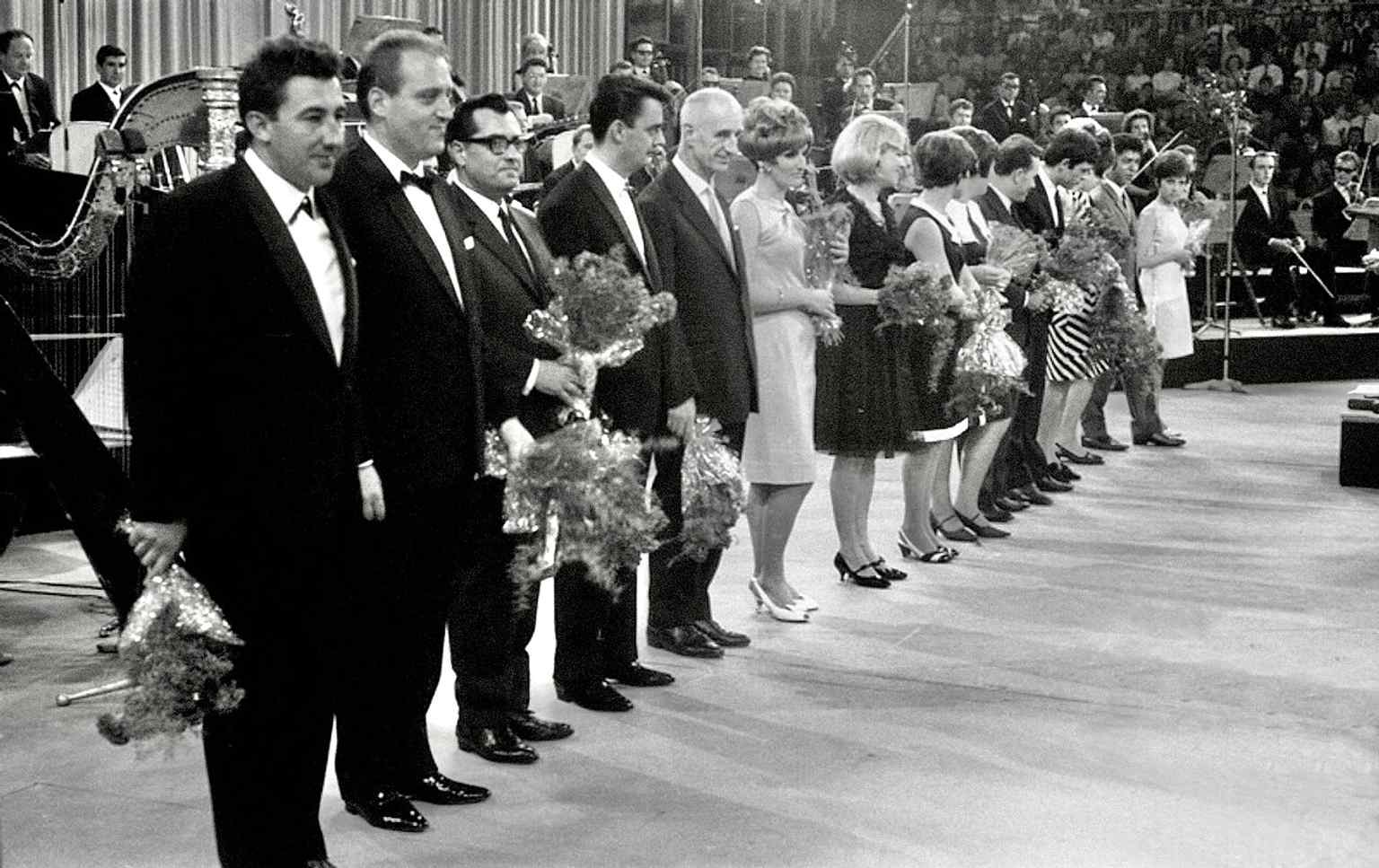
An ice skating event from 2016, showcasing the venue's continued use for various ice sports, following the 1970 World Figure Skating Championships which pioneered computer scoring here.Photo: Gary Beacom, Wikimedia Commons, CC BY-SA 4.0. Cropped & resized. 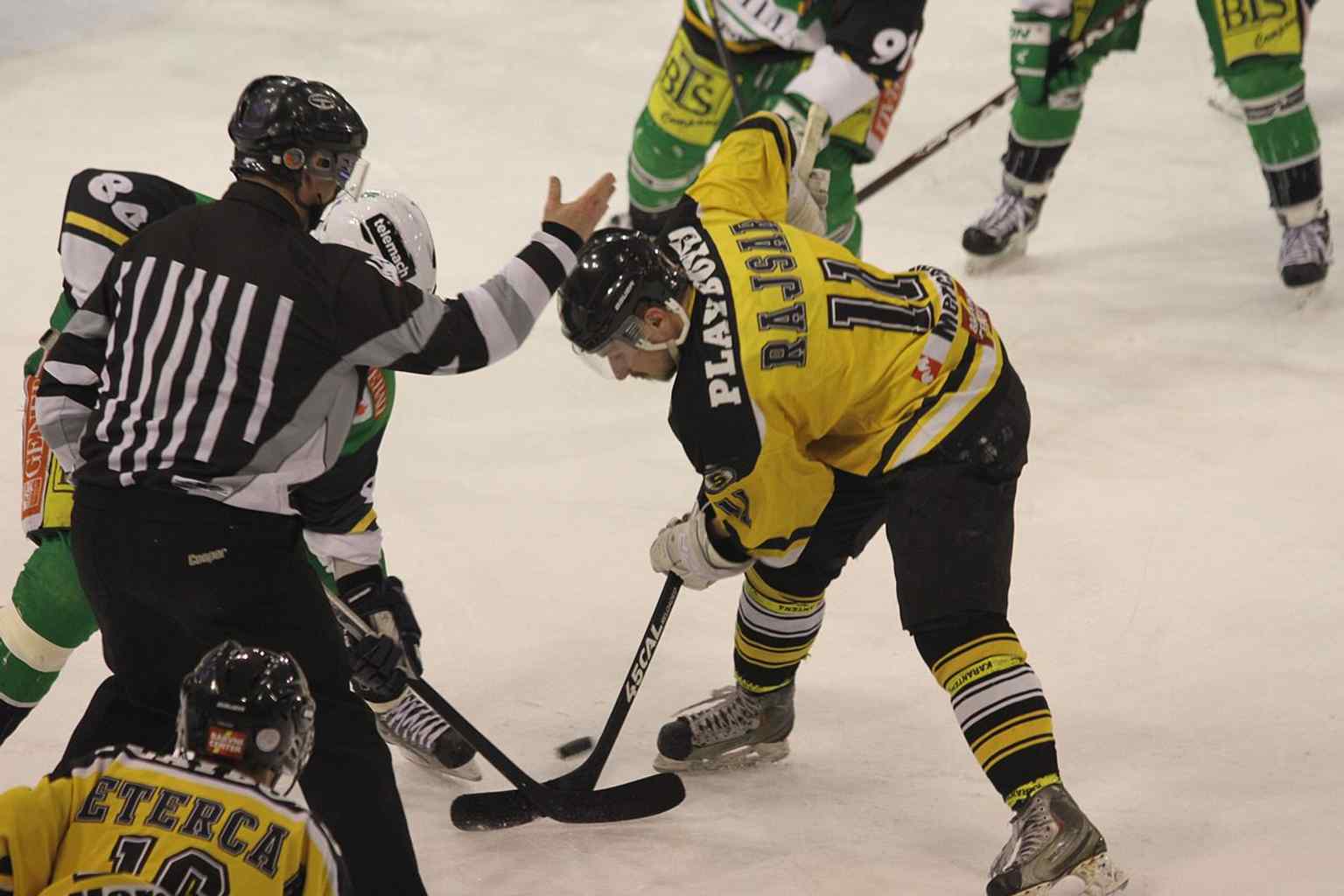
Musicians on stage during the 1966 Slovenian Song Festival, demonstrating Tivoli Hall's role as a major concert venue for various cultural events since its opening.Photo: Marjan Ciglič, Wikimedia Commons, Public domain. Cropped & resized. 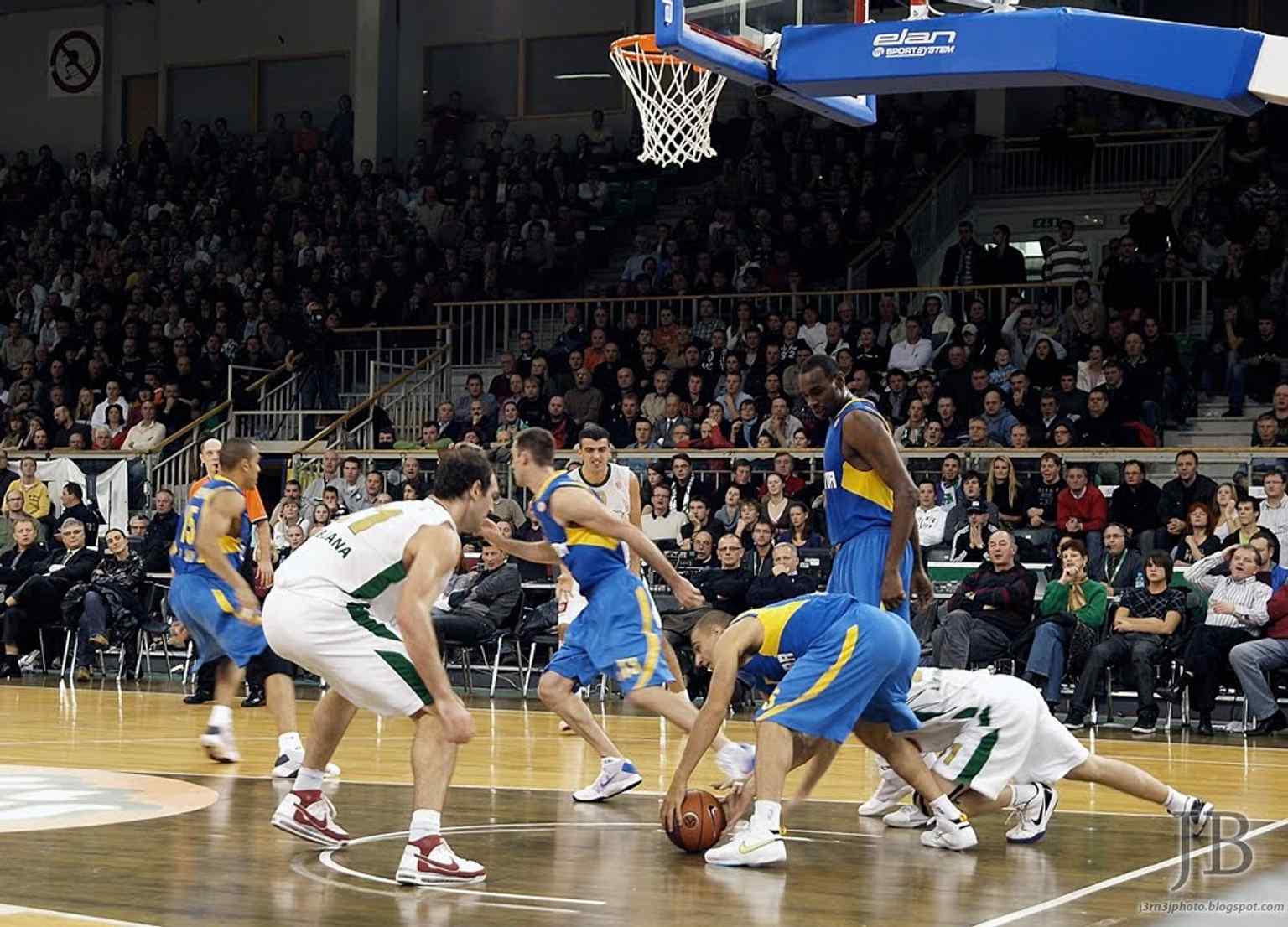
An audience gathered for the 1966 Slovenian Song Festival, illustrating Tivoli Hall's capacity to host large cultural gatherings, including seminal events like the BOOM Festival.Photo: Marjan Ciglič, Wikimedia Commons, Public domain. Cropped & resized. 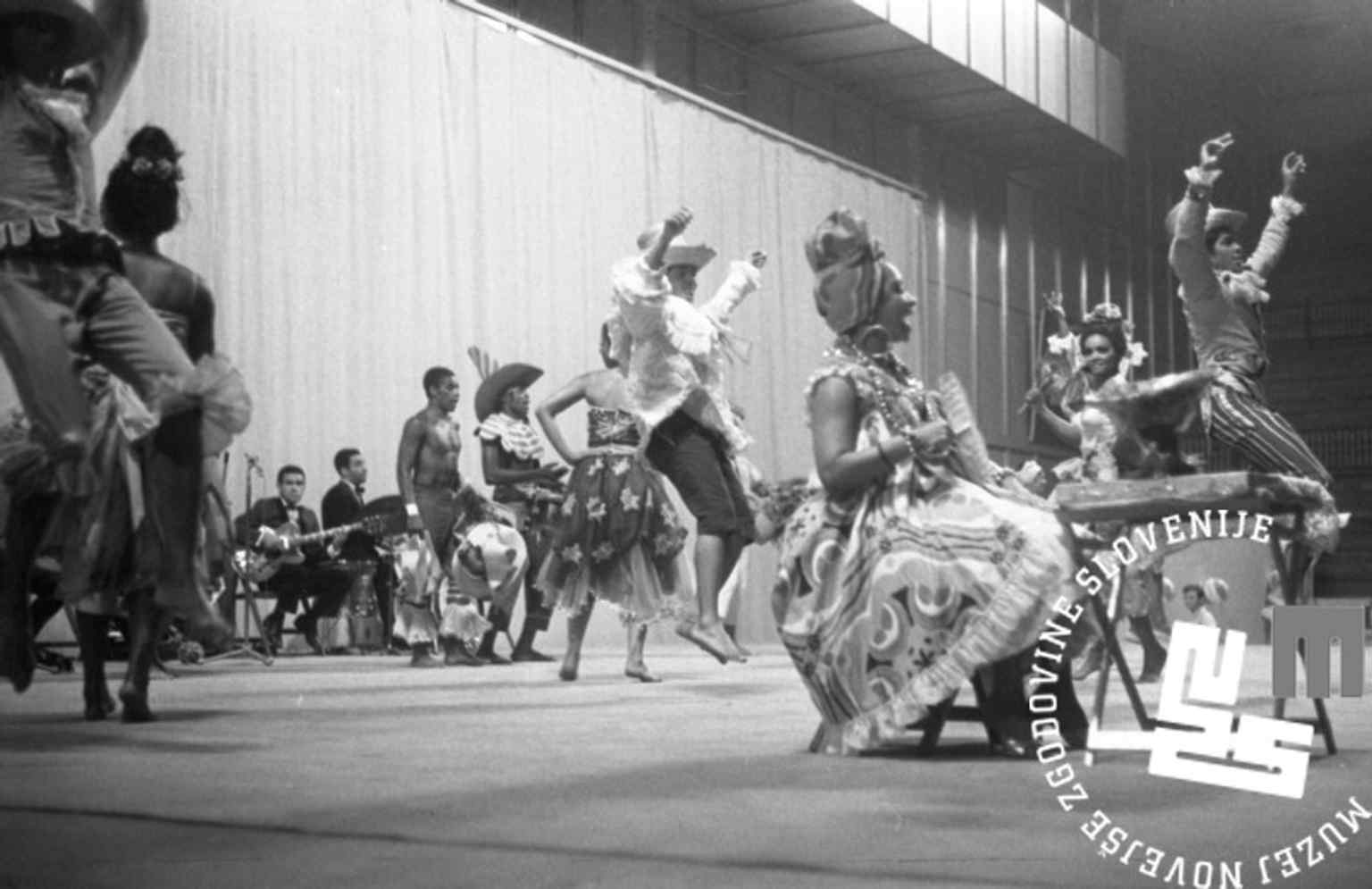
A 1969 performance by the Brazilian Black Dance Theatre, showcasing the hall's diverse use beyond sports and bringing international cultural acts to Ljubljana.Photo: Marjan Ciglič, Wikimedia Commons, Public domain. Cropped & resized.

Frequently asked questions
How do I start the tour?
After purchase, download the AudaTours app and enter your redemption code. The tour will be ready to start immediately - just tap play and follow the GPS-guided route.
Do I need internet during the tour?
No! Download the tour before you start and enjoy it fully offline. Only the chat feature requires internet. We recommend downloading on WiFi to save mobile data.
Is this a guided group tour?
No - this is a self-guided audio tour. You explore independently at your own pace, with audio narration playing through your phone. No tour guide, no group, no schedule.
How long does the tour take?
Most tours take 60–90 minutes to complete, but you control the pace entirely. Pause, skip stops, or take breaks whenever you want.
What if I can't finish the tour today?
No problem! Tours have lifetime access. Pause and resume whenever you like - tomorrow, next week, or next year. Your progress is saved.
What languages are available?
All tours are available in 50+ languages. Select your preferred language when redeeming your code. Note: language cannot be changed after tour generation.
Where do I access the tour after purchase?
Download the free AudaTours app from the App Store or Google Play. Enter your redemption code (sent via email) and the tour will appear in your library, ready to download and start.
If you don't enjoy the tour, we'll refund your purchase. Contact us at [email protected]
Checkout securely with 


.jpg)


.jpg)
![This Photo was taken by Miha Peče. Feel free to use my photos, but please mention me as the author. I would much appreciate if you send me an email [email protected] or write on my talk page, for my information. Please do not upload an edited image here without consulting me. I would like to make corrections only at my own source to ensure that the changes improve the image and are preserved.Otherwise you may upload an edited image with a new name. Please use one of the templates derivative or extract.](https://upload.wikimedia.org/wikipedia/commons/d/d5/Tivoli_park_in_Ljubljan.jpg)


