
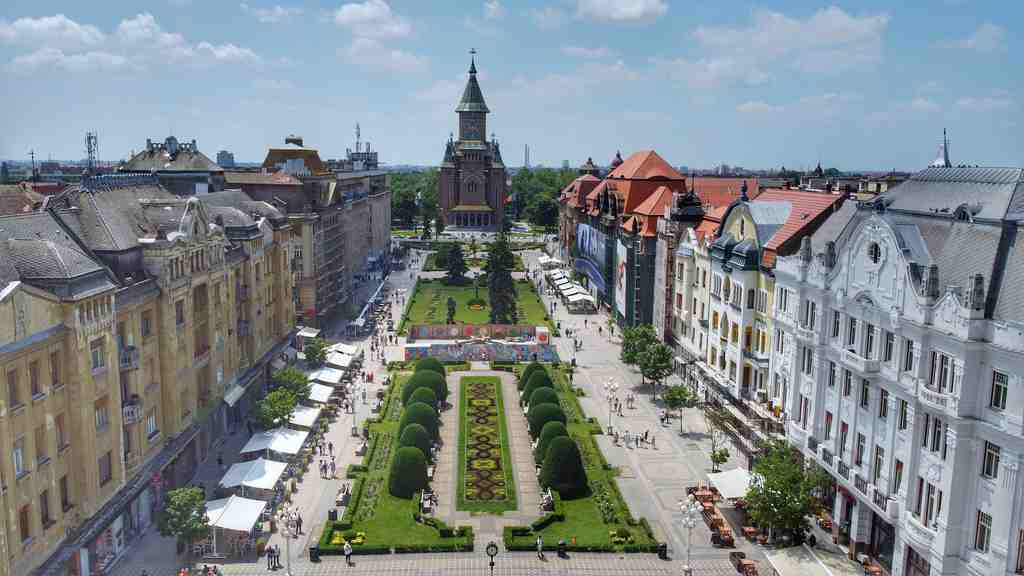
Victory Square stretches wide before you, framed by grand, ornate façades and gardens leading straight toward the towering Metropolitan Cathedral at the far end-just look ahead where the tall spire rises up above all else.
Welcome, traveler, to the heart that beats at the center of Timișoara-Victory Square! Imagine yourself standing where the city’s most dramatic and hopeful moments played out, surrounded by rows of stately palaces, leafy promenades, and bustling café terraces. If you listen closely, you can almost hear the buzz of life from both past and present blending in the air.
What you see wasn’t always a grand square. Once, this area held the walls of the old fortress, hemming the city in and guarding its secrets. But at the dawn of the 20th century, a mighty transformation began. After Emperor Franz Joseph I finally agreed to cancel Timișoara’s fortress status in 1892, visionary architect Ludwig von Ybl started sketching dreams-a broad boulevard, bursting with light and potential. Demolition started, walls came down, and the city opened its arms to new streets, shops, and palaces.
Flash forward to 1910, and the very first grand building on this square was about to rise-the Lloyd Palace, which you can still spot to your right if you stroll along the Corso promenade. The western side filled up with palaces so quickly, you’d think the builders were powered by too much Timișoara coffee! On the east, the impressive Löffler Palace set the tone before the First World War called “time out.”
Never just a pretty face, Victory Square has always been the stage for big moments. Here, on December 20, 1989, the city roared with hope-Timișoara was declared the first city in Romania free of communism. Imagine the cheers, the tearful embraces, and the trembling sense of change when revolution swept through these streets, washing away decades of silence.
Look north, and you’ll see the Opera and the National Theater anchoring one end. This was once Opera Square, where drama unfolded both on- and off-stage. To the south is the Metropolitan Cathedral, whose presence ended the square’s time as a main street and crowned it with a spiritual calm. Between these two giants, the square transforms as day melts into night. On the right, the Corso promenade shines with fancy façades and the whisper of bygone luxury-this was where Timișoara’s upper crust strutted, pausing at the famed Lloyd restaurant for desserts so good they nearly started their own revolution. On the left, Surogat, a more relaxed stroll, is where workers, students, and-when allowed-soldiers claimed their piece of the city’s rhythm. Don’t be surprised if you feel the urge to saunter just a little differently depending which side of the square you’re on!
Victory Square is never quiet, though the sound changes with the seasons. JazzTM might pulse through the air in summer, the Timfloralis flower displays add bursts of color in spring, while winter wraps the square in Christmas lights and the hum of holiday markets. Just don’t try to outsing an opera singer at the Opera and Operetta Festival-trust me, you’ll lose.
Among the square’s many treasures, look for the “she-wolf with cubs” statue, a gift from Rome in 1926 that found itself knocked down, picked up, and knocked down again thanks to shifting allegiances and a little political stubbornness. Not far from her, you’ll spot the “fountain with fish,” an enchanting splash built in 1957, with sculpted fish tails swirling in the cool water. And down by the Cathedral, the stainless steel Monument of the Crucifixion, gleaming in sunlight, stands as a solemn reminder of the city’s fight for freedom during the 1989 Revolution.
So, while Victory Square looks calm today, remember you’re standing on a stage where history never really left-it just changed costumes. Take it all in, and let’s continue to the next marvelous landmark!




