
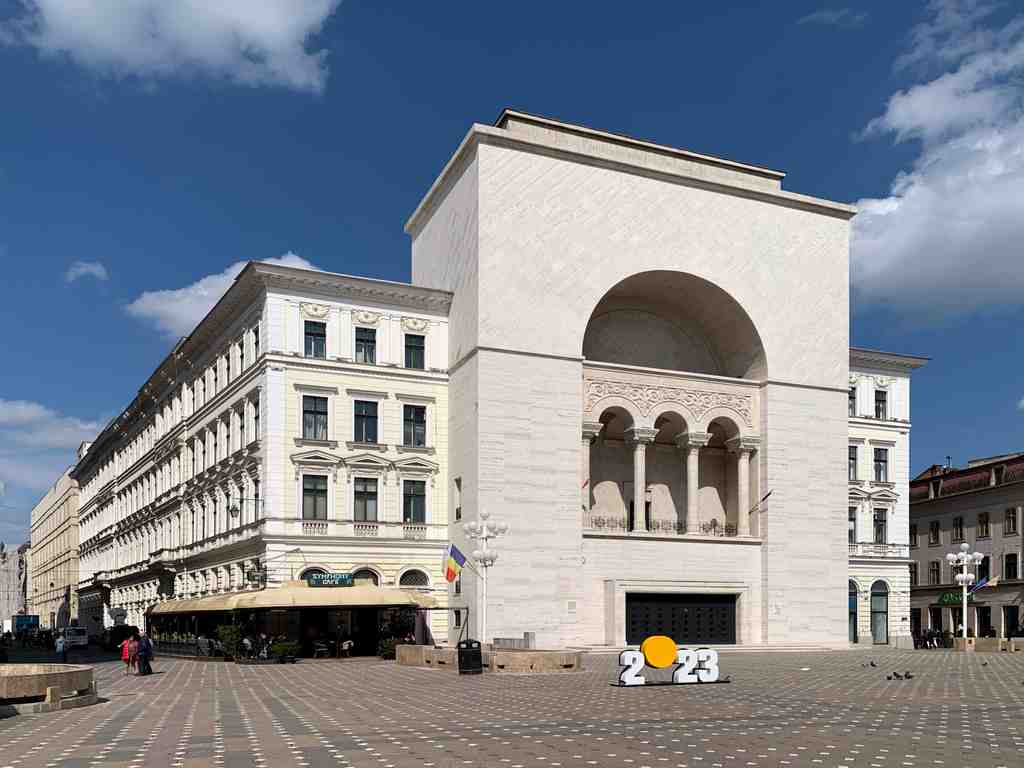
Facing you at the northern side of Victory Square is a towering, bright white limestone building with a dramatic arch and balcony above its entrance-impossible to miss if you look for the massive rectangular block topped by a deep, shadowy alcove.
Now, pause a moment and imagine-you’re standing where emperors, rebels, actors, opera divas, and revolutionaries all left their mark. The Timișoara Palace of Culture isn’t just a building; it’s been the beating heart of drama, music, and even revolution for over a century. If its walls could talk, well, we’d probably need earplugs… and popcorn.
Let’s go back in time: the spot you’re at was once bustling with carriages and the march of soldiers, because the original building here was part of the city’s fortifications. But with the dreams of theatre-lovers (and pretty deep pockets), a plan was hatched to build something grander. In 1872, an Austrian emperor himself, Franz Joseph I, nodded his approval. That meant champagne and maybe fancy hats-no pressure, right? The auditorium was plush and gilded, chandeliers sparkled, and actors gazed out at nearly a thousand expectant faces.
But fate has a strange sense of humor. One evening in 1880, the rumble of fire echoed through the halls. Costumes and a piano were narrowly rescued, but most of the auditorium went up in smoke. The townsfolk weren’t giving up-after all, who else could host grand balls, dramatic duels of words, and the occasional, raucous night at the theatre? The city bought back every box seat and rebuilt in style, only for flames to strike again in 1920. Seriously, if this place could collect loyalty points for fire insurance, it’d get a lifetime pass by now!
Despite disaster, the community returned stronger, with architects crafting a space inspired by Italian palazzos on the outside and a vivid Neo-Romanian style inside-think grand frescos of fairytales and heroes gazing down as crowds cheered, booed, and maybe snoozed during the dull bits.
But the Palace of Culture became truly historic not just for theatre, but for the fate of a region. Tucked beneath your feet, the Kronprinz Rudolf restaurant was the covert stage for a different drama: in 1918, Aurel Cosma and his companions gathered to boldly unite Banat with Romania, a daring declaration echoing up through marble and plaster.
Fast forward: the world grew turbulent, and this building became the epicenter. In 1989, during the Romanian Revolution, crowds surged outside-imagine shouts, banners, hope swelling in the icy December air-as leaders in the Palace of Culture declared Timișoara the first city free from communism. The news shot out across the country like a burst of sunlight after a storm.
Of course, as you see now, the building is a striking blend of old and new. Its original archways and muses are mostly gone-rumor has it some statues were pinched and now live on a house elsewhere! Decades of restoration, criticism, and even architectural controversy followed. The current dramatic arch and balcony? That’s the result of an architect’s bold, even divisive, vision in the 1930s. Some called it heroic; others just missed the old charm. Even today, there’s debate-should it stay as a symbol of revolution, or be restored to its ornate prewar glory? The compromise: parts restored, but the now-iconic arch remains.
Inside, the pulse of creativity continues. The Romanian National Opera and three great theatres-Romanian, Hungarian, and German-share the stage. The Great Hall fits nearly a thousand dreamers, all gazing at frescoes of muses and mythic figures, with Ovid’s words reminding the audience to sing, to dance, and to create beauty. If you hear faint music or laughter as you peer at those carved columns and arches, maybe it’s just the next show warming up-or the ghosts of actors past, itching for an encore.
So, gaze up, take in the soaring limestone and the grand, almost cinematic balcony, and know you’re in the presence of centuries of courage, art, fire, and revolution. Not bad for a night out, right?


