
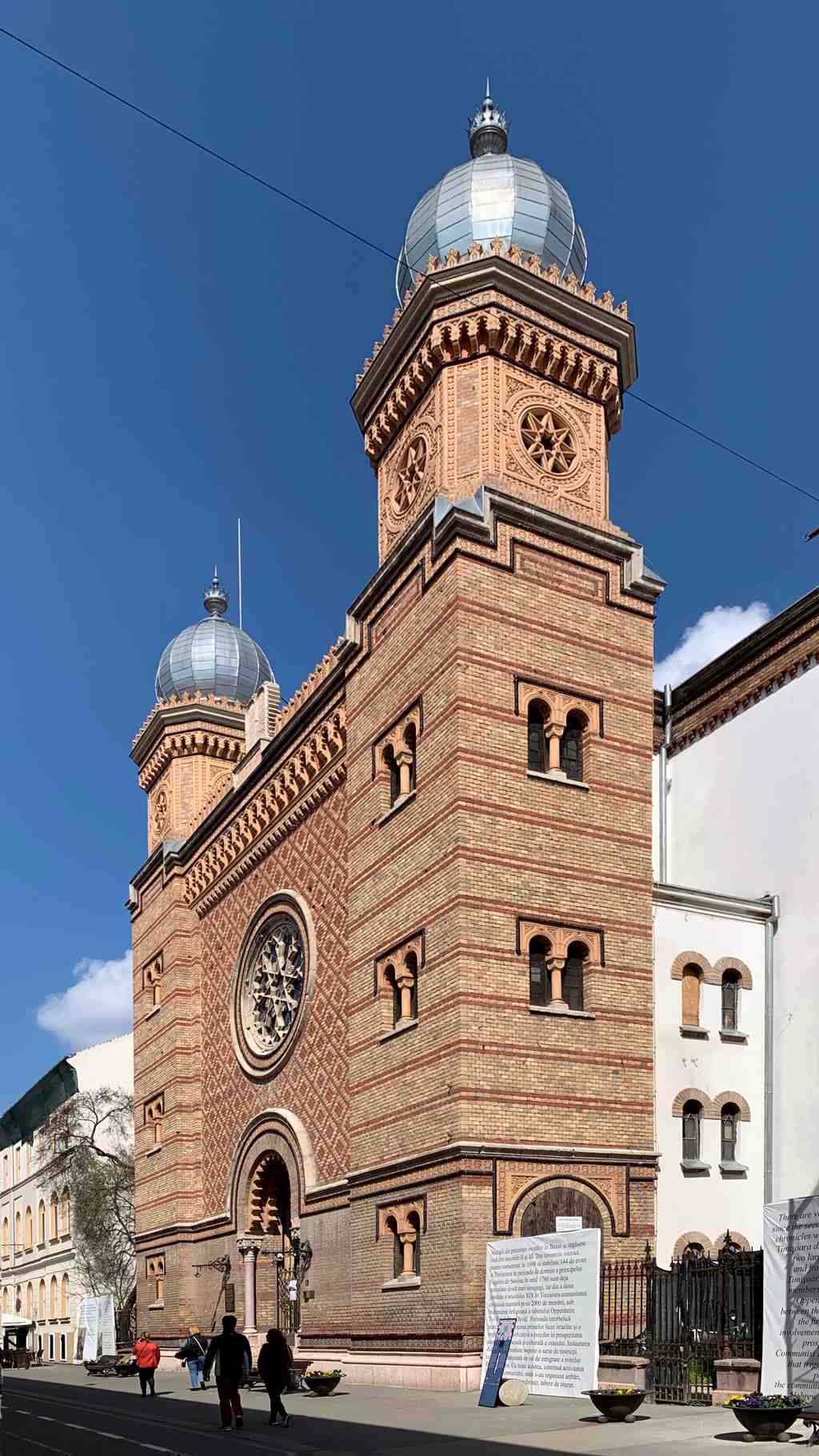
Look ahead for a dramatic red-brick building with two towers and a big rose window featuring the Star of David-if you see colorful ceramic tiles and geometric patterns, you’ve found the Cetate Synagogue!
Standing here in front of the Cetate Synagogue, you might feel like you’ve taken a sudden left turn out of Timișoara and straight into a romantic scene from The Arabian Nights-minus the flying carpets, unless city traffic really gets wild. This extraordinary building was dreamed up by Viennese architect Carl Schumann and finished back in 1865, and trust me, its story is as colorful as its brickwork.
Let’s set the scene: the mid-19th century, horse-drawn carriages rattling past on dusty streets, and the Jewish community of Timișoara feeling that a grand new synagogue is just what the city needs. Thanks to Rabbi Mór Hirschfeld, the town rallied together, passing the hat for donations, and bought two plots right here-one from the old Janicsáry family, another from the Piarist college. As the foundation was laid, plans grew ambitious; this would be no ordinary synagogue.
When it was first opened-right before Rosh HaShanah in September 1865-the city buzzed. In fact, it had such a regal debut that, two years later, Emperor Franz Joseph himself made an appearance, dazzling the congregation with imperial style. That’s some royal approval! 1867 wasn’t just the year for imperial visits; it’s also when Jews across the Empire gained full citizenship for the first time. You can almost imagine the joy and newfound sense of belonging echoing through these very walls.
Architecturally, the Cetate Synagogue is a bit like the city’s own layer cake. Mismatched? No, eclectic! You’ll spot Romanesque Revival influences, Moorish Revival flourishes, and decorations shouting out its Jewish identity with pride. The facade-bright red and honey bricks, glazed tiles shining in the sun-draws your eye to that enormous rose window above. Peer up and you’ll see the Star of David at its heart, like a jewel crowning the building.
The main entrance leads to a vestibule, where the stairs branch off to the towers and upper lodges reserved for women. Inside, benches carved for generations, a sweeping dome, and rich stained glass spill colorful light everywhere. And over there, on the far side, an organ built in 1899 by Carl Leopold Wegenstein looms, ready to fill the space with music once again.
But time, as ever, moves on. For nearly 140 years, this space bustled with prayer, laughter, and maybe a little bit of “Who took my seat?” But after World War II, the local Jewish community shrank as many left for Israel, and in 1985 the synagogue’s doors closed. Yet the silence didn’t last long; the building found new life as a concert hall. Imagine music drifting from those upper galleries-violins and cellos mingling with the ghosts of old prayers.
Today, after careful restoration beginning in 2017, the synagogue sparkles again-reopened not just as a place of prayer, but as a living museum for the Jewish community of Timișoara. Who knows? Perhaps as you stand here, you can hear echoes of all those lives weaving together over centuries, drawing you into the next chapter of this remarkable building’s story.




