
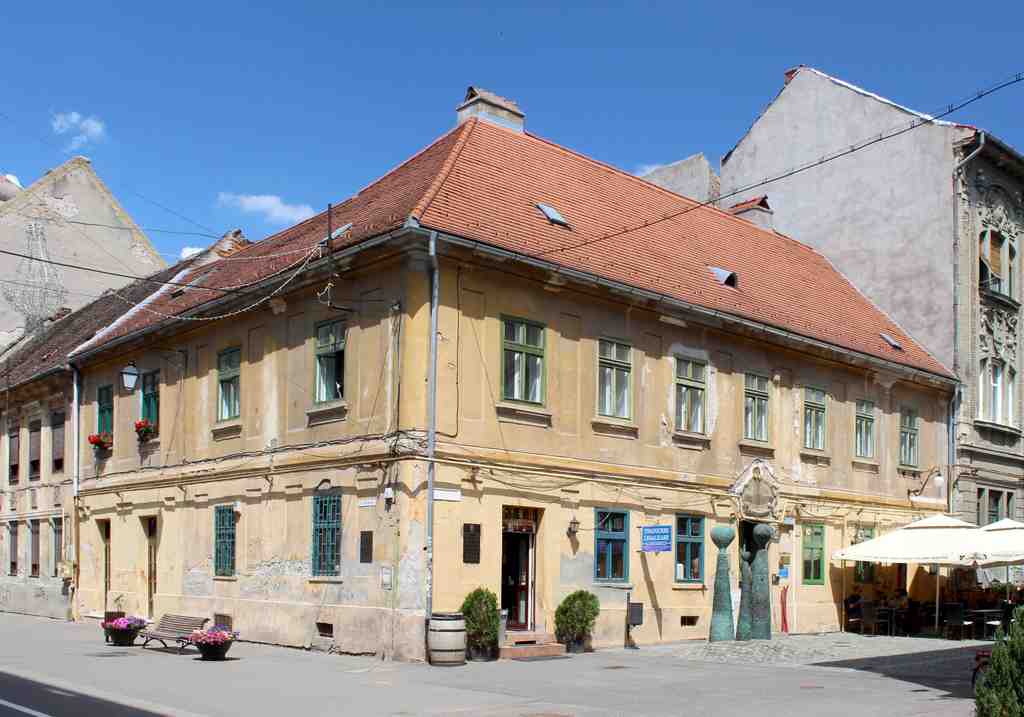
Look for a corner building with soft yellow walls, green-framed windows, and a sloping red roof, sitting at the intersection of Eugene of Savoy Street and Mărășești Street-just ahead on your right!
Alright, traveler, get ready for a story that’s bursting through old brick and echoes through the centuries. You’re standing at the Prince Eugene House, but don’t let the modest look fool you-this place is built on a gateway that once crackled with the roar of conquest and the whispers of spies!
Picture this: it’s October 1716, and the Ottoman Empire has been ruling Timișoara for over 160 years. Their mighty fortress stands, surrounded by thick stone walls and guarded by five gates. Right here, under your feet, was the Rooster Gate-or, in Turkish, the Horoz Kapısı-which had seen it all: traders, soldiers, the odd merchant chicken (none of whom survived the siege). The gate tower, built way back in the medieval days, was so iconic it even landed itself a spot on the Banat of Temeswar coat of arms. But on October 18th of that year, history galloped through-a determined fellow named Eugene of Savoy, commander of the Habsburg army, fresh off victory after a tough siege, led his troops in right through this spot. You can almost hear the drumbeats, the calls of celebration, and, if you listen closely, perhaps the Ottomans softly muttering “Oh no, not again!”
As the dust settled, the gate was renamed the Prince Eugene Gate in his honor. Later, thanks to a little bureaucratic creativity, it became known as the Forforosa Gate. Time marched on and, as the Austrian defense system evolved, the gate got swallowed up by new fortress walls-imagine the grand old arch slowly bricked up and hidden inside a rectangular building laid atop the old Turkish ditches, an honest-to-goodness architectural time capsule.
Now, here’s a twist you might not expect: between 1739 and 1769, the Jewish community used that very building as a house of prayer. By 1817, everything had changed: the old gate and the building over it were demolished, but the bricks were reused (no waste in this city!) to build the Prince Eugene House right where you’re standing. During construction, the city said, “Hey, don’t forget to immortalize the old gate,” so the owner stuck a stone medallion above the entrance-a nod to the past, a wink to history. The real original is now at the National Museum of Banat.
Despite the grand name, poor Eugene of Savoy never spent a night here-it was built some 81 years after he’d left this world! Instead, the house saw life under many owners: merchants, widows, and businessmen all had their turn. In the 20th century, the building hosted everything from vegetable shops to pubs, then a theater agency, and eventually, it even became the nerve center for local commerce and agriculture.
And now? This sturdy U-shaped house, with its classicist decorations, old baroque window sills, and sun-bleached walls, continues to watch over the corner-proof that the best stories in Timișoara often start at the threshold. Take a good look at that medallion above the entrance-a little time machine, gazing out on a city that’s always moving but never forgets.




