
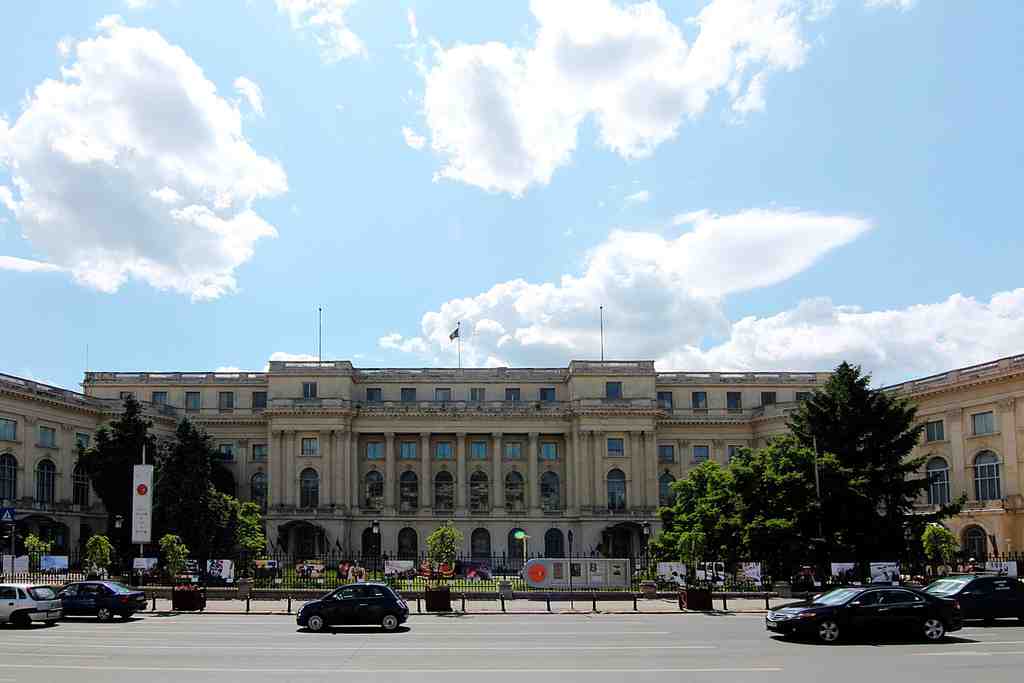
Ahead of you stands a grand U-shaped neoclassical palace with elegant rows of arched windows and a flag flying from its central rooftop-just look for the wide, imposing façade set back from the street, flanked by trees and ornamental iron fencing.
Now, let’s dive straight into the lively world of the Royal Palace of Bucharest-where kings and queens, secret passages, bombings, revolutions, and even a touch of urban legend have all made an appearance. This striking palace was never meant to be confused with Elisabeth’s Palace, although with so many royal residences in Bucharest, you’d be forgiven for needing a royal family tree just to keep up!
The story begins in 1812, when the original Casa Golescu went up right here. Back then, it was palatial for its time, boasting a whopping 25 rooms. Imagine the echo of horse hooves and carriages arriving, and the scent of pine wood drifting from fireplaces! Within a few decades, the elegant house turned into the ruling court of Alexandru Dimitrie Ghica, then played home to the first ruler of a united Romania, Alexandru Ioan Cuza. In 1866, it welcomed Carol I, setting the stage for its true royal destiny.
But this site’s drama really took off after a devastating fire in 1926. The old palace didn’t stand a chance! Enter a Czech architect and his team-along, no less, with Queen Marie, who, with a keen eye for design (and apparently a knack for bossing around architects), oversaw the construction of the new palace, which finally opened its doors in 1937. The result? This imposing structure in front of you, with a U-shaped arms seemingly ready to embrace all of Victory Avenue.
It wasn’t all tea, cookies, and royal audiences, though. In 1940, the very throne room hosted the moment when young King Michael II had to take a rather serious oath-imagine a room tense with generals, patriarchs, and political bigwigs. World War II brought even more drama. After King Michael bravely seized back control of the country from a pro-Nazi government, the Germans retaliated. On August 24, 1944-boom!-the Royal Palace was bombed so badly it became unlivable. The elegant villa behind it, once the family’s private residence, was wiped away. King Michael even had to beg to sleep over at his aunt’s place. Family reunions must have been awkward after that!
After 1947, communism arrived and the monarchy was swept aside. The palace’s ornate trappings of royalty were removed or hidden. Its halls held communist party meetings, foreign delegations, and even the body of a dictator for a final bow. During Nicolae Ceaușescu’s reign, the throne room was renamed and used for official functions, but if you squint, you might still spot a hint of royal grandeur hiding under communist wallpaper.
Let’s not forget the urban legend-some joke there’s a secret tunnel from here straight to the Kretzulescu Church next door, a royal shortcut for dodging paparazzi or running out for a quick blessing (or maybe just picking up forgotten groceries)!
The ‘80s brought revolution, chaos, and fire to these walls, with priceless art nearly lost in the blaze. But post-1989, the Royal Palace rose from the ashes, restored and alive with art and music. Today, the palace is home to the National Museum of Art of Romania, as well as a concert auditorium that’s open to the public. Step closer, and picture yourself as a royal guest entering that grand octagonal hall, sunlight glinting off polished marble, the thrill of history swirling in the air. The building’s great column on the central façade isn’t just a quirky architectural feature: it’s one last royal joke, meant to symbolize the unity and stability of a monarchy. And if you see the Romanian tricolor with a big royal crest flying above, you’ll know the king-at least in spirit-has come home.




