
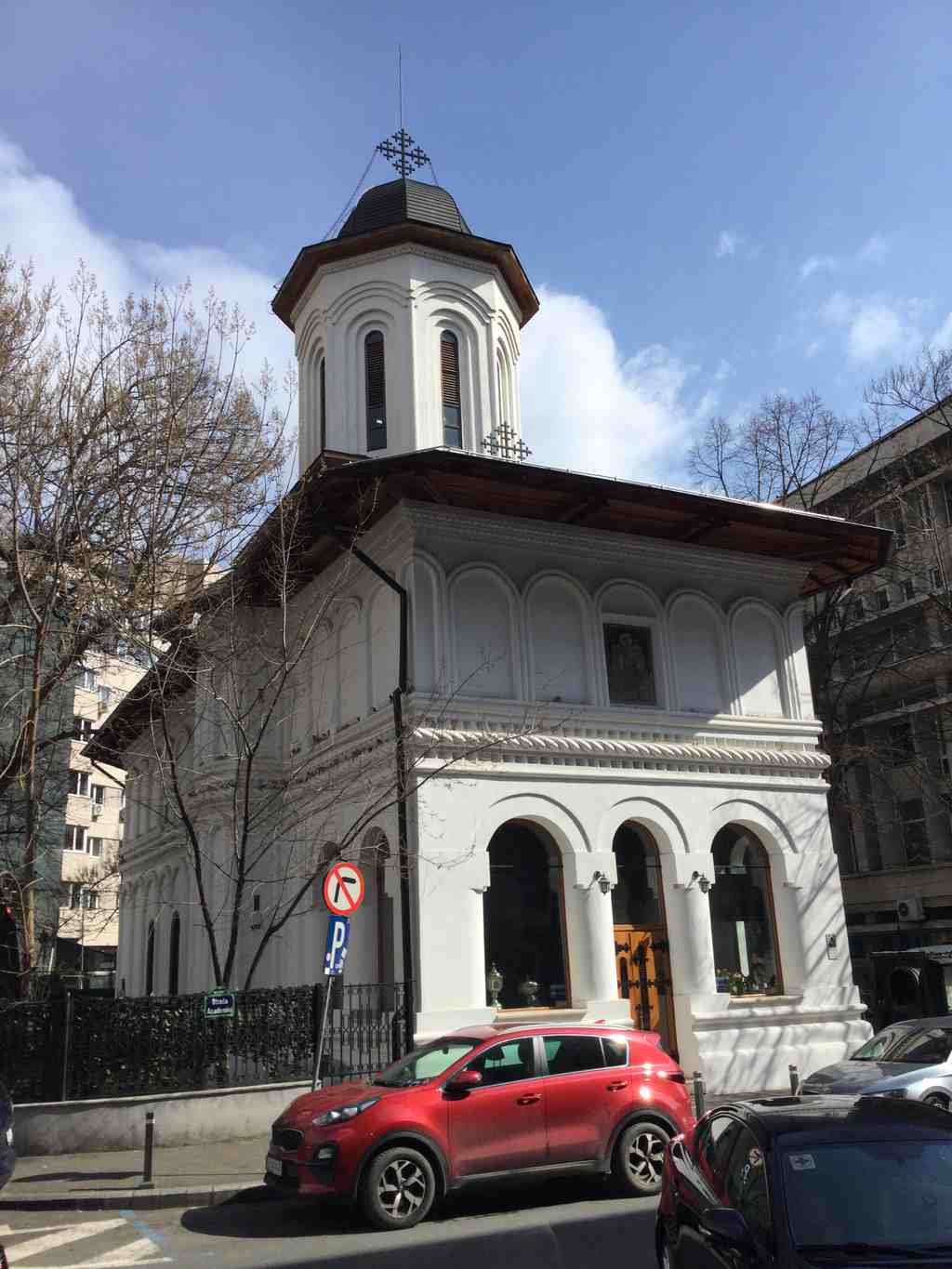
To spot the St. Nicholas in-a-Day Church, just look for the striking white church with tall arched windows, capped by a distinctive octagonal bell tower right ahead of you on this quiet, tree-lined street.
Now, let me weave you into the story of this rather legendary landmark. Imagine the bustling heart of 17th-century Bucharest, where weaving through the city’s muddy streets, people whispered about a tiny wooden church that sprang up seemingly overnight-so quickly, in fact, that it earned the tongue-in-cheek name “in-a-day.” Some say the church was built to fulfill a bold bet, with workmen rushing through the night, their hammers and saws echoing until dawn. Others, slightly more practical, will tell you it was finished exactly one year after it began, but why spoil a good story with facts, right?
Originally, this was just a humble wooden chapel built by Postelnic Neagoe, but its fate soon twined with the powerful Marica, who carried it off as her dowry when she married none other than the soon-to-be prince, Constantin Brâncoveanu. In true royal fashion, Marica relocated the wooden church, making room for a sturdier stone version in 1702. The construction was overseen by Ianache Văcărescu, which explains the elegant brickwork you see around the windows and the saw-tooth string course wrapping the facade. During the 18th century, the church was the proud domain of Bucharest’s barbers’ guild-a place for barbers to pray for steady hands, no doubt!
In a delightful twist of architectural drama, the church once had a secret footbridge built by Prince Ioan Caragea, connecting his upper-floor residence directly to the church. Imagine him sneaking across the hidden passageway, hoping no one caught him going to pray in his pajamas. The passage is gone now, but if you look closely, you can spot the patch in the brickwork where the door once was.
This building has weathered fires, proposals for demolition, and even moonlighted as the spiritual home for Bucharest’s Albanian Orthodox community-where the legendary Fan Noli himself preached. Its bell tower was scorched in 1825, only to rise again in new form. The church has seen enough drama for a soap opera: marriages, fires, repairs, and restorations, all leaving their mark.
So as you stand before this elegant yet unassuming church, imagine all those centuries layered within its walls, and know you’re gazing at a survivor-a place built on faith, a dash of legend, and maybe, just maybe, a winning bet on a very long day.




