
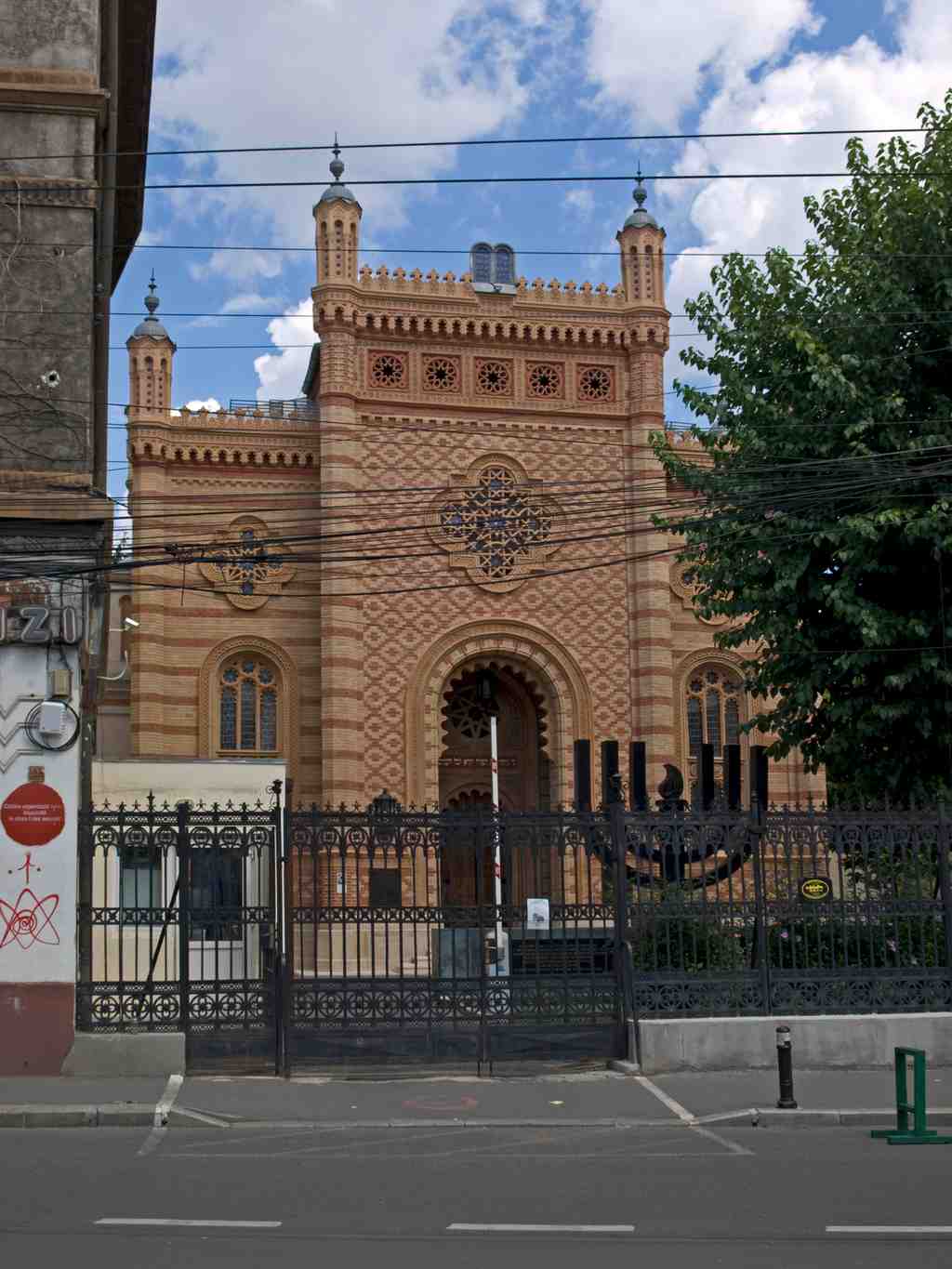
Standing in front of you, on Strada Sfânta Vineri, is a grand, rectangular building faced with two-tone patterned bricks, tall arched windows, and crowned by six slender towers-just look past the black iron fence and spot the intricate rose window above the ornate Moorish portal.
Welcome to the Templul Coral, the spectacular “CoraI Temple” of Bucharest-where history isn’t just old, it’s positively lively! Imagine you’re standing in the middle of 19th-century Bucharest: the city is alive with voices from every corner of Europe, and the local Jewish community, led by a visionary named Isaac Leib Weinberg, dreams of a synagogue as dazzling as those found in Vienna or Paris. And why shouldn’t Bucharest have its own showstopper?
It all began in 1857, on this very street, in the Mahalaua Stelei neighborhood. Picture a group of hopeful leaders haggling over the price of the land-2,400 gold coins! They’d just bought the spot where you’re standing. Early plans for the temple hinted at tall Gothic arches, but those ideas were soon swept aside for something even bolder, something “Moorish-Byzantine,” a style that makes you want to hum a bit of exotic music as you wander by.
Work truly kicked off in 1864, but the journey was anything but smooth. The city buzzed with debate-should the new temple follow the strict old ways or embrace the progress of the modern world? Leaders argued, designs flipped back and forth, and even the city’s top banker, Iacob Loebel, joined in with the architects from Vienna, Enderle and Freiwald, to steer the dream forward.
By early 1866, the walls were up, and the intricate brickwork glowed under the city sun. The Torah scrolls were ordered from Budapest, and excitement ran high. Just imagine Bucharesters peering through the iron gates, eager to see what was rising behind them.
But then-disaster! Nationalist unrest swept the city. The very temple you see before you, so close to completion, was set ablaze in a night of violent protest. The flames crackled and roared, eating up months of work, fueled by anger over a proposed law granting citizenship to the city’s Jews. The air would have been thick with smoke and fear as neighbors watched the firelight dance against these decorated walls.
The damage was enormous-over 209,000 lei went up in smoke. It could have marked the end of the dream, but restoration began at once, even with help from Romania’s own ruler, Carol I. The city’s spirit and the determination of its Jewish community shone through. Finally, in July 1867, with all wounds repaired, the temple was inaugurated. Modern rabbi Antoine Lévy led the ceremony, joined by diplomats and government officials who all understood that this wasn’t just a building: it was a symbol of hope.
Over the decades, the Coral Temple has kept on evolving-new conference rooms, galleries, a museum upstairs, and renovations after earthquakes, political turmoil, and the devastations of the Second World War. In January 1941, imagine the sound of breaking glass as legionaries stormed the synagogue, leaving behind a scene of heartbreak, only for the community to rebuild once more, showing resilience at every turn.
And it doesn’t stop! Since 2008, further restoration has breathed new color and life into its facades and interiors-mending stonework, restoring stained glass, and reviving the extravagant polychrome brushwork, so the temple looks as enchanting as ever today.
Look at the facade: red-and-cream bricks ripple across the walls, a tapestry of color. The grand arched doorway beckons you closer, crowned with delicate carvings. Up above, six small towers guard each corner, and the massive rose windows invite sunlight to dazzle the interior. If you peer inside (or just imagine for now), you’ll find three grand naves divided by elegant arches, a soaring semicircular vault overhead, and ancient benches still welcoming worshippers.
Just before you, in the small square, stands a black iron menorah, a silent, strong memorial to the victims of the Holocaust-a reminder that behind all the beauty is a story of survival, grief, and hope.
And the guest list! Over time, the Coral Temple has welcomed religious leaders, world-famous rabbis, prime ministers, and even the head of Romania’s Orthodox Church. Step closer and you’ll feel the echoes of conversations, laughter, and prayer from generations past.
So, next time you hear the phrase “if these walls could talk,” just remember: here at the Templul Coral, they already do-if you listen carefully enough. And rumor has it, they enjoy a good joke, too-just don’t ask them about the heating bill.




