
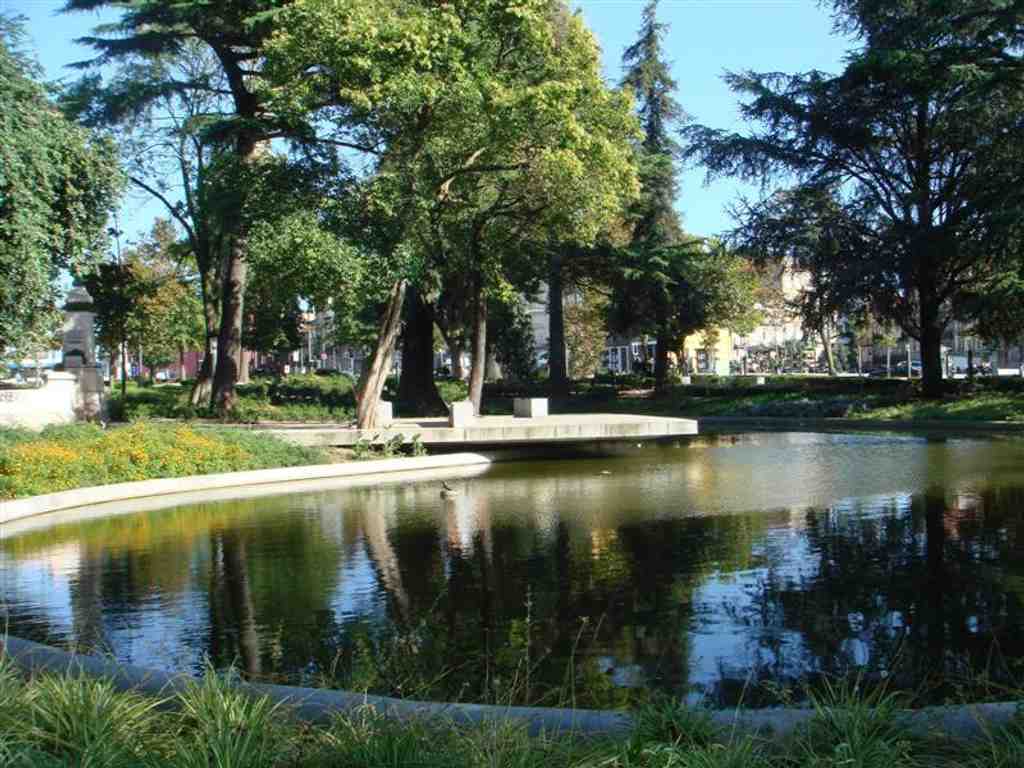
On your left, João Chagas Garden opens as a formal green space with curving paths, a cast-iron bandstand, and a stone-edged lake set among long-established trees.
It looks gentle now, but this ground carries harder memories. During the Siege of Porto, in eighteen thirty-two and eighteen thirty-three, people cut down many of the trees here for fuel for the Military Hospital and the Recolhimento dos Meninos Órfãos, a home for orphaned boys. One tree, remembered as the Gallows Tree, seems to have survived only because a Misericórdia official intervened. A garden, then, can remember violence just as surely as a wall can.
In eighteen sixty-five, the Viscount of Vilar d'Allen founded this place as a public garden, and the German landscape designer Émile David gave it romantic curves and pauses, turning damaged ground into somewhere people could stroll, sit, and think. If a city under siege must burn its own trees to survive, what does it choose to save from itself?
That question never quite left. A cyclone in nineteen forty-one changed much of the garden’s appearance. Then, for Porto 2001, the architect Camilo Cortesão reshaped it again, aiming for something modern, safe, and transparent. Many in Porto thought the result too bold, too severe, and the debate lingered, helped along by practical troubles with lighting and the lake’s water system.
Among the sculptures, Flora, dedicated to the gardener Marques Loureiro, feels especially fitting: cultivation, memory, and survival in one figure. Next, we leave this broad, haunted calm for a clever urban oddity at Carmo Church, about a three-minute walk away. The garden remains open at all hours.




