
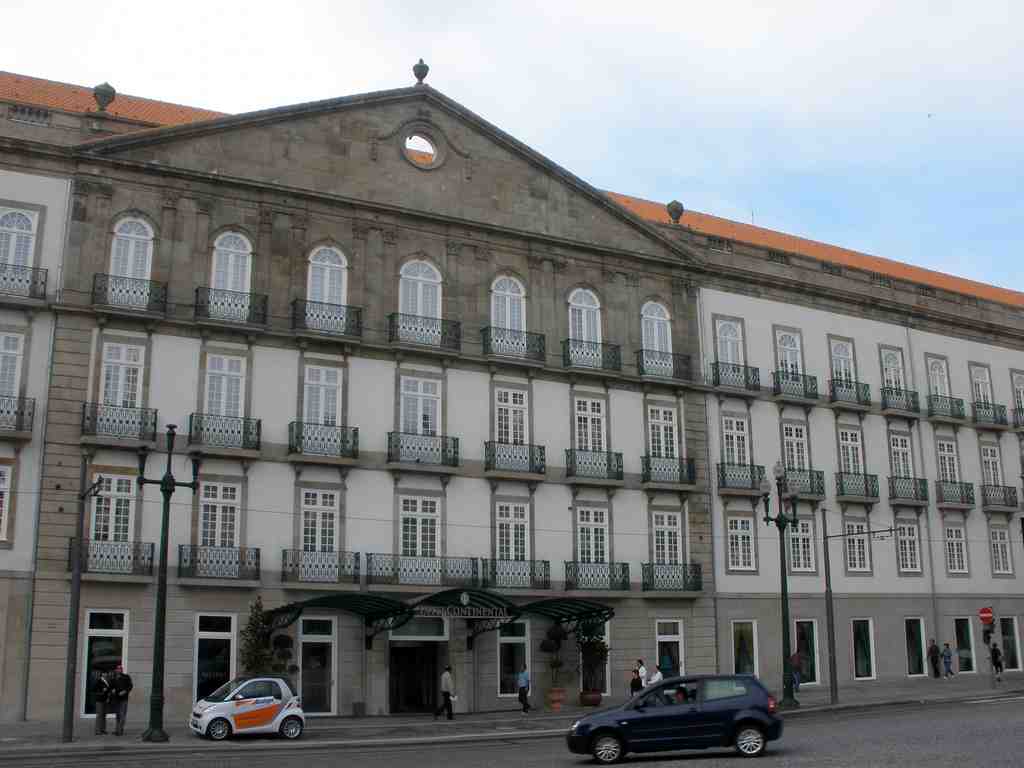
Look for the long pale-stone façade with its disciplined rows of tall windows, wrought-iron balconies, and dark roof pierced by dormer windows.
At first glance, this seems to be a very self-assured nineteenth-century palace. But Porto likes to play a quieter game than that. Again and again, the city takes an old institution, keeps part of its skin, and teaches it a new role. This building is one of the clearest lessons in how to read Porto properly: never ask only what a place is. Ask what it used to be.
Beneath this elegant front sits the memory of the Convent of the Lóios, also called the Convent of Santo Elói. Its story began in the late fifteenth century, when Bishop Dom João de Azevedo ordered the convent buildings in fourteen ninety, and on the sixth of November, fourteen ninety-one, the first stone was laid for the church of Nossa Senhora da Consolação.
The convent did not stand still for long. In the late sixteenth century, the community enlarged and rebuilt it. Father Pedro da Assunção laid the first stone of a new main chapel in fifteen ninety-three, with Bishop Dom Jerónimo de Menezes present, and the architect Manuel Garcez guiding the design. In the seventeenth century, craftsmen enriched the church with altarpieces, ceiling work, pulpits for preaching, and even a new organ. So this refined frontage once sheltered a world of prayer, ceremony, timber, gilding, and incense.
Then the city began to lean on it. In seventeen sixty-four, João de Almada e Melo ordered a new square to open in front of the convent. Suddenly this inward-looking religious house had to face a growing public city. In seventeen ninety-eight, José de Champalimaud designed a new front for that purpose, but the upheavals of the early nineteenth century interrupted the work, leaving the building suspended between convent and palace.
Take a good look at the façade now. Its symmetry is calm, almost formal. And yet very few people passing by would guess they are looking at a converted convent rather than a building born as a palace.
The nineteenth century pushed the transformation even further. Between eighteen ten and eighteen twenty-two, Portuguese troops occupied the building and turned it into a military hospital. During the Siege of Porto in eighteen thirty-two, it housed the mint, where coin was produced in the middle of political crisis. Prayer gave way to soldiers, medicine, and money.
After the religious orders were dissolved in eighteen thirty-four, the businessman Jesus Cardoso dos Santos bought the property at public auction for eighty contos de réis. He had to complete the frontage. After his death, the building passed to his wife and three daughters, known as the Cardosas, and they gave the palace the name it still carries.
By the end of the nineteenth century, one damaged tower gave authorities the excuse to demolish the church and the rest of the convent. Only this main façade survived. Even the old stone and bells were reused for practical purposes.
So here, in the polished heart of Porto, a grand civic face still wears the outline of a religious past. When you are ready, continue to Liberty Square, about a minute away, where the city’s public stage opens wide and the layers become harder to miss.




