
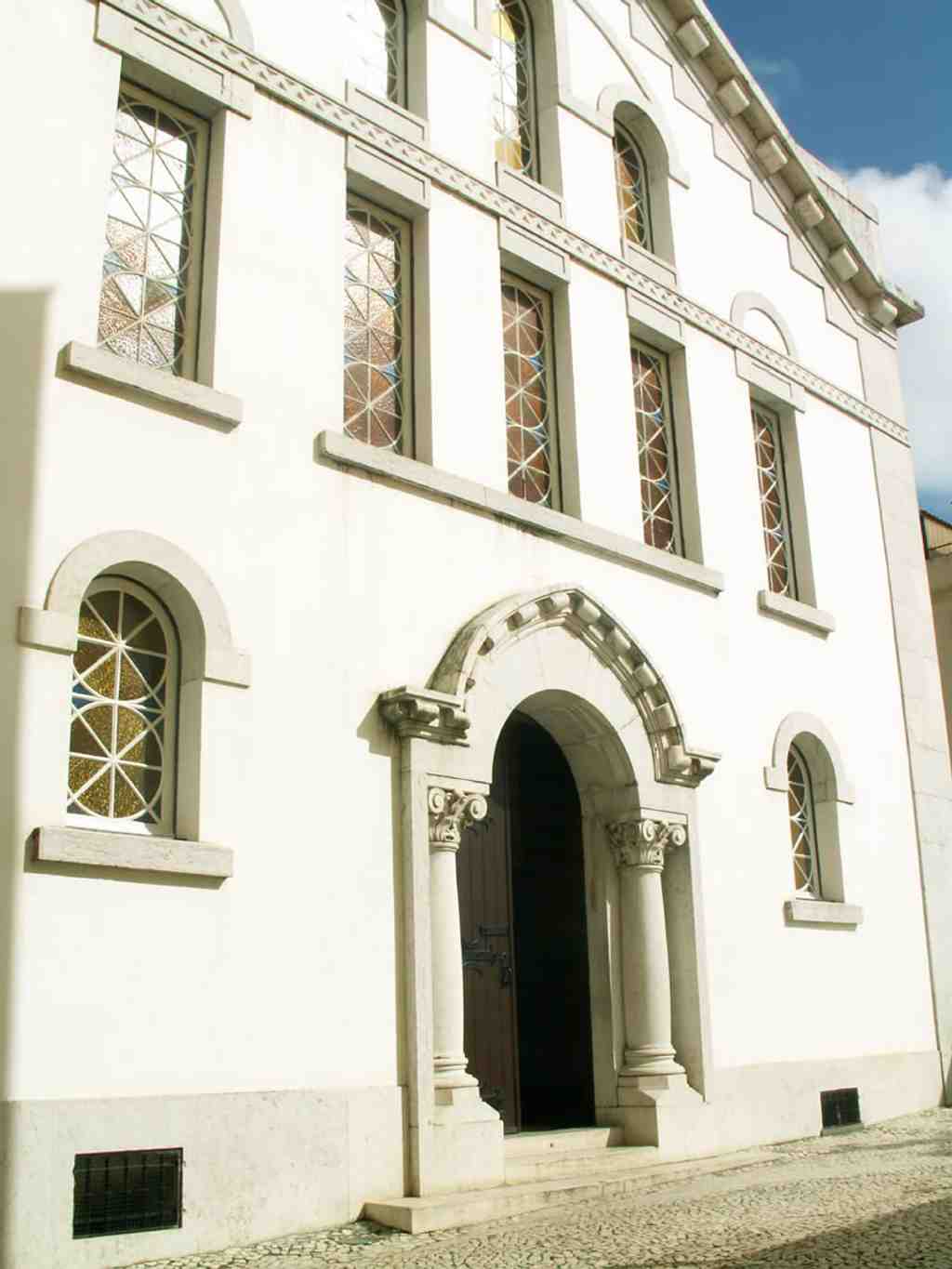
To help you spot it, look ahead for a white stone building set back from the street, with tall arched windows framed by decorative lattices, and an inviting doorway topped with a curved arch and flanked by elegant columns.
Now, take a moment to let your eyes wander up and down these walls-you’re standing in front of the Lisbon Synagogue, the Shaaré Tikvah, or “Gates of Hope.” This place holds stories as winding as the cobbled streets of Lisbon itself. If you listen closely, you might almost hear the shuffle of footsteps from over a century ago, when the city’s Jewish community finally found their way back after centuries in the shadows.
Imagine, for a moment, the year is 1497. Jews have been living in Lisbon for centuries, but overnight, everything changes. King Manuel I orders them to either leave, or become Christians. Synagogues are forced shut and handed over to Christian orders, and for those who convert, a frightening game of cat and mouse with the fearsome Inquisition begins. For hundreds of years, Jewish life survives only in secret-whispered prayers behind closed doors, celebrations hiding behind the drapes, hearts pounding at every unexpected knock.
Fast forward to the early 1800s. The darkness of persecution begins to lift, just a bit, as the Inquisition is finally abolished. Jewish merchants from places like Morocco and Gibraltar-Sephardi Jews-bring vibrant new life to the quiet streets of Lisbon. Still, there’s no official synagogue, just secretive gatherings in private homes. Even as the city bustles with horse carts and market calls, the idea of building a real synagogue must have seemed like something out of a dream. But, as you can see, dreams can be persistent!
Now, in the closing years of the nineteenth century, the community dares something bold. On March 4, 1897, an official request is sent far and wide: let’s build a synagogue! It takes years of petitions, paperwork, and a committee with more names than a football team roster-Leão, Abrahão, Mark, Jacob, Saul, Jaime, all juggling plans and hopes. Finally, in 1901, land is secured on Rua Alexandre Herculano. And in 1902, thanks to a generous donation, plans start to take real shape by the hand of Miguel Ventura Terra-a man with both the name and ambition for epic architecture.
Picture workers bustling about as, on May 25, the cornerstone is laid by Abraham E. Levy. You’d see dust in the sunlight, hear the clang of hammers, maybe even get a whiff of sawdust and cement. By 1904, at long last, with over four centuries of waiting and hoping piled behind every brick, Lisbon’s Jews have a place of worship again. Shaaré Tikvah-Gates of Hope-stands tall with space for 400 men and 200 women, designed in a striking mix of Romanesque Revival and Byzantine Revival styles. There are elegant windows, geometric patterns, a portico flanked by strong columns-all giving a sense of both grandeur and safety. Notice how the building is slightly hidden from the main street: a leftover from an old law that said non-Catholic temples couldn’t show their faces to the thoroughfares.
If you peek through the doorway, imagine an interior of pillars and galleries, a central aisle stretching up to the bima, and, above it all, the sanctuary where the Torah scrolls rest. Men sit below, women in the galleries above, everyone facing east-towards Jerusalem. There have been repairs over the years-the roof needed a little “biblical flood” of attention in the 1940s, and the grand reopening in 1949 featured none other than the Chief Rabbi of Paris himself.
In 2004, the community threw quite the birthday party for its centenary-no balloon animals, but the President of Portugal and Israel’s Sephardi Chief Rabbi helped mark the occasion! Even today, there’s a sense of quiet mystery here-a story folded into Lisbon’s heart, both hidden and enduring, a monument to resilience, faith, and the courage to open new gates of hope, even when the world tries to bar the door.
So as you stand here, take a breath, and imagine all those generations who waited for this building to rise-a place that whispers of hardship, defiance, and the stubborn optimism of people who refused to let hope fade away.




