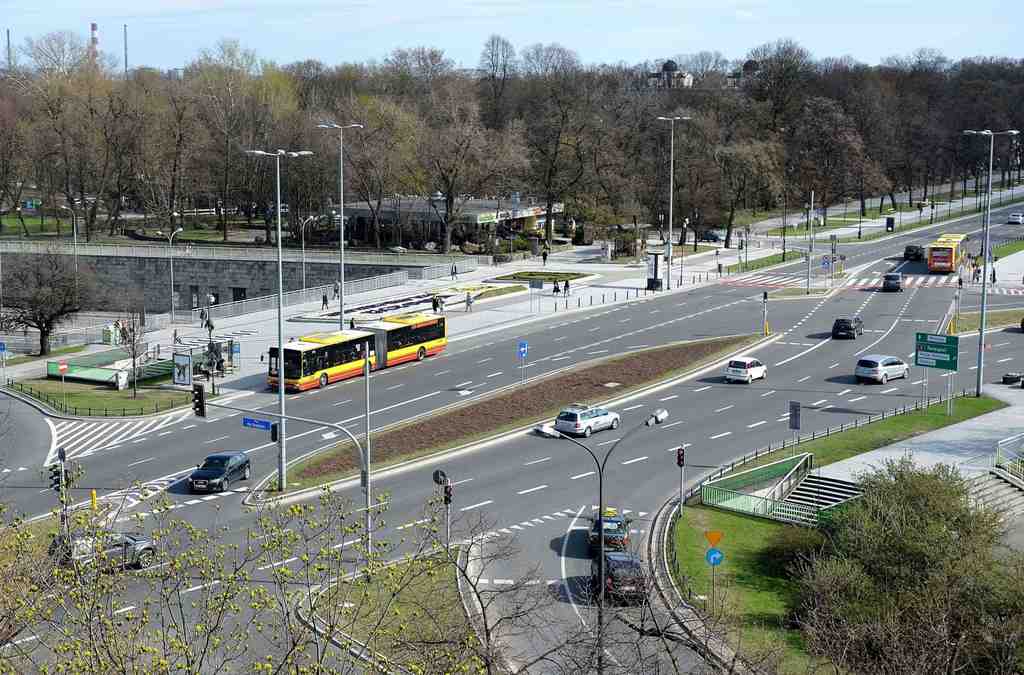
In front of you is a broad two-level square of asphalt lanes and concrete retaining walls, with a small circular upper plaza and fountain marking one side.
Crossroads Square, or Plac Na Rozdrożu, began in seventeen sixty-eight as something far more ceremonial than this road machine. August Fryderyk Moszyński placed it on the Stanisław Axis, an eighteenth-century urban plan that lined up roads and squares around Ujazdów Castle, so the city would feel both organized and faintly theatrical. Warsaw does enjoy a grand gesture.
Here is the part most people miss: through much of the nineteenth century, this was valued less as a junction than as an unpaved green viewing ground. It stayed open, lightly landscaped, and visually tied to the castle. So yes, this place once worked more like a prospect point than a traffic knot... which feels almost insulting to the buses.
Its identity kept shifting. In eighteen ninety-four, a Russian Orthodox church dedicated to Saint Michael the Archangel rose nearby at number twelve Ujazdów Avenue, serving Russian soldiers and civilians. After Russian forces withdrew in nineteen fifteen, the church sat mostly empty, decayed, and came down in nineteen twenty-three. One regime installs a symbol; the next removes it. Efficient, if grim.
For a brief stretch after nineteen oh one, the square even gained its only tenement house, and inside it the café Łobzowianka became a known address until it closed in nineteen thirty-five. During the interwar years the square went by Freedom Square, and planners imagined even bigger roles for it, including a grand Piłsudski monument and a whole new district radiating outward. None of that happened. Warsaw is full of ambitious blueprints that never made it past the drawing board.
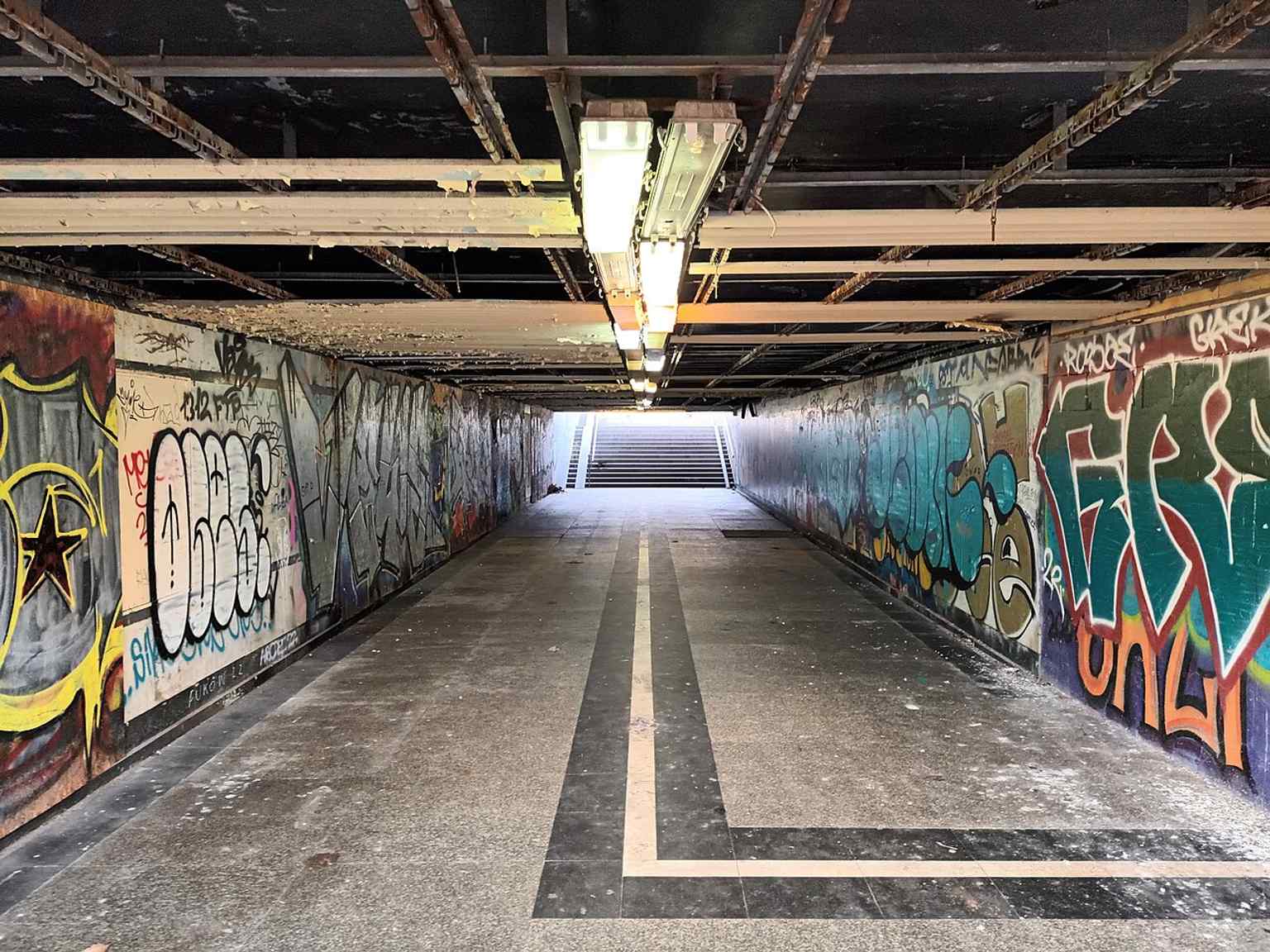
Some plans did arrive with force. Between nineteen seventy-one and nineteen seventy-four, engineers drove the Baths Route through here. They cut in People’s Army Avenue, pushed traffic onto a lower level, and built a forty-six-meter tunnel under the square. That is when the old axis got bent diagonally, the pedestrian routes sank into underpasses, and the western side gained the little round plaza with the fountain. If you want a quick comparison, have a look at the before-and-after image in the app.
The square never stopped collecting political meaning. The building at eleven Ujazdów Avenue housed the German Criminal Police during the occupation, then the Ministry of Public Security after the war. Later came monuments: Roman Dmowski in two thousand six, still controversial because his racist and antisemitic views are impossible to airbrush away, and Ignacy Daszyński in two thousand eighteen, adding yet another argument in bronze.
So even standing in what looks like an interchange, you are really in a layered draft of Warsaw: royal geometry, green outlook, vanished church, unrealized monument, police power, expressway engineering. A square can be many things, even when traffic tries to simplify it.
From here, head toward Rainbow, about a nine-minute walk away.