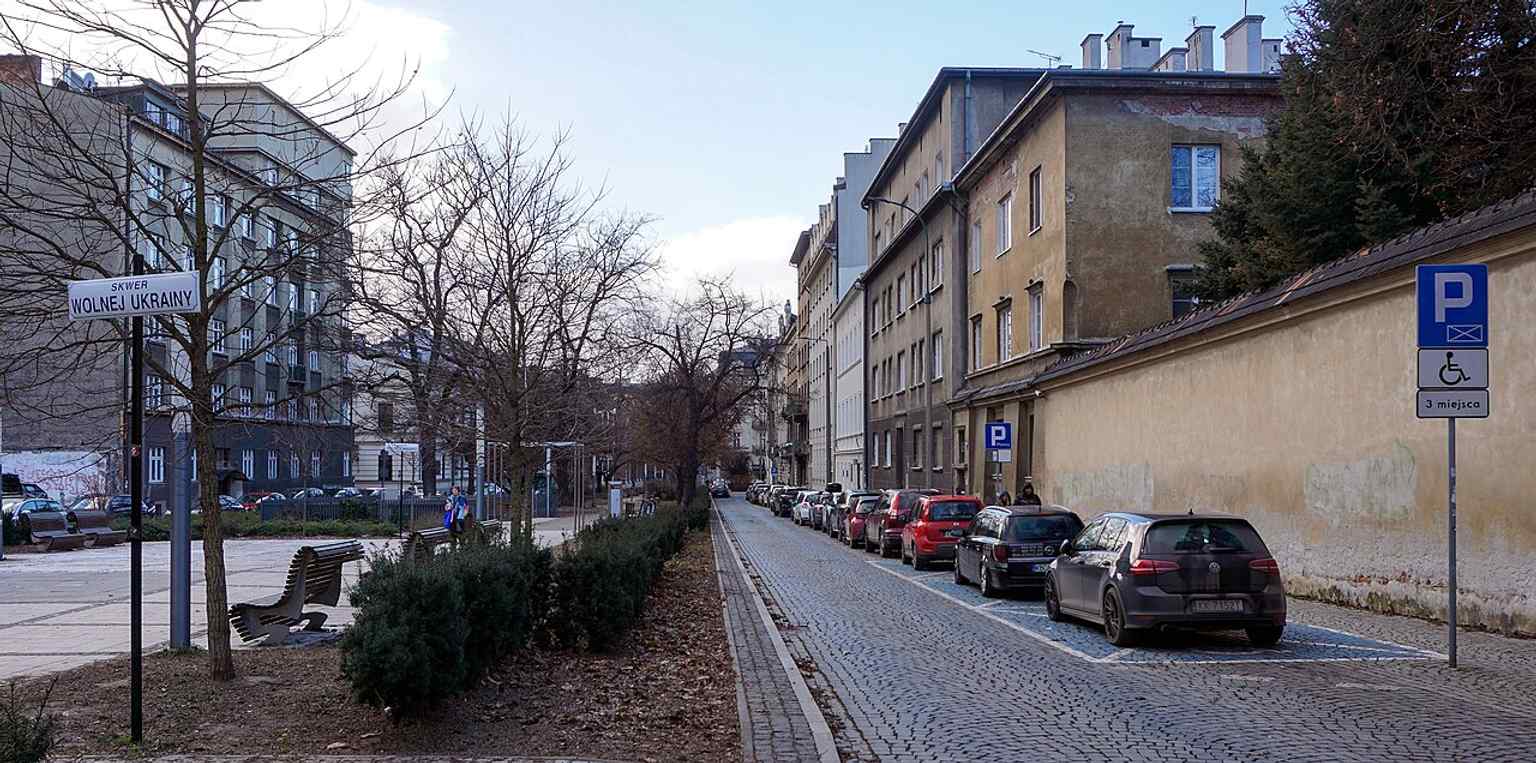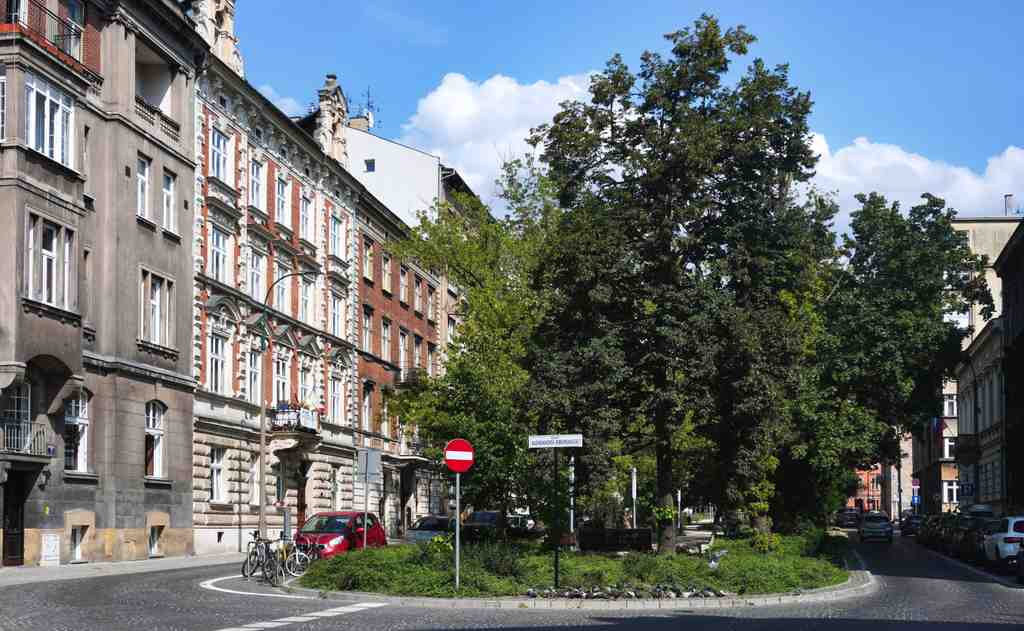
Look for the unusually broad street with twin carriageways split by a long planted median, framed by pale stone and stucco townhouses, with the convent church rising at the eastern end as its fixed marker.
Biskupia begins this walk with a small deception. It calls itself a street, yet it spreads itself so generously that locals long treated it as a square, Plac Biskupi, as though the city could not quite decide what this space wanted to be.
That uncertainty runs deep. You are standing in what used to be a jurydyka, a privately governed enclave just outside the medieval city’s own legal order. Before Kraków received its charter in twelve fifty-seven, some of this land already belonged to the bishops, and in the early fourteenth century Bishop Jan Muskata bought more ground here, extending a little world of church ownership beyond the old core. What began, most likely, as the bishops’ farm gradually filled with gardeners, tailors, servants from the episcopal palace, and many bakers who could sell bread in Kraków without belonging to the official guilds.
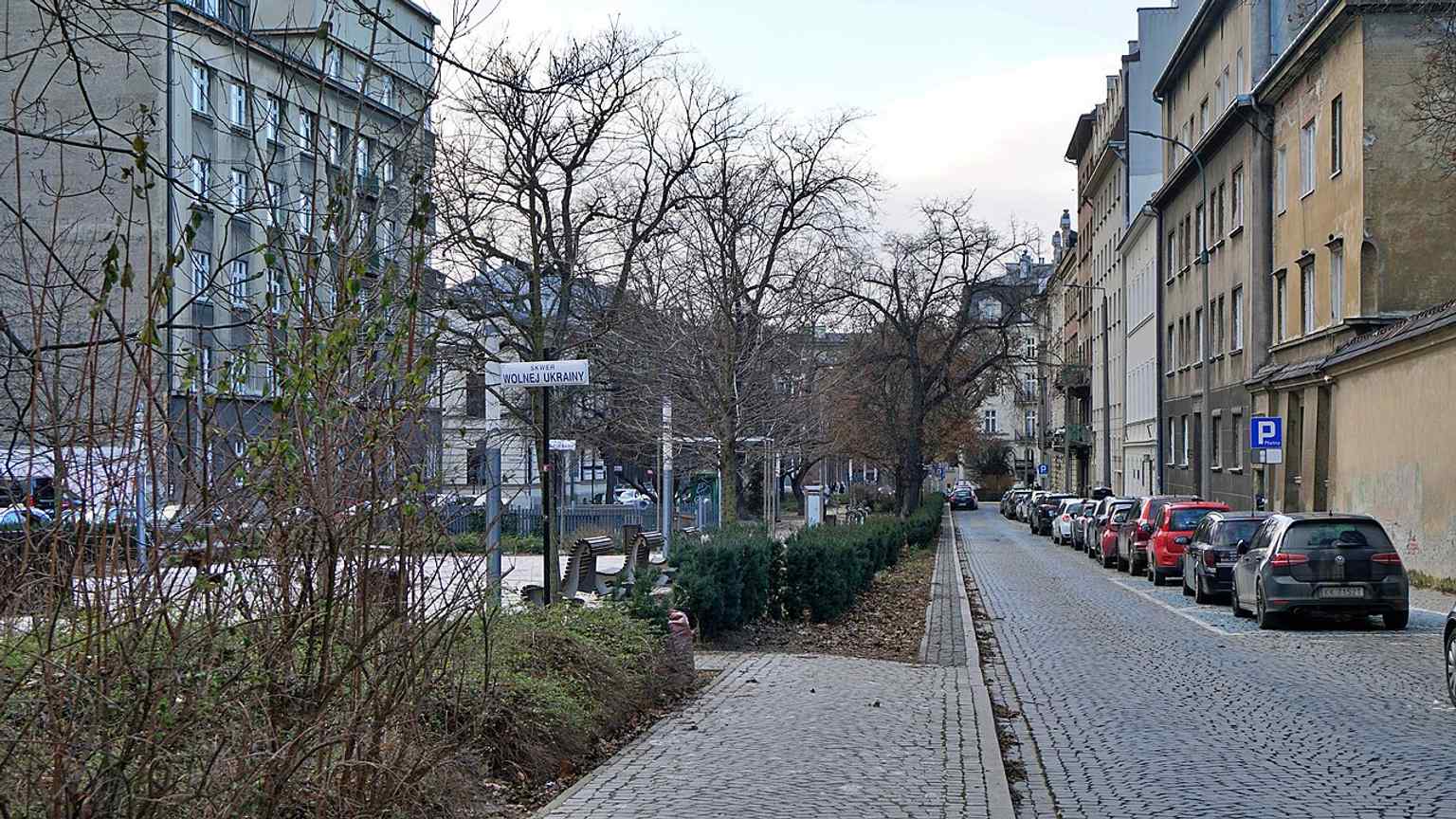
And here is the detail locals delight in sharing quietly: for centuries, the name Ulica Biskupia did not even belong to this stretch. It referred to today’s Krowoderska. This place, meanwhile, drifted under humbler names, Goły Plac, the bare square, or simply no proper name at all. Memory here has always been negotiated, never settled. In twenty twenty-two, after Russia’s invasion of Ukraine, some residents wanted the entire street renamed for Ukraine’s defenders; the council rejected that, but the eastern part became Skwer Wolnej Ukrainy, the Square of Free Ukraine. One piece of ground, several claims on what it should remember.
Take a slow look at the width of it now. The split roadways, the central green, the pause in the urban fabric: does this feel to you like a street, a square, or something still unresolved between the two? If you want a wider sense of its shape, the view on your screen catches that stretched, in-between character beautifully.
Biskupia has survived repeated erasures. In the age when this jurydyka was built mostly of wood, fire and war ravaged it again and again. After the Swedish invasion, officials counted the losses in sixteen fifty-nine and found that only five of fifty-one houses had survived. So the calm you see now rests on a long record of disappearance.
Yet private ambition left elegant traces. At number two, architect Jan Zawiejski designed Jasny Dom, the Bright House, for himself in the years nineteen hundred and nine to nineteen ten. It is one of those wonderfully personal addresses that tells you an architect was not only shaping the city, but placing his own life inside it. Farther along stands the Y-M-C-A, the Young Men’s Christian Association, at number nineteen, a modern building whose architect, Wacław Krzyżanowski, even designed parts of the interior.
More recently, this broad ground became a civic argument all over again. In twenty fourteen, the city proposed underground parking here. Residents pushed back. They wanted trees, benches, play space, and room for pedestrians instead of another machine for storing cars. After delays, disputes, and a broken contract, the redesign finally opened in early twenty twenty-two: a park zone, a play zone, and an urban square with a fountain.
So Biskupia offers a fitting beginning. Even a quiet, slightly awkward side street can hold bishops, bakers, architects, diplomats, protesters, and competing futures all at once. Keep that in mind as we continue to Galeria Olympia, about an eight-minute walk away.