
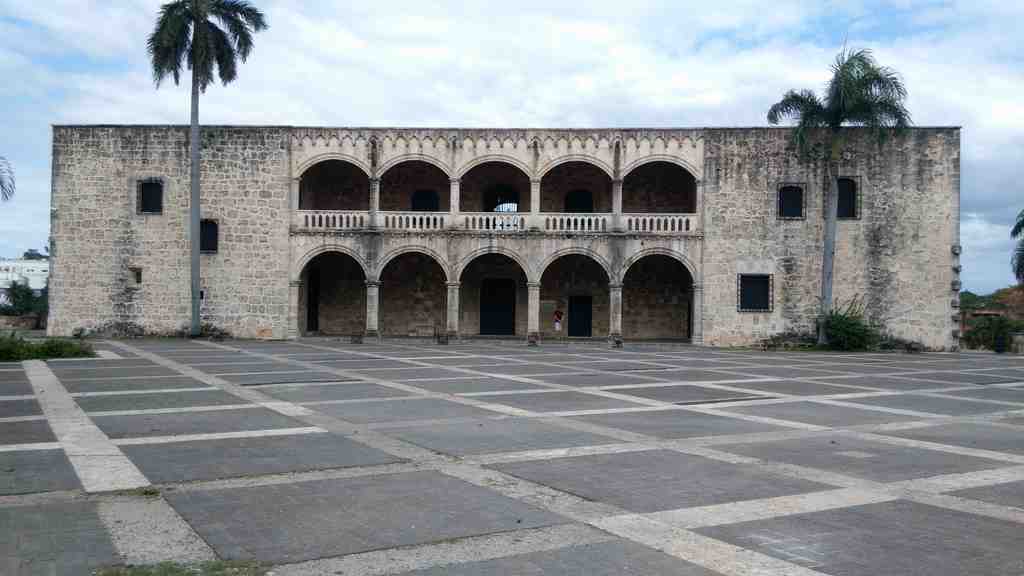
To spot the Alcázar de Colón, look ahead for a massive, two-story stone palace with a row of grand arches on both the ground and upper floors, flanked by tall palm trees and rising proudly at the edge of a wide, open plaza.
Welcome to the legendary Alcázar de Colón! Standing right here, you’re gazing up at the very first fortified European palace in the Americas - and if it seems majestic, well, just imagine it centuries ago with the clatter of horses’ hooves and the bustle of noble life all around. Picture the building when it was new, glittering under the Caribbean sun, built of pale coral blocks hauled up from the shore and stacked to create Gothic arches, airy Renaissance balconies, and a home fit for colonial royalty. This palace was shaped by centuries of drama, adventure, and, yes, the occasional pirate invasion.
Now, why is it called the Alcázar de Colón? Because it was the family home of Diego Columbus, son of Christopher Columbus, making this the only known residence of the Columbus family in the New World. Diego moved in with his wife, María Álvarez de Toledo, and their children-Juana, Isabel, Luis, and Cristóbal-lived and grew up right behind these walls. So next time you argue over room assignments at home, just remember: they started it here!
Construction started back in 1511, on a plot of land granted by King Ferdinand II of Aragon, and by 1514, it was ready to host governors, visiting conquistadors, and maybe a few ghostly secrets. The design was inspired by a Spanish mansion in Salamanca; rumor has it, if you squint hard enough, you might see the resemblance-but careful, don’t trip on the cobblestones!
This palace was once the political heart of the Spanish colony: Columbus himself was governor and viceroy, and his house was the base for major expeditions. Famous conquistadors, like Hernán Cortés and Pedro de Alvarado, strutted through here, plotting the next chapters of adventure-or mischief, depending on who you ask.
But with great palaces come even greater trouble! In 1586, British pirate Sir Francis Drake stormed into Santo Domingo. Picture the noise as men rushed about, treasures jangling, and pirates laughing as they plundered everything not nailed down. The palace never quite recovered from Drake’s visit… Well, wouldn’t you need some rest after a pirate attack?
Three generations of the Columbus family called this place home, with María Álvarez de Toledo holding on until her death in 1549. By the late 1500s, the family’s influence (and maybe their dinner parties) faded, and the mansion slowly crumbled. By the mid-1700s, the grand home had become ruins, almost turned into a prison-imagine prisoners wandering where noble children once played! By 1776, only half of the original 55 rooms survived.
Luckily, in 1870, the Dominican government decided, “Hey, let’s not turn this into a jail,” declaring it a National Monument. Nearly two centuries later, in the 1950s, the palace finally got a top-to-bottom makeover. Now, it’s a captivating museum with 22 rooms, each filled with centuries-old furniture, art, and a tapestry collection so rare it would make a king jealous. Some of these stunning tapestries were woven by the legendary Flemish Van Den Hecke family from patterns drawn by Charles Le Brun-no small feat!
The Alcázar you see now is only about half its original glorious size. Still, these coralline stone walls have seen more history, laughter, and chaos than most places in the Caribbean. If only these stones could talk, they’d have stories even funnier than mine-and that’s saying something! Don’t forget: your footsteps are echoing where explorers, pirates, nobles, and dreamers once lived the stories we can only imagine today.




