
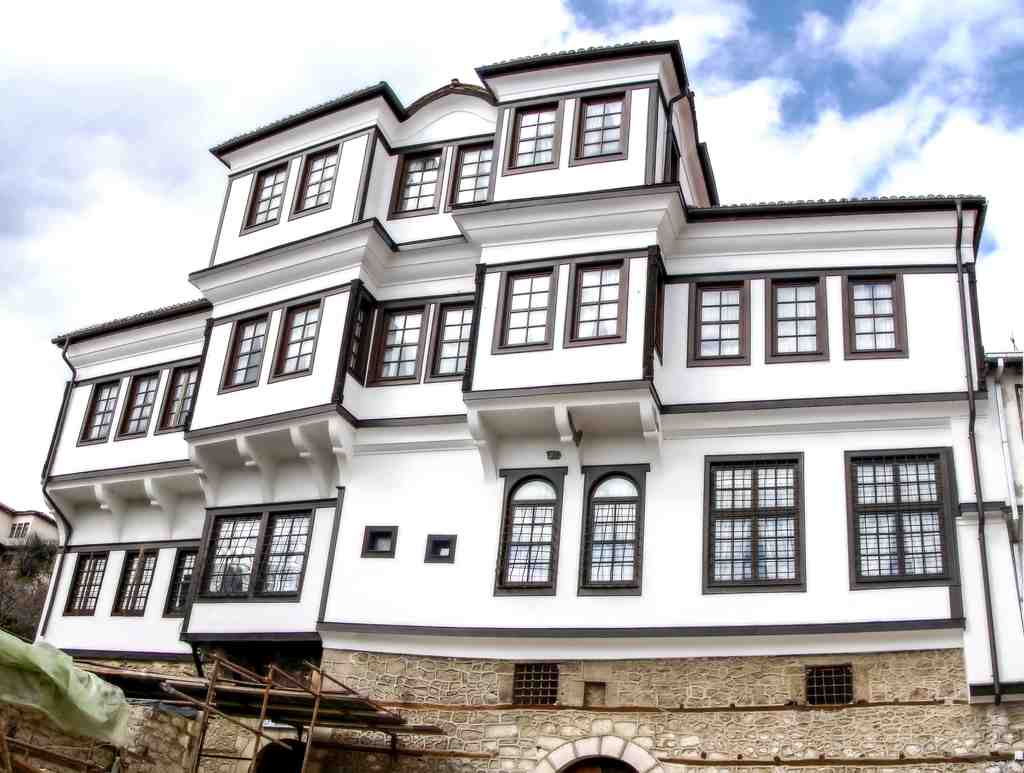
Look right in front of you at that striking building rising from a solid stone base into a bright white facade, defined by its dark, grid-patterned wooden windows and jutting, multi-tiered upper floors.
The Robev brothers, Angele and Anastas, were titans of trade whose vast merchant empire stretched all the way from Istanbul to Vienna and Leipzig. Their incredible wealth allowed them to build a magnificent family mansion right here in 1827.
But when you have that much money, people notice. Actually, it wasn't a laughing matter for them. In January 1861, a notorious regional criminal named Dzeladin Bey, often recorded in history as Husref-Bey, targeted their opulent home. He intentionally set the property ablaze, a devastating act that burned the original structure straight to the ground.
But this city has a habit of surviving its scars. Instead of being defeated by the ashes, the family brought in master builder Todor Petkov between 1863 and 1864 to reconstruct an even grander mansion. They built their legacy back from the ground up, turning a devastating loss into the ultimate architectural status symbol. It stands today as a profound testament to how culture and heritage can weather the storms of destruction.
The new place was designed as a twin-brotherly mansion, split right down the middle. Dr. Konstantin lived in the left wing, while Anastas's kids took the right. To make sure both sides were spectacular, the family sparked a bizarre artistic rivalry. Petkov's team worked on the left, while a separate group of master carvers from Debar took the right. The catch... they were strictly forbidden from seeing each other's work. Because of this blind competition, the intricately carved ceilings and built-in cupboards in the left wing have a completely different ornamental style than those in the right. The upper quarters still feature a shirvan, which is a traditional enclosed wooden balcony typical of Ottoman-era Ohrid, where the family proudly entertained their guests.
But the drama did not end there. Decades later, occupying soldiers completely stripped the left wing of its irreplaceable woodcarved elements. Family member Angele Robev fiercely protested the looting, but his official complaints were entirely ignored. The stolen masterpieces were reportedly carted off to the city of Niš in Serbia and vanished without a trace.
Eventually, the house transitioned from a private residence to a public museum, officially nationalized by the state in 1953. It now holds incredible archaeological treasures. Take a glance at your app to see one of its most famous pieces. That is a fragmented torso of the goddess Isis from the second century BC, an artifact so significant it is actually printed on the Macedonian ten-denar bank note.
As you walk to our next stop, think about what else might be buried beneath our feet, as we dive deeper into the older, more mysterious layers of this ancient city. We are heading just a two-minute walk away to the Church of St. Nicholas Virgin Mary Chelnitsa. Oh, and if you want to explore the inside of the Robevi House yourself, it is open Tuesday through Sunday from nine in the morning until three in the afternoon.




