
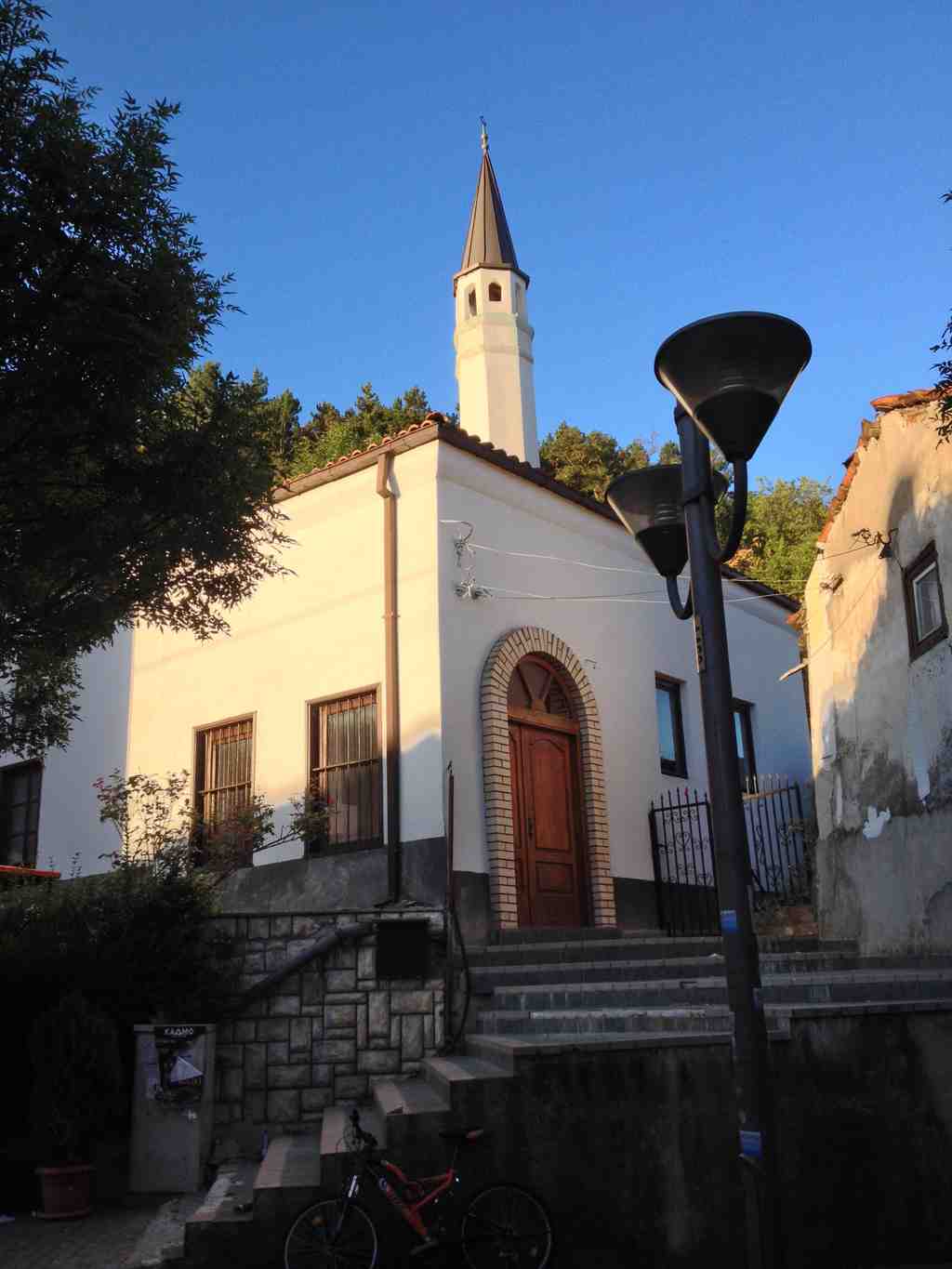
Just up the hill on your left is a simple, square white building perched above a stone retaining wall, marked by an arched brick doorway and a slender, white minaret with a dark, pointed roof. You are looking at the Haji Hamza Mosque.
This spot rests right on the northeast slope of Deboj Hill, a commanding natural rise that has anchored the physical and cultural landscape of the city for centuries. Sitting securely here at the start of the old bazaar, this building has worn a few different hats over the years. Back in the sixteenth century, it began its life as both a mosque and a madrasa, which is a traditional Islamic school for scholars. But as the generations rolled by, the space evolved into a tekke. When that transition happened, they built the minaret you see today, along with a tomb and a courtyard fountain.
If you look closely at that minaret, you might notice an architectural quirk. Almost all Ottoman minarets feature a classic wrap-around balcony, where the muezzin steps outside to sing the daily calls to prayer. But not this one. It rises from a square base, shifts into an octagonal body, and closes off completely at the top like a little watchtower. Because of this, the muezzin never stepped out onto a ledge. He just sang his vibrant calls directly through those narrow upper windows.
This place also holds a rather baffling modern mystery. In 1972, a visiting historian documented a precious marble plaque kept safely inside the prayer hall, carved with the original name of the madrasa. But somewhere along the line during later twentieth-century renovations, that heavy stone slab completely vanished. To this day, nobody knows who walked off with it or where it ended up.
Despite losing literal pieces of its past, the mosque itself held its ground. When the Balkan Wars swept through, many Ottoman buildings crumbled, but Haji Hamza dug its foundations into the hillside and quietly survived the shifting tides of power, eventually reopening fully restored in 2018.
Let us keep heading up the slope of this ancient hill, where we are going to find a structure built entirely from a local leader's grief, as we make our way toward the Clock Tower, just a nine-minute walk from here.




