
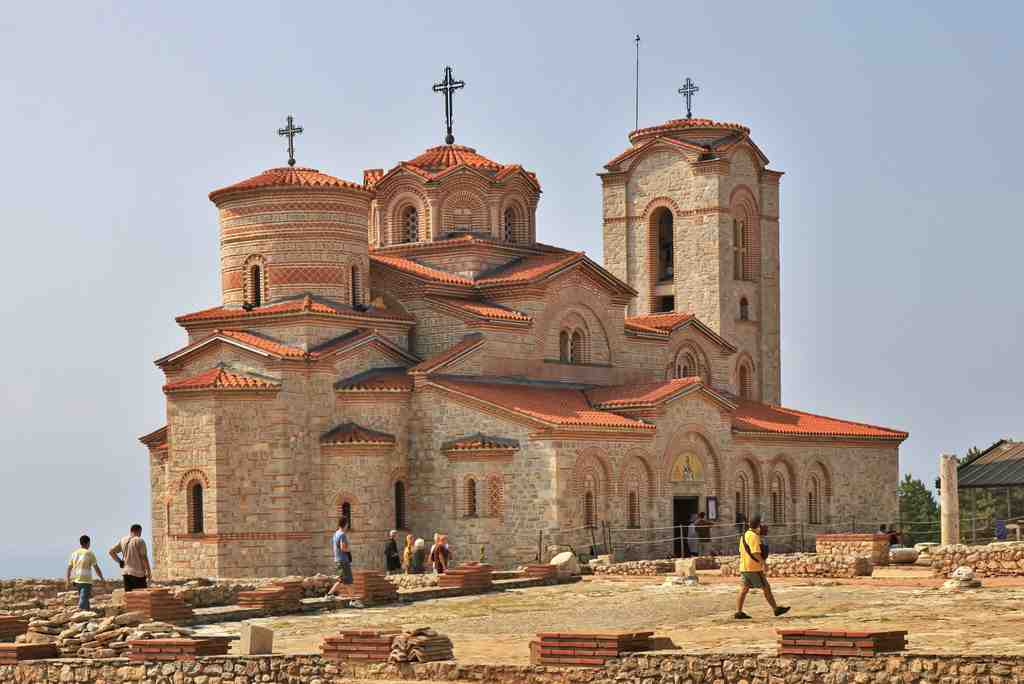
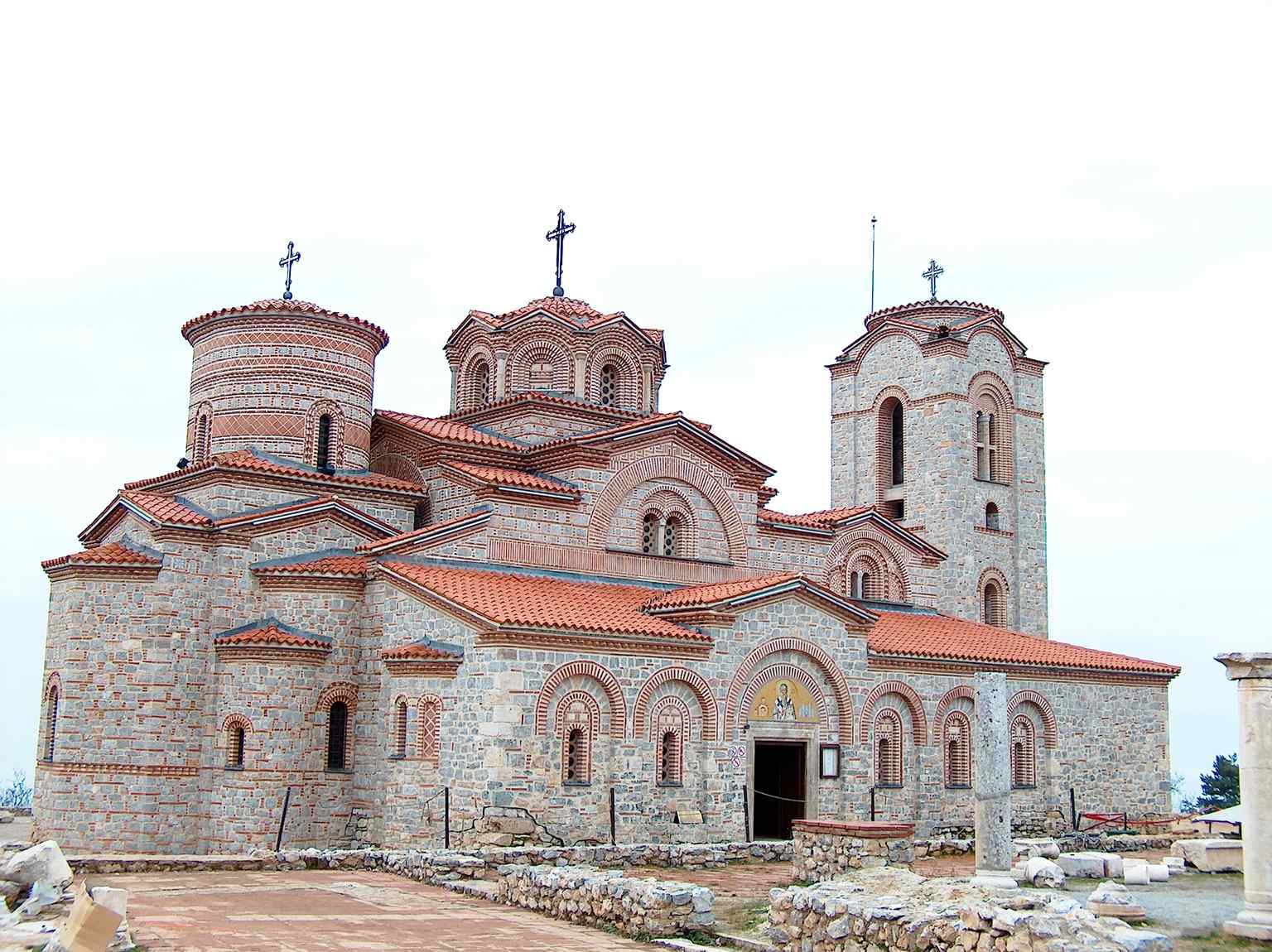
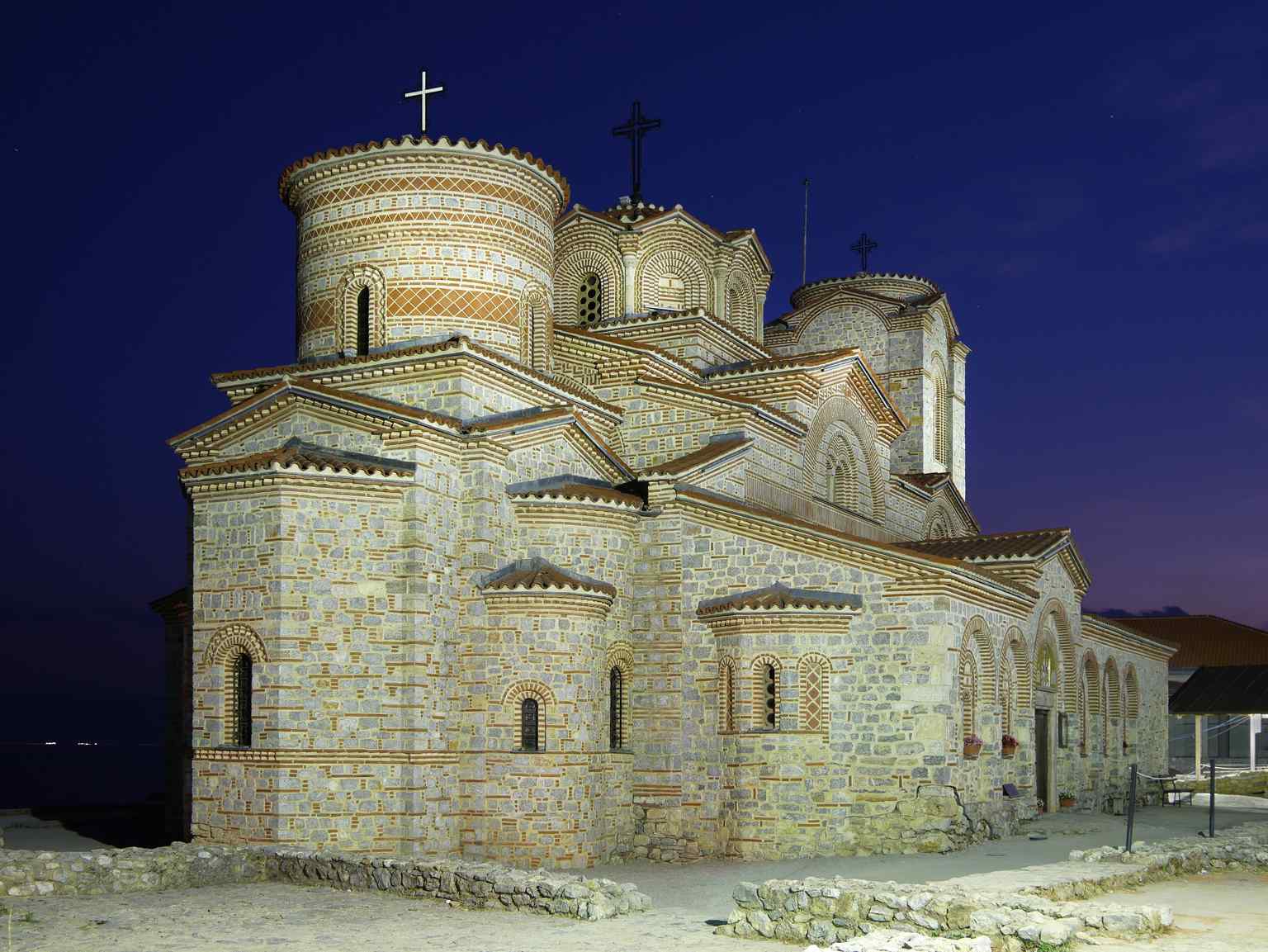
To your right stands a striking structure of pale stone and banded red brick, shaped by multiple terracotta-tiled domes and anchored by a tall arched bell tower.
That is the Church of Saints Clement and Panteleimon. Now, to really understand the soul of this place, we have to talk about Saint Clement of Ohrid. He arrived way back in the ninth century and basically turned this very hill into a massive literary school, teaching his students the Glagolitic alphabet, an early script that was used to translate the Bible into Old Church Slavonic.
When Clement passed away in nine sixteen, he was laid to rest right here, in a tomb he had actually built with his own two hands. And he rested peacefully for hundreds of years. But then came the shift to Ottoman rule. By the fifteenth century, the Ottoman Empire swept in and took over the site.
You can imagine the absolute panic of the local Christian community. Their spiritual father, the patron saint of their city, was in danger of being lost. In a desperate, frantic scramble in the dark, they broke into the tomb, gathered his relics... his holy physical remains... and smuggled them across town in secret. They hid him inside the Church of the Holy Virgin Peribleptos, where he stayed safely sheltered for centuries.
While Clement was away, his original church was turned into a mosque, and later replaced by the Imaret Mosque. If you check your screen, you can see the preserved foundation outlines of that former Islamic structure, which remain today as a permanent physical testimony to its Ottoman past. The site functioned as a soup kitchen for the poor for a long time. It was not until the nineteen forties, right in the looming shadow of World War Two, that an archaeologist dug into the ruined walls of the mosque and astonishingly uncovered the lost foundations of Clement's original Slavic church, including his empty burial crypt.
Fast forward to the year two thousand, and a massive project began to completely rebuild the church by hand using original materials. And then, on August eleventh, two thousand two, something beautiful happened.
After more than five hundred years in hiding, Saint Clement finally made the journey home. In a grand procession, his remains were carried back up this hill. If you look at your screen, you can see his tomb inside the newly rebuilt church, where his relics are now encased in glass directly over the original framework he built himself.
It is an incredible full circle of survival. You can step inside to see the tomb yourself any day of the week from eight in the morning to seven in the evening. Now, let us leave the Middle Ages behind and dig even deeper into the ancient past as we head to our final stop, Karađulevci, which is just a six-minute walk away.






.jpg)