AudaTours logoAudaTours

Eindhoven Audio Tour: Monks, Masters & Modern Marvels

Audio guide13 stops

A secret tunnel once ran beneath Eindhoven’s streets, echoing with whispered plans and midnight escapes. In a city shaped by silent rebellions and bold artists, every step hides a story waiting to be uncovered. This self-guided audio tour leads you off the obvious path, revealing the poetic, the scandalous and the ingenious sides of Eindhoven most never see. Who once tried to steal power from deep inside Eindhoven Castle’s walls, and what vanished without trace during a stormy night at Monastery Mariënhage? Which artwork in the Van Abbemuseum drove visitors to outrage—and why is a single window always kept open in the old quarter, no matter the weather? Wander through centuries of secrets. Graffiti hides beneath stained glass. Concrete and canvas share uneasy truths. Peek behind façades and let Eindhoven remake itself under your feet. Ready to dig beneath the city’s surface? Your journey into hidden Eindhoven begins now.

Tour preview

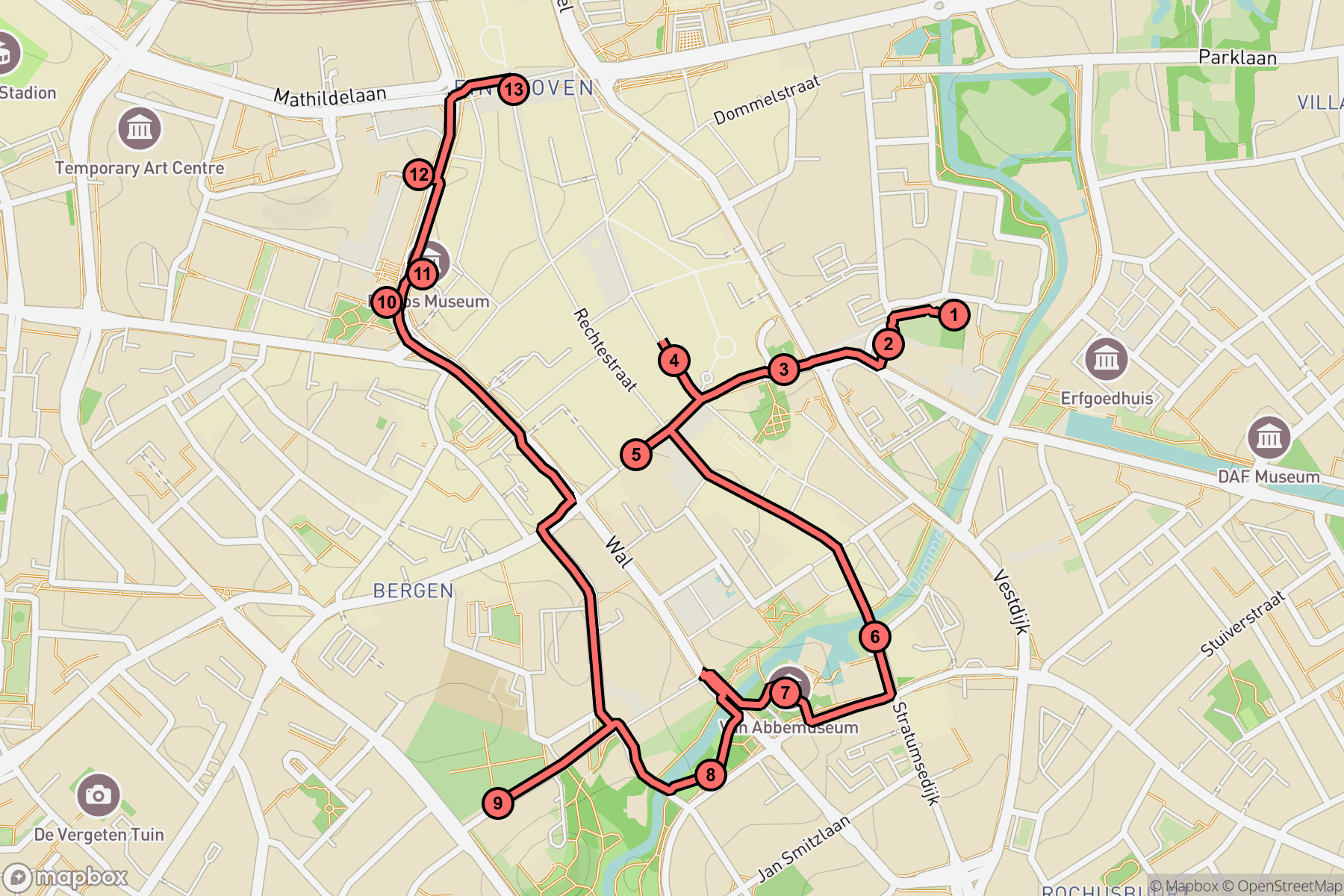
map

About this tour

  • schedule
    Duration 90–110 minsGo at your own pace
  • straighten
    3.4 km walking routeFollow the guided path
  • location_on
  • wifi_off
    Works offlineDownload once, use anywhere
  • all_inclusive
    Lifetime accessReplay anytime, forever
  • location_on
    Starts at 18 September Square

Stops on this tour

lock_open 3 free previews · 10 unlock with purchase

  1. Imagine, if you will, the year is 1944, and the atmosphere is thick with tension. The city of Eindhoven is caught up in Operation Market Garden, anxious and waiting, when…Read moreShow less

    Imagine, if you will, the year is 1944, and the atmosphere is thick with tension. The city of Eindhoven is caught up in Operation Market Garden, anxious and waiting, when liberation finally comes on the 18th of September. That day became so important to the city that when it was time to name this new square years later, there was only one fitting choice: 18 Septemberplein. Quite the upgrade from its days as a mere “Parallelweg”! But let’s go even further back. In the late 1800s, right where you stand now, a railroad was laid, brute and noisy, slicing Eindhoven in two. An old air bridge allowed brave pedestrians to cross, but everyone else had to wait for the endless parade of trains rumbling by. For decades, that railway was more frustrating than waiting for your online shopping delivery in the 1990s. Then came the devastation of World War II, including the 1942 “Sinterklaas bombing” by the RAF, which destroyed a large chunk of northern Eindhoven. From this tragedy, hope and new plans were born. Architect J.A. van der Laan came up with a grand reconstruction plan, moving the railway a hundred meters north towards Woensel. By 1953, after years of work, the new elevated tracks allowed the city to reclaim this space. Imagine tunnels cut into the earth where once a wooden bridge and a proud gate-known as the Woenselse Poort-kept travelers in check. Today, bits of that old town gate are actually displayed downstairs in the city’s unique Tube bicycle parking. So, don't be surprised if you park your bike on ancient history next time you visit! As the 1950s rolled into the 1960s, this square was supposed to be the Demerplein, a grand plaza lined with bold new buildings. In 1952, the C&A building opened here, soon joined by a furniture store where-plot twist-McDonald’s now resides. By 1969, the stunning De Bijenkorf department store was unveiled, designed by Giò Ponti, a real Italian superstar of architecture. I guess you could say Eindhoven was getting a little bit of Milan right here in the Lowlands. Life wasn’t always glamorous, though. Through the ‘70s and ‘80s, city planners tried all sorts of tricks to make this square lively and safe from swarming traffic. Restaurants, honeycomb-shaped tiny shops, and kiosks popped up like mushrooms, trying to lure people in. Still, cars and buses zoomed by, honking and rumbling, barely noticing the hungry poffertjes stands or the misplaced dance floor. There was even a wild idea for an underground shopping mall-let’s just say that one didn’t quite make it out of the planning stage. As time rolled into the new millennium, out went the roundabout, in came the bold new look by architect Massimiliano Fuksas in 2009. Now, drink in the views: swanky paving stones underfoot, waves and bubbles in the fountains, entrance tubes poking out of the earth like futuristic worms, and a light show that could make a disco jealous. You’ll spot the Blob’s shiny glass bubble and the Witte Dame’s white curves nearby, while the Piazza shopping center calls you in for a visit. If you’re here on a Tuesday, watch the market come alive-cheese mongers, bakers, and chatter everywhere. And next time you walk down Emmasingel, look out for The Blob and The Bubble-Eindhoven’s way of reminding you that the past and future are always holding hands on this square. Alright, explorer! Ready for the next chapter? Onward to the Monastery Mariënhage-follow me!

    Open dedicated page →
  2. location_on
    2
    Right in front of you stands the mighty Lichttoren - the Light Tower - with its striking seven-sided, white façade. It's the kind of building you’d expect to house superhero…Read moreShow less

    Right in front of you stands the mighty Lichttoren - the Light Tower - with its striking seven-sided, white façade. It's the kind of building you’d expect to house superhero headquarters, but in Eindhoven, the real heroes were the lightbulbs! Designed in a bold, functionalist style with some expressive twists by architects at TABROS, this tower started shining back in 1909 when the west wing was built, and by 1911, it was bustling with the hum of the Philips Lighting Factory. Imagine walking by at night a century ago: the top floor would be alive with lamp endurance tests, their glowing bulbs casting an otherworldly light visible for miles around. No wonder locals nicknamed it the ‘Lichttoren’-it was impossible to miss! Later, it transformed from a factory floor into the headquarters of Philips’ lighting division. It even got its own secret agent jargon-ED for the east, EC for the west. These days, instead of engineers and inventors, you’ll find residents, creative offices, and some of Eindhoven’s favorite café-restaurants on the ground floor. Since 2009, the tower has a high-tech look: super-efficient LED lighting keeps it glowing with modern flair. Right next door, its bright neighbor: the sleek Witte Dame. So yes, the Light Tower always finds a way to shine!

    Open dedicated page →
  3. Witte Dame
    3
    As you stand outside this striking white giant, let your imagination leap back to the late 1920s. Picture workers in overalls hustling in and out of a shiny new factory, the air…Read moreShow less

    As you stand outside this striking white giant, let your imagination leap back to the late 1920s. Picture workers in overalls hustling in and out of a shiny new factory, the air buzzing with excitement and the scent of industry. This, my friend, is the Witte Dame-the “White Lady” of Eindhoven. But don’t let her name fool you! She didn’t always dress in white. Built between 1928 and 1931, she started as a cluster of Philips buildings, known only by mysterious codes: EE, EF, and EH. Originally designed to produce radio tubes, she was just part of a high-tech neighborhood that included the famous Lichttoren and the very first Philips lightbulb factory. For decades, machines whirred night and day here, until one day in the 1980s, silence fell. Philips moved the action elsewhere and wanted to demolish the building. But here's where the tale gets dramatic-a band of local heroes, led by artist Bert Hermens, said, "Not on our watch!" They fought to save the building, even giving it its new name: the Witte Dame. Bert must have really loved this place! Redesigned in the 1990s, the building reopened in 1998, now gleaming white since 1953, and became a creative hub. Today, it hosts everything from the Design Academy to bookstores and coffee shops. Who says an old factory can’t have a glamorous second act?

    Open dedicated page →
Show 10 more stopsShow fewer stopsexpand_moreexpand_less
  1. Now, picture a chilly morning in 1891. The air inside is thick with the smell of heated glass and singed cotton as workers carefully assemble carbon filament bulbs. For Eindhoven,…Read moreShow less

    Now, picture a chilly morning in 1891. The air inside is thick with the smell of heated glass and singed cotton as workers carefully assemble carbon filament bulbs. For Eindhoven, these were times of transformation. The Philips brothers-engineer Gerard and savvy businessman Anton-were true lighting rebels! They set out to improve how people lived, learned, and even got lost in the middle of the night. Fast forward to 1951, and this place becomes a ‘light demonstration centre,’ with a temporary reconstruction of that original 1891 lamp-making workshop. You can almost imagine visitors gasping as they watched experts pull glowing filaments from purified cotton and create these magical, reliable lights. In 1975, the old factory underwent major renovations to modernize its demonstration laboratory. A decade and a few moves later, parts of the building would shift focus again, welcoming Philips Company Archives and a gallery for art inspired by light. In 1993, the reconstructed 1891 workshop reopened, showing every dusty detail of how those early lamps were born. By 1997, the doors were thrown open for everyone, and tens of thousands would come to marvel at the amazing progress made in these very rooms. Even the architecture got a fresh look! Eventually, a brand-new, purpose-built Philips Museum opened here in 2013, with Dutch royalty-Queen Beatrix-doing the honors. Inside, you’ll see everything from vintage vacuum cleaners and medical X-ray machines to early radios, TVs, and the famous Philips shavers-proof that innovation doesn’t stop at the light bulb. Don’t miss the legacy of Jan Zwartendijk either, a company man who saved thousands during World War II. So, whether you’re here for the gadgets, the glowing lamps, or just hoping to get a ‘bright idea’ for your next project, this museum is where it all began.

    Open dedicated page →
  2. Fast forward to 1992. German architect Walter Brune unveiled his grand creation: a three-floor, glass-roofed wonderland with four entrances and over 80 shops, from fashion to food…Read moreShow less

    Fast forward to 1992. German architect Walter Brune unveiled his grand creation: a three-floor, glass-roofed wonderland with four entrances and over 80 shops, from fashion to food to fun. But Heuvel isn’t just for shopping; you’ll find homes, businesses, cafes, and even the Muziekgebouw Frits Philips concert hall and a casino. Not to forget the underground parking and bike paradise-very practical, very Dutch! A glow-up in 2015 gave Heuvel its modern style and eco-boost. In 2017, it was crowned the most sustainable shopping center in the Netherlands. And check out the massive light sculpture by Har Holland at the Catharinaplein entrance-121 glowing, color-changing tubes create a light show that makes everyone look good, even if your shopping bags are empty.

    Open dedicated page →
  3. You’re now standing before the grand Monastery Mariënhage, a place where history is so layered you might expect to trip over a monk or a medieval knight at any moment. Picture…Read moreShow less

    You’re now standing before the grand Monastery Mariënhage, a place where history is so layered you might expect to trip over a monk or a medieval knight at any moment. Picture this: centuries ago, this was the site of Kasteel Ten Hage, a real-life “motte” castle, which isn’t, sadly, named after a motley crew, but after the mound it stood on. Imagine a rectangular donjon, surrounded by a moat and the gentle swishing of the Dommel river. This spot belonged to the Lords of Cranendonck and Eindhoven, and from around 1100 to the early 1400s, was a noble residence. Then, in 1419, a big shift happened. Jan van Schoonvorst, after constructing a brand new (and possibly less drafty) castle elsewhere, decided to donate his old castle and grounds here to a group of Augustinian canons. All prompted by his wife, Johanna de Rochefort - proof that couples have always had joint decision-making, especially when castles are involved. On April 2nd, 1420, the Augustinian canons founded a monastery. The first handful of monks with ambitious names like Godefridus Wijnants and Wouter Willemsz moved in. The early monastery clung to the rules of Saint Augustine, with a local twist of Brabantish devotion. They even set up their own library, which - fun fact - became the richest monastic library of the Netherlands by 1487. Word on the street is monks here knew how to throw a book party. During the Reformation calamities of the 16th century, the monastery had its fair share of drama: suspicions of “new ideas”, monks dragged off to Leuven for religious interrogation, and plenty of turmoil. Then, in 1566, came the “Beeldenstorm”, the great iconoclasm. Statues toppled, relics smashed, turmoil all around. It must have sounded like chaos - so here’s a taste: But the monks’ troubles didn’t end there. In 1581, as the Eighty Years’ War raged, State troops torched the monastery and hauled off around twenty monks. To get their freedom, the monks literally ransomed themselves using valuables they had hidden from the flames! After their escape, their buildings were left battered, especially after further shelling in 1583, which hit the east wing hard. Renovation followed in the 1600s, and even Spanish troops found temporary lodging in the monastery when Eindhoven’s main castle was falling apart - imagine trying to pray with a hundred grumpy soldiers as roommates. By the late 17th century, monastic life here faded until finally just three monks remained and, in classic “you don’t have to go home, but you can’t stay here” style, the buildings were seized. The next few centuries saw the cloister repurposed endlessly: as a stately home, a cotton-printing factory, a residence for town officials, even a granary during times of war. By the late 19th century, Augustinian friars reclaimed the site, built a new church, and founded a school: the Gymnasium Augustinianum, whose student chapel showcases stunning expressionist brickwork - probably the hippest you’ll find this side of heaven. The place survived the ravages of war, industry, and changing times. In the 20th century, it even hosted a drama academy and a respected scholarly library. Today, after many transformations, the cloister complex is called DOMUSDELA, lovingly restored and reimagined as a place for ceremonies, meetings, and events, open to all walks of life. Part of it is now a hotel - those monks would hardly recognize the room service! Many religious trappings were gently retired to make it a welcoming space for everyone. As you look around, remember: under your feet and all around you, layers of history swirl. Streets nearby bear the names of those connected to these very halls: Johanna de Rochefort, Aert Roelofs, Nicolaas Clopper… Monks, counts, soldiers, schoolkids - all left their mark. And somewhere in the ether, maybe, a medieval monk is wondering why no one brews their own beer here anymore. Now, that’s an afterlife mystery worth pondering!

    Open dedicated page →
  4. You’re now standing right outside the grand Augustijnenkerk, also known as the Paterskerk or the Roman Catholic Sacred Heart Church. Here, on Tramstraat 37, you’re at the heart of…Read moreShow less

    You’re now standing right outside the grand Augustijnenkerk, also known as the Paterskerk or the Roman Catholic Sacred Heart Church. Here, on Tramstraat 37, you’re at the heart of a story that’s been part of Eindhoven’s life since the late 19th century-a place that’s seen soaring hopes, tough negotiations, wartime scares, musical marvels, and fiery calamities. Don’t let its serious neogothic face fool you-this church has seen more drama than a soap opera marathon! Let’s start by taking in the sight. Picture, if you will, the three-aisled cross-shaped church built with deep brown-red bricks and bands of yellow stone. Now, tilt your head back to admire the striking six-sided tower, rising a dizzying 66 meters into the Eindhoven sky. Someone once called it “the rocket of Tramstraat!” And would you look at that enormous statue on the spire? Meet “Jezus Waaghals,” or Daredevil Jesus-a four-meter-tall, 800-kilo creation of wood and copper by Jean Geelen. Jesus stands with his arms open wide, as if he’s either inviting all of Eindhoven in for a hug or trying to catch a football someone’s kicked way too high. Either way, in his earlier, golden years, the eyes of the city-and even some protest letters in the paper-were drawn to him. Now, think back to the 1890s. The Augustinian monks of Mariënhage monastery next door were new arrivals and didn’t have more than a temporary church-a spiritual tent, if you will. So, they embarked on building this impressive church. Original plans were much too expensive. It took three attempts to design something everyone liked (or at least could afford) and negotiation battles over the ground it would stand on. At one tense point, they had to swap land plots with the city council to make it work. And the ground was so marshy, the church ended up standing on 1,400 piles. Just imagine the sound! The official cornerstone was laid on a May morning in 1897, but misfortune struck: the head builder passed away, slowing everything down. Still, by 1898 the church came to life with its first procession and mass, even before the paint was dry-or the pigeons could claim it as their own. The statue, by the way, was so controversial, the local paper had a field day debating whether it was a beacon or an eyesore. As with all good drama, it stayed. Step closer for some extra detail: above the church door, you’ll see three saints keeping watch-Augustine, his devoted mother Monica, and Nicholas of Tolentino. Inside, colorful stained glass windows by Daan Wildschut and Charles Eyck pour light across an interior of bare brickwork and neogothic woodwork, sourced in part from artisan Jan Custers. In its heyday, you might find the church full for baptisms, weddings, or those famous 4 a.m. “fishermen’s masses”-where early risers and late-night partygoers swapped stories and yawns. Years rolled by. Sometimes there were crowds, sometimes-especially by the late ‘60s-only an echo and a passing mouse for the 8 a.m. mass. The Second World War brought bomb blasts that shattered windows and forced the church to use a factory kettle instead of bells. The Daredevil Jesus was camouflaged, so enemy pilots couldn’t use him for directions. Decades later, they even found bullet holes from the events of 1944. Let’s not forget the moments of trouble and recovery: there were several fires-most memorably in 1959 and 1974, one in the chapel to St. Rita of Cascia. Luckily, neither felled the church for long, but soot and smoke meant some Sunday services became outdoors events. And the organ! For 40 years, Dorthy de Rooij reigned over it, with composer Mathieu Dijker bringing music that premiered right here, creating lasting memories. Eventually, shrinking congregations and the monks’ advancing years spelled the end of regular worship. After years of uncertainty and the odd TV broadcast, the Paters finally stopped services in 2016. In classic Dutch style, the building adapted rather than disappeared: now restored as part of DOMUSDELA, it hosts ceremonies, meetings, and even joyful events. So, next time you step inside-or even just glance up at that dramatic spire-remember: this church has survived storms, war, smoke, and more. It might no longer ring every Sunday, but its story is far from silent!

    Open dedicated page →
  5. Now, Eindhoven actually had two castles. The earlier one, Ten Hage, stood outside town. But after the city got permission to build proper walls in 1389, excitement grew. Why not a…Read moreShow less

    Now, Eindhoven actually had two castles. The earlier one, Ten Hage, stood outside town. But after the city got permission to build proper walls in 1389, excitement grew. Why not a brand-new castle, plonked in the city itself? Something fit not just for a noble, but as part of the muscle keeping the city safe. Building started around the early 1400s-even then, municipalities liked to keep building projects hush-hush until the paperwork came through, it seems! As lordship passed from one grand family to the next-Willem van Milberg, Jan van Schoonvorst, then the storied Van Horne family-the castle became a political chess piece. In 1420, Ten Hage was given to monks and became the Mariënhage Monastery, so the new castle was definitely already serving its purpose inside the city’s walls. It wasn’t exactly a cozy home-more like a badge of power and a place for welcoming VIPs. Floris van Egmont, for example, often hosted all the biggest names of the day. His successor, Maximiliaan, even had a “joyous entry” in 1541. Royalty strolled these halls, but probably preferred their other, more comfortable properties-perhaps even somewhere with central heating! Did you know Eindhoven Castle even had a connection to William of Orange? Yep, his wife, Anna van Egmont, inherited it. William of Orange, maybe not so focused on interiors, was here in 1563 for a dramatic meeting with other famous rebels, Lamoraal van Egmont and Filips van Montmorency. Spoiler: some of them were later executed for standing up to the Spanish king. Politics in the 16th century was a real-life Game of Thrones-just with more doublets and less dragons. Now, get ready for some drama. The Eighty Years’ War turned life here upside down. Picture Spanish cavalry barracked in the castle. Rebels and royalists swapped the castle like kids trading toys-sometimes through force, sometimes through deceit, occasionally with an accidental siege or two. The castle became a prison for people who really, really didn't want to be there, and was repeatedly pillaged, burned, and rebuilt. In 1581, there was so much looting that over 600 people died in the chaos. In the midst of this, furniture was smashed, gold taken, even the rent collector’s desk was raided-tax season was brutal. As years wore on, war left its scars: collapsing towers, crumbling walls, and more soldiers using it as a stopover than any princess wearing a dress. By the late 1600s, most of the castle was demolished-out with a bang, not a whimper. By the 18th century, there wasn’t a castle to see, just a pasture called “Casteelsveld,” awaiting someone’s sheep…or maybe the world’s slowest joust. Yet the land was never truly empty. In the 1800s, a stately home called Villa Ravensdonck popped up here. It saw action as a farmhouse, tobacco factory, and finally a restaurant. If only those medieval lords could see today’s menu: less black bread, more fine wine! Fast-forward to recent decades, and archaeologists got curious. With every new construction site and ditch dug, out came fascinating relics-charred pottery, jewelry, game pieces, and even old bones-traces of the castle’s busy life and violent ends. In 2019, a chunk of the old wall was rebuilt at the corner of Vestdijk and Ten Hagestraat, its whimsical water well and little bench marking the spot for curious explorers like you. So, while treasure chests or knights in shining armor might not leap out at you, beneath your stride and all around, stories linger-a castle of conquest, intrigue, crumbling stones, and some grand feasts. Who knows, maybe the only thing never taken by invaders was the kitchen’s secret recipe for pea soup!

    Open dedicated page →
  6. As you stand here, let’s take a moment to soak in the stunning sight of St. Catherine’s Church. Its two grand towers rise like sentinels above Catharinaplein, and if you listen…Read moreShow less

    As you stand here, let’s take a moment to soak in the stunning sight of St. Catherine’s Church. Its two grand towers rise like sentinels above Catharinaplein, and if you listen carefully on a quiet day, you might just hear the deep hum of church bells and the murmur of centuries past. But don’t worry-you don’t need to confess anything just yet! Our story begins all the way back before Eindhoven was even a glint in a city planner’s eye. The original church on this spot dates back to the 13th century, built from humble bricks when the town was new, and the only real “rush hour” was a flock of geese crossing the street. In 1340, it’s first mentioned as 'sancta Katarina,' and she wasn’t just any church-she was a daughter of the mighty St. Peter’s Church in Woensel. Over time, St. Catherine’s became the heart of a bustling parish and a destination for passionate pilgrims drawn by a miraculous image of Our Lady. But this church has truly seen life’s drama. It was set ablaze by invaders from Gelre in 1486. If that wasn’t dramatic enough, the tower itself blew down in a storm in 1526-clearly, Eindhoven’s early weather was not ideal for medieval architecture. Then there were more attacks, a citywide fire, and even an icon-smashing riot in 1566, when a crowd destroyed the beloved statue. Like a hero in a soap opera, the church was constantly battered but never beaten. After the Peace of Münster in 1648, the Protestants took over the building and St. Catherine’s became a Protestant church-talk about a surprise plot twist! In the late 1700s, the church became a judge’s courtroom, then a horse stable, a bakery, a home, and finally a military warehouse. Imagine horses mixing with hymnals and loaves of bread in the very place where you’re now standing. Eventually, in 1798, the building made its way back to the Catholics and was re-consecrated in 1810. But it was still too small for the city’s growing flock, so the old church was torn down. In its place arose the neo-Gothic marvel you see today, designed by Pierre Cuypers-a man who loved spires almost as much as the Dutch love bicycles. Completed in 1867, the new St. Catherine’s Church boasts 73-meter-tall towers-one “male” (the David tower) and one “female” (the Mary tower), inspired by the chart-topping hit makers of the French Gothic world, like the Cathedral of Chartres. If you spot all the rose windows, you’ll see nods to Saint Catherine’s famous wheel. Take a wild guess which way the choir is facing-not east, but west! Cuypers wasn’t afraid to break a few rules, but don’t tell the purists. But time hasn’t always been kind to St. Catherine’s. She was badly damaged by bombings in World War II and needed a lot of patching up. Today, her stained-glass windows-crafted after the war-glow with artistry from Charles Eyck and Pieter Wiegersma. It’s now a protected monument, resting here with a dignity that took centuries to earn. Here’s a mysterious twist: during excavations in 2003, hundreds of skeletons were uncovered beneath this very square, silent witnesses to centuries past. One of them, Marcus van Eindhoven, was reconstructed-his face seen by modern eyes for the first time in ages. Creepy? Maybe. Fascinating? Absolutely! Before you continue, don’t miss the sound of the carillon-gifted by Philips employees, it once rang out over the city. Or, if you slip inside, listen for the mighty organ’s 5,723 pipes-the biggest in town. Talk about making a joyful noise. Shall we keep walking and see what other surprises Eindhoven has in store? Interested in knowing more about the design, restoration or the carillon

    Open dedicated page →
  7. Right in front of where you’re standing, swirling days of drama and invention, the Stratum Watermill once churned the waters of the Dommel. Imagine a scene back in 1340: a wooden…Read moreShow less

    Right in front of where you’re standing, swirling days of drama and invention, the Stratum Watermill once churned the waters of the Dommel. Imagine a scene back in 1340: a wooden mill creaking as the river spins its wheel, townspeople with sacks of grain lined up-like a medieval drive-thru, but the only thing on the menu is, well, flour. By 1442, this was the official grain mill for locals. Not by choice, mind you! If you wanted bread, you had to grind your grain here. Some might call it forced loyalty; the lords of Eindhoven just called it a banmolen. When Filips Willem of Orange was in charge, they nicknamed it the "princenmolen." Royalty: making flour fancy since way back when. Jump to 1812, and suddenly the clatter of spinning looms joins the splashing river. The Smits family, local textile bigwigs, bought the mill and built a bustling little factory. The catch? That factory burned to the ground in 1896-let’s just say, things really heated up. By 1928, the mill and any factory leftovers were torn down, and the millpond filled in. But don’t be fooled-2002 brought archaeologists who dug up the mill’s bones, now displayed nearby in the Van Abbemuseum garden. So the Stratum Watermill may have vanished from the riverbank, but it pops up in the most unexpected places-like a bit of flour dust you just can’t sweep away.

    Open dedicated page →
  8. Now, if your nose tingles, don’t worry-no cigar smoke here anymore, just the spirit of modern creativity. Back at the beginning of the 20th century, Henri van Abbe spent his…Read moreShow less

    Now, if your nose tingles, don’t worry-no cigar smoke here anymore, just the spirit of modern creativity. Back at the beginning of the 20th century, Henri van Abbe spent his fortunes-earned from Karel I cigars and Indonesian tobacco-collecting paintings for his own home. Imagine Henri and his friend Carl Alandt, traipsing around art shows, hunting for treasures by Dutch masters like Jan Sluijters, Lizzy Ansingh, and Carel Willink. When his house was stuffed to the rafters, he decided, “What if the whole city could see what I’ve got?” That’s true generosity-or perhaps an early solution to hoarding! So Henri donated thousands of guilders to build this very museum, even adding extra money just for new paintings. The building was designed by architect A.J. Kropholler in a traditional Dutch style: think brick walls, elegant symmetry, and that classic little tower above the entrance. As you walk up the steps, you might notice two proud stone horses flanking the staircase. Those are by John Rädecker, the same artist who created the sculptures for Amsterdam’s National Monument. And if you think you spot a famous figure out front-well, that’s “Balzac” by Rodin. You’re in good company! Step closer to the glass doors, and imagine splashes of sunlight pouring through high windows onto busy exhibition halls. From the start, Kropholler wanted visitors to leave the noise and buzz of the outside world behind. Once inside, it was all about the art and the stillness... unless a school group was visiting. Speaking of which, there’s a story about an early painting here-a reclining nude by Sluijters. Whenever children arrived, the porter had to whisk it away. “Eyes forward, kids… nothing to see here!” The museum’s collection grew and grew. Today, it holds nearly 3,000 pieces: paintings, sculptures, drawings, installations, and video works. Some of the world’s greatest artists are right at home here, from Picasso and Chagall to Fernand Léger. The Van Abbemuseum owns one of the largest collections of the Russian revolutionary artist El Lissitzky in the world. There’s modern masters-Kandinsky, Mondriaan, and Braque. And there are cutting-edge creators from around the globe, with art that asks big questions about identity, society, and change. By the end of the last century, the original museum was bursting at the seams. Time for an extension! After some tough debates-locals didn’t want the historic face of the museum to disappear-architect Abel Cahen designed the new wing. Finished in 2003, it’s now four times bigger, covered in sleek grey slate, and even includes a tower almost 26 meters high. The new and old buildings blend together, curling around the Dommel river. See the water? On a sunny day, the museum almost glows, casting reflections on the surface-some locals say it looks like a fortress for the imagination. Inside, day and night are part of the experience, thanks to Belgian designer Maarten van Severen’s open, light-filled spaces. The museum is home not only to art, but to stories, research, a bustling café, and a modern library with over 120,000 titles-a real treasure-trove for any curious visitor. Over the years, there have been all kinds of colorful exhibitions, from explorations of Dutch identity and global cultures to playful experiments-like a football table made of clogs. Each event has invited locals and visitors to get involved, ask questions, and see the world from new angles. And don’t miss the neon glow at night, when the Van Abbemuseum becomes a lighthouse for creativity across Eindhoven. So, ready to step inside and discover which masterpiece speaks to you? Or perhaps wonder what, exactly, to make of the wackier installations-don’t worry, you won’t be the first! Remember: in modern art, there are no stupid questions. Only unexpected answers. Ready to delve deeper into the arise, collection or the the building? Join me in the chat section for an enriching discussion.

    Open dedicated page →
  9. Take a moment right here and breathe in. You’re now standing before the Cemetery of St. Catherine’s Church, known locally as the Catharinakerkhof, on Zwembadweg. The iron gate,…Read moreShow less

    Take a moment right here and breathe in. You’re now standing before the Cemetery of St. Catherine’s Church, known locally as the Catharinakerkhof, on Zwembadweg. The iron gate, cool and sturdy, opens into an enclave where time quietly tiptoes between shadows and centuries-no surprise if you get the sense that the air here is thicker with stories than anywhere else in Eindhoven! Imagine the year: 1877. The brand new cemetery, freshly consecrated for the St. Catherine parish, welcomed its first resident just twenty days after it opened. Before that, burials clustered around the old medieval church, but when those demolition plans came knocking and the new, grand neo-Gothic Catharinakerk rose, a change of scenery for the dearly departed was in order. From then on, this field of quiet memories began to collect not only townsfolk but also the proud and storied families of Eindhoven-about 1600 souls laid to rest behind these old walls. Oh, and fun fact: there used to be a moat circling the cemetery until 1916! Now, it’s a wall-much less stressful when you just want to pay a visit. Take a look at the gateway before you-an architectural sandwich of red brick and tradition, built in the 1930s. To the left, the caretaker’s house; on the right, a modest barn. Walk under that round arch with its sturdy ironwork, and look up-there’s St. Catherine herself, keeping watch over who comes and goes. And if you hear a bell, well, don’t be alarmed. It’s probably just the clock tower reminding us time waits for no one! Step in a little farther. The central avenue stretches ahead, lined with monuments that have earned their stripes as national heritage sites. One dramatic stop: the Smits van Oyen family’s gothic chapel, with its red pressed brick, bands of carefully carved stone, and stained glass. The wooden doors are not only richly decorated, but also topped with the proud family name and a coat of arms-no half-measures here. If it feels a bit like stumbling into a tiny medieval church, you’re on the right track. Inside, Christ on the cross gazes down gently as memorial plaques whisper names of the past. Not to be outdone, the Mignot family’s chapel is a stone marvel by Antwerp’s own F. van Ballaer. The gray stone tapers elegantly, hemmed in by a low wall and a heavy chain-because, let’s be honest, every good chapel needs a little suspense. Peek through the copper door, signed by the architect, and you might catch the colored light from the leaf-patterned stained glass. The back wall is a trio of arched windows depicting Christ and Mary-a peaceful crowd for eternity. No wonder it’s protected as a cultural gem. Now, let’s head over to the Mignot-Bouvy monument-if you have a flair for drama, this neo-Renaissance piece has plenty. Picture a classic sarcophagus, bronze chains, and a sorrowful sculpture seated inside an arched niche, surrounded by urns and torches. The inscriptions recall loved ones, weaving stories from Charleston, South Carolina, all the way to Eindhoven. It’s a blend of mourning, art, and a little bit of “my monument’s fancier than yours.” Don’t miss the Fens-van Moll family grave, crafted by local sculptor H.J. Kluytmans. Decked with stone drapery, decorative crosses, an insistent angel, and a leafy cross, it practically says: “If you’re going to rest, rest in style.” Even the sarcophagus lid gets involved, listing those remembered in clear, careful script. Finally, pause at the Marto family’s neogothic grave: an angel carved by Hendrik van der Geld-who, in a twist worthy of a soap opera, married into the Marto family the same year the cemetery opened. She sits atop a rugged stone, cradling a wreath, holding a cross-a silent guardian persisting through weather and time. So take your time here. The Catharinakerkhof is more than a resting place; it’s a living museum-where every monument, every old name, and every echoing footstep adds another line to Eindhoven’s story. And remember: if you see an angel, she’s just here for the company! Wondering about the gatehouse, burial chapel smits van oyen or the mignot family burial chapel? Feel free to discuss it further in the chat section below.

    Open dedicated page →
  10. This little park is named after Anne Frank, whose diary inspired millions. But there’s more here: next door is the Lex and Edo Hornemannplantsoen, and together these places honor…Read moreShow less

    This little park is named after Anne Frank, whose diary inspired millions. But there’s more here: next door is the Lex and Edo Hornemannplantsoen, and together these places honor Eindhoven’s Jewish community. Like Anne, the Hornemann brothers suffered during World War II simply for being themselves. Right before you is the Anne Frank monument, made in 1990 from gleaming Vanga granite and bronze. The artist, Theo van Brunschot, wanted to remind us of the stories we must never forget. See the bronze plaque with Anne’s face? It honors the 304 Jewish men, women, and children of Eindhoven who were persecuted and killed in the war years. There’s even a small bowl on the pillar, where you can place a stone, a nod to the Jewish way of remembering the lost. History isn’t always pretty. In 2003, the park became infamous for all the wrong reasons, linked to a national scandal. But today, as the sunlight filters through the trees, this space calls for reflection, hope, and maybe - just maybe - a better future. And hey, I promise there’s nothing spooky hiding behind the bushes, except for maybe a sneaky squirrel or two. Congratulations on making it to the end of the tour!

    Open dedicated page →

Frequently asked questions

How do I start the tour?

After purchase, download the AudaTours app and enter your redemption code. The tour will be ready to start immediately - just tap play and follow the GPS-guided route.

Do I need internet during the tour?

No! Download the tour before you start and enjoy it fully offline. Only the chat feature requires internet. We recommend downloading on WiFi to save mobile data.

Is this a guided group tour?

No - this is a self-guided audio tour. You explore independently at your own pace, with audio narration playing through your phone. No tour guide, no group, no schedule.

How long does the tour take?

Most tours take 60–90 minutes to complete, but you control the pace entirely. Pause, skip stops, or take breaks whenever you want.

What if I can't finish the tour today?

No problem! Tours have lifetime access. Pause and resume whenever you like - tomorrow, next week, or next year. Your progress is saved.

What languages are available?

All tours are available in 50+ languages. Select your preferred language when redeeming your code. Note: language cannot be changed after tour generation.

Where do I access the tour after purchase?

Download the free AudaTours app from the App Store or Google Play. Enter your redemption code (sent via email) and the tour will appear in your library, ready to download and start.

verified_user
Satisfaction guaranteed

If you don't enjoy the tour, we'll refund your purchase. Contact us at [email protected]

Checkout securely with

Apple PayGoogle PayVisaMastercardPayPal
Loved by travellers

Thousands of tours started.
Plenty of opinions.

4.8 across the App Store and Google Play. Here's a few we keep coming back to.

starstarstarstarstar
This was a solid way to get to know Brighton without feeling like a tourist. The narration had depth and context, but didn't overdo it.
Christoph
Christoph
Brighton Tour
starstarstarstarstar
Started this tour with a croissant in one hand and zero expectations. The app just vibes with you, no pressure, just you, your headphones, and some cool stories.
download Get the app

Pop your headphones in.
Step outside.

Free to download. Tours in every city. Start in 60 seconds — no account, no card.

Download on the App StoreGet it on Google Play
starstarstarstarstar_half
4.8
AudaTours app icon
headphones
~ 4 min until your first tour starts
public
1,000+ cities worldwide
all_inclusive
AudaTours
Unlimited

Every tour. Every city. One subscription.

3101 tours2271 cities138 countries50+ languages

