
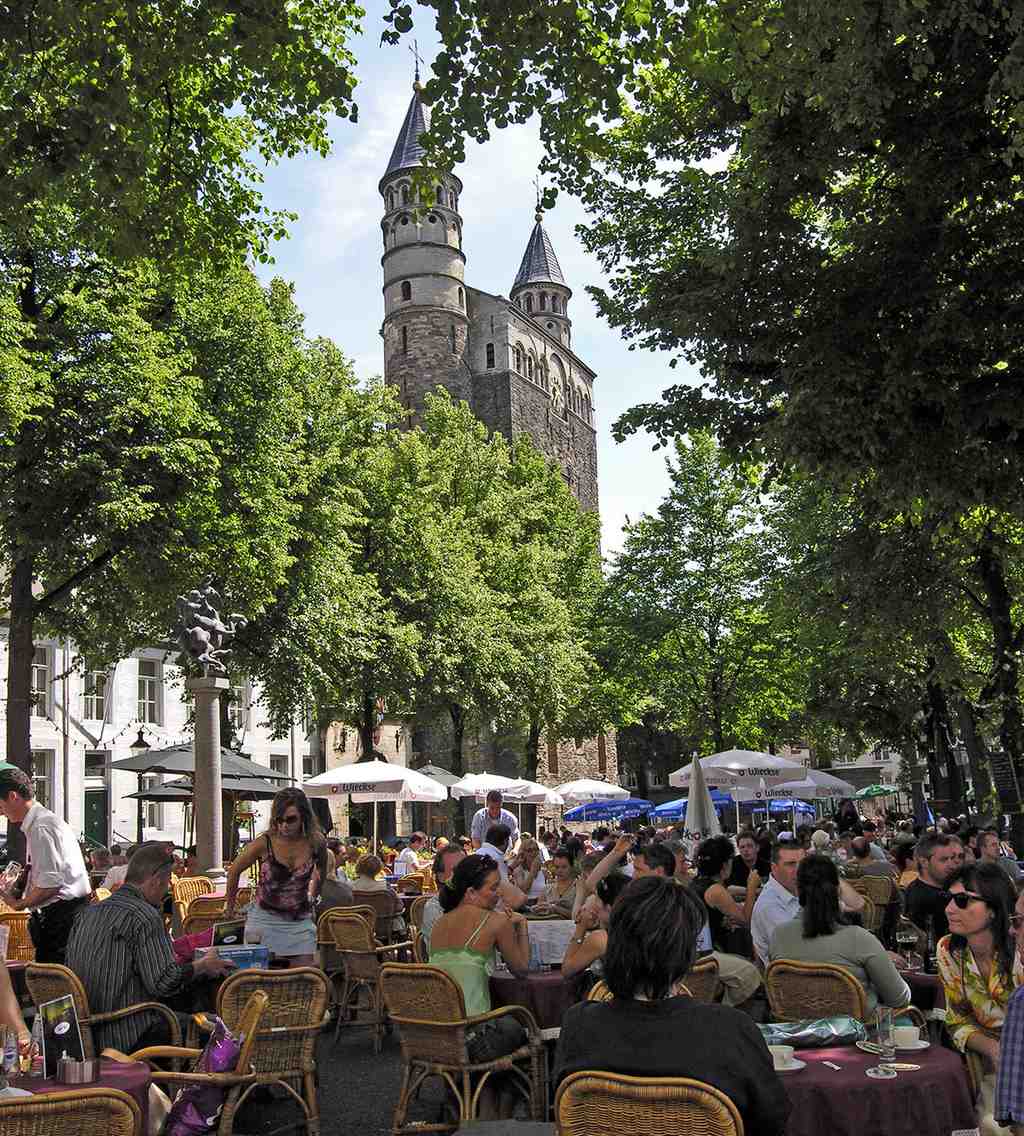
To spot the Onze Lieve Vrouweplein, look ahead for a cozy square filled with lively café terraces shaded by large trees, and just behind them, you’ll see the massive twin-towered façade of the Basilica of Our Lady rising above it all.
Welcome to the beating heart of old Maastricht! You’re now standing where locals and travelers have gathered for centuries. Look up-the grand church with strong stone towers, almost like a castle, looms over the square. That’s the Basilica of Our Lady, and the square owes its name and atmosphere to this ancient giant. But don’t let the cheerful café tables and clinking glasses fool you-underneath your feet are layers of history, mystery, and just a dash of Roman intrigue.
If you had a shovel and could safely dig right here (not recommended unless you fancy a stern chat with the city council), you’d find Roman remains about four to six meters down. In the early 1900s, builders discovered a round tower foundation in the basilica’s courtyard. At the time, people scratched their heads and thought, “What’s this doing here?” Only much later did they realize it was part of a Roman fortress. Fast-forward to the 1980s: archaeologists uncovered a massive six-meter-wide Roman moat right here, plus temple stones and walls, even a western city gate from around 333 AD. Many of these treasures are displayed at the Museum Cellar Derlon, just steps away. Imagine the bustling Roman settlement, and after the legions left, the area stayed alive with new settlers. Over a thousand years ago, workers used chunks of ancient Roman fortress to build the basilica’s west end-a solid bit of recycling if you ask me.
Back in the Middle Ages, this square was a patchwork of churchyards, houses, and a rather crowded sense of community. Picture the 14th-century St. Nicholas Church on one side, a tight cluster of canon houses on the others, and a raised cemetery taking up most of the open space. In fact, the square used to be much smaller until the St. Nicholas Church grew too old and was demolished in 1838. By then, the area was turned into a public promenade, and the graveyard was leveled-imagine the city deciding it needed somewhere to walk (and gossip) more than it needed extra gravestones.
During French rule, the basilica itself was turned into (of all things) a stable and blacksmith’s workshop. Picture prancing horses right where you are now, a very different sort of “pastoral” scene. When the 19th century rolled in, linden trees lined the western edge, café culture blossomed, and Hotel Derlon with its famous kitchen took root. Today, the aroma of coffee and the chatter at terraces have replaced the old church bells and merchants’ calls.
The architecture here paints a vivid timeline-look around and you’ll spot ornate brick facades with decorative stonework from the 17th to 19th centuries, and stately canon houses mixed among cafés. At the center, the Basilica’s solid sandstone front looks like it was designed to keep invaders-and drafts-at bay. Just beside it, a softer, yellow stone Gothic doorway was restored by Pierre Cuypers, and the statuary above is all neo-Gothic. On the opposite side, you might see the playful “House with the Pelican,” a delight of 1905’s art nouveau, with a pelican and rams’ heads sculpted in stone for a touch of whimsy.
Keep your eyes open for bits of unexpected detail: the old wool weigh-house, its stone slab marked 1721, stands with a proud stone pelican overhead. There are even little religious statues tucked into corners, placed just after the Second World War. In the middle of the square, a bronze statue of Jupiter on horseback stands atop a centuries-old column-a nod to the Roman Jupiter pillar found nearby.
And what’s a square without food and drama? Over the years, this spot became the favorite hangout for everyone from starched-collar canons and jostling traders to today’s hungry, happy crowds. The square is filled with good cheer and strong coffee most mornings, and probably a mischievous story or two from the night before.
So enjoy the shade of the grand trees, the rhythm of busy terraces, and know you stand in a place where ancient Romans, medieval priests, French troops, and modern friends all left a mark-in stone, stories, and maybe a few spilled drinks, too.


