
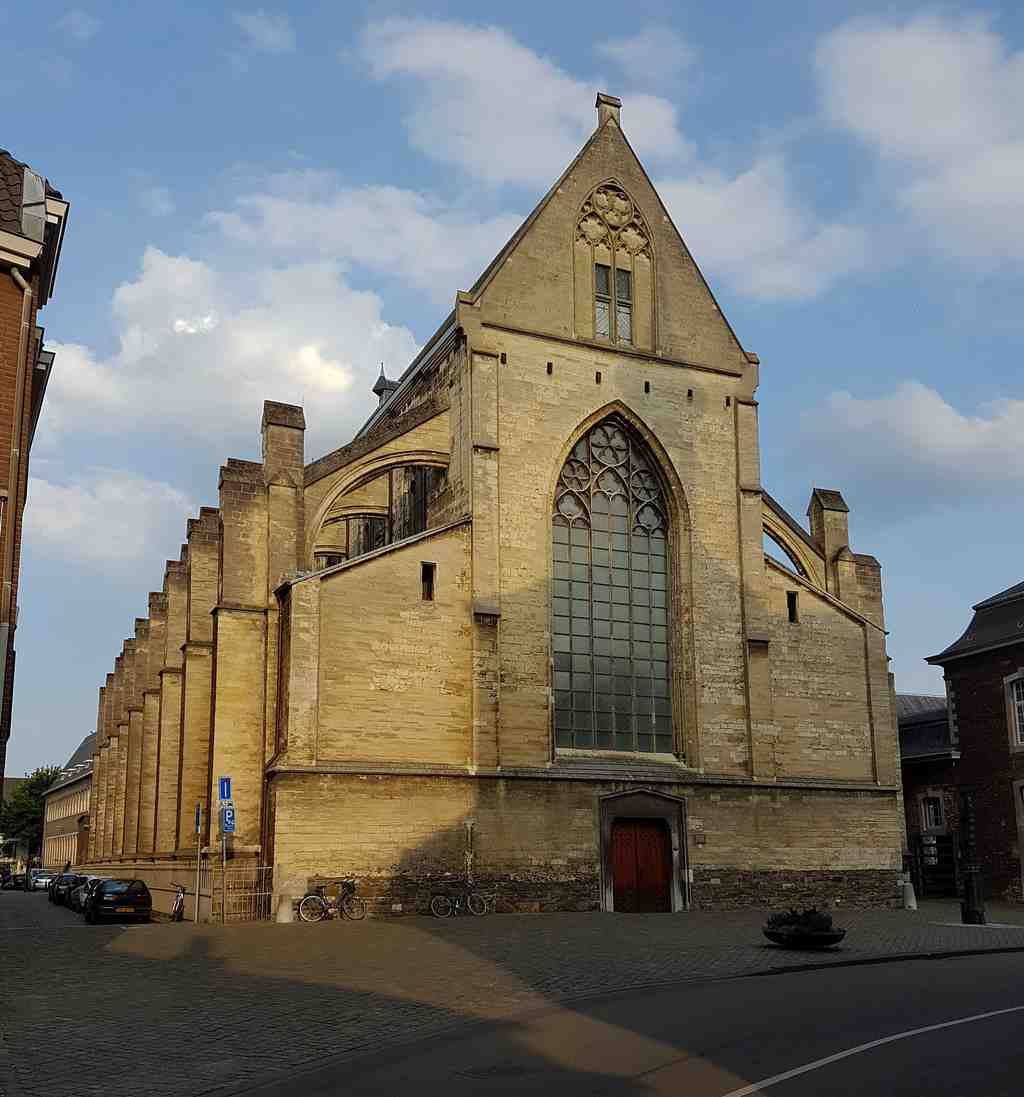
Straight ahead, you’ll spot the Old Friars Minor Monastery by its tall, sandy-colored stone walls, impressive pointed windows, and the row of chunky buttresses marching down the left side-keep an eye out for the massive Gothic arch and the simple wooden door near the base.
Let’s take you back through the centuries! Imagine the year is 1234. The air is thick with the sounds of hammers and laughter as the very first Franciscans, the so-called “Lesser Brothers,” settle right here-invited by a bishop and setting up shop against the old city wall, just a stone’s throw from where you’re standing. They start to build this great and surprisingly modest church-it’s big, sure, but there’s no fancy tower, just that soaring roof, thin ribs of stone, and the huge pointed window you see above the entrance. It was less about showing off, more about preaching and helping the city’s poor. Picture monks bustling in simple brown robes and the echo of prayers drifting out into the medieval streets.
By the late Middle Ages, the monastery is the beating heart of Franciscan life. But not everything is peaceful-oh no! There were dramatic disputes over money with the priests from the nearby St. Servatius and St. John churches. At times, it must have looked like a scene from a medieval soap opera, with everyone trying to out-negotiate each other. And when the religious wars came, the Franciscans were thrown out, chased away by soldiers and rival religious groups. Their beloved Madonna statue, once attracting crowds of worshippers, had to go into hiding. I’d say the monks had a knack for dramatic exits!
Once the monks were gone, the building’s career changed faster than a chameleon on a rainbow. In came orphans, followed by soldiers who turned the church into an arsenal stuffed with cannons and muskets. The old church became a hospital-imagine wounded soldiers limping through the great doorway, the sound of boots on stone floors mingling with prayers just hoping for some peace. Later, it became known as the “Great Arsenal” and eventually the “Sint-Pieterskazerne”-or, for those in a hurry, “the Military Commandant’s House.”
For a while, the place was almost falling down. By the 1800s, artists came to capture its crumbling glory-drawings showed it as an overgrown relic, dark and mysterious, like something out of a Gothic novel. When Maastricht’s days as a fortress city ended in 1867, the army packed up, and, if these old stones could sigh with relief, you’d have heard the sound echo down the street!
In the 20th century, some heroes with a love of history rescued it. The archivists turned the church into a treasure house for documents-old manuscripts and secret letters replaced cannonballs. But restoration wasn’t easy or cozy! Staff shivered through icy winters, desks stacked high against the ancient walls, all while dodging the occasional falling stone (and, apparently, more than a few pigeons). During the latest big restoration, clever architects floated a modern archive deep below your feet-so secure that even the river Jeker couldn’t get in! If you spot a strange crack running through the outer wall, that’s no accident-think of it as an artistic wink at Maastricht’s nearly 800-year-old city wall, hidden behind the stones.
Look up again-the inside once bustled with monks, orphans, soldiers, and now researchers flipping through medieval parchments. If you could listen hard enough, maybe you’d hear the distant echo of a monk’s footsteps, a musket’s clatter, or a librarian’s quiet “shhh.”
So take a moment and look around you: from holy prayers and hidden statues, to soldiers’ boots and scholars’ whispers, the Old Friars Minor Monastery has truly seen-and heard-it all! And let’s be honest: after so much excitement, even a centuries-old building deserves a peaceful retirement job as a historical archive.


