
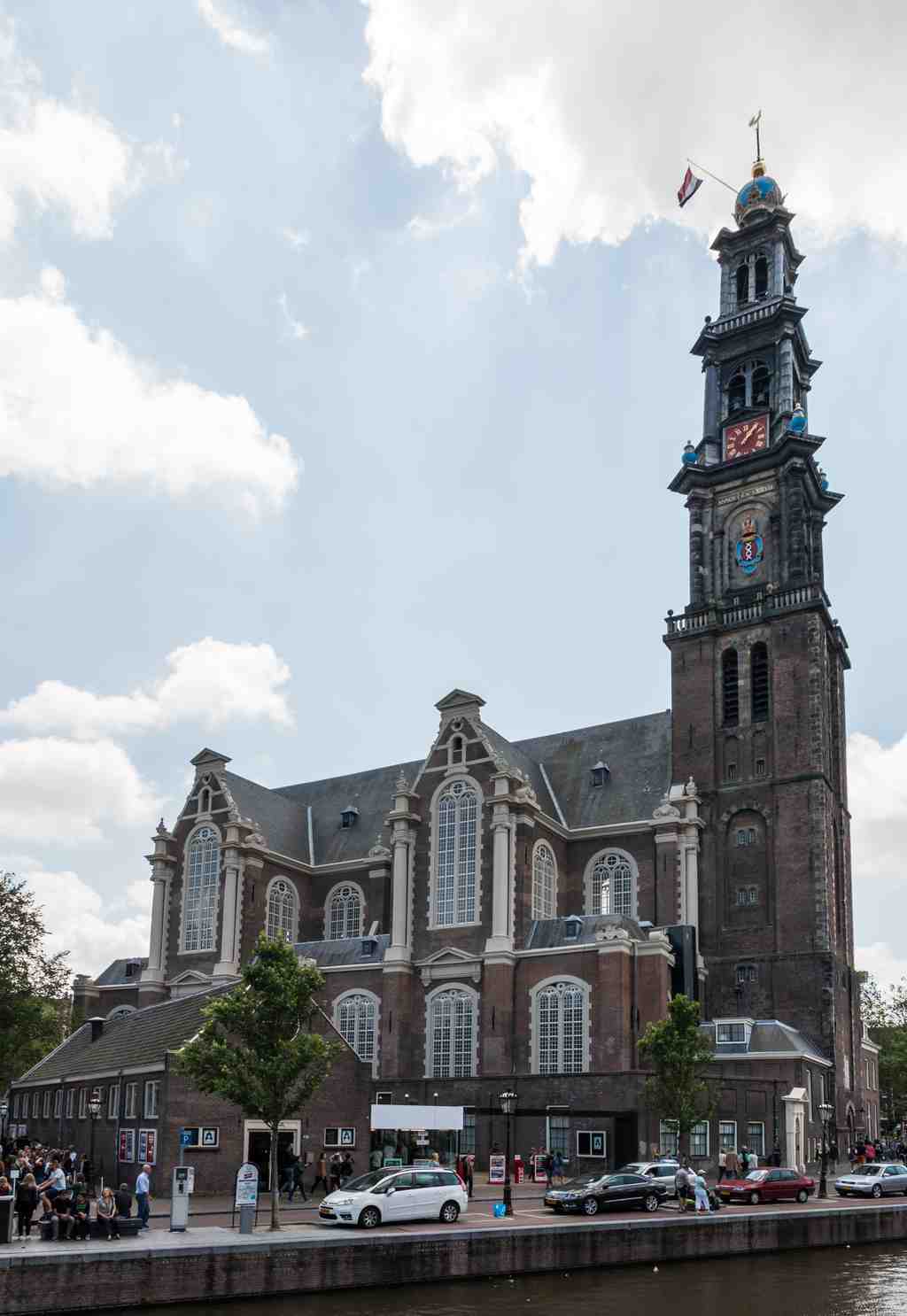
To spot the Westerkerk, just look up ahead for the soaring brick church with tall, white-trimmed windows and, most famously, the tallest tower in Amsterdam topped with a sparkling blue imperial crown.
Now, let your imagination travel back to the 1600s: you’re standing beside canals lined with merchant houses, with the sweet smell of tulips and the sounds of craftsmen drifting through the air. Facing you is the Westerkerk-a Renaissance masterpiece built between 1620 and 1631! Designed first by Hendrick de Keyser and finished by his son Pieter, this church was one of the first in Amsterdam built specifically for Protestant worship after the city’s dramatic Reformation, not just cobbled together from old Catholic relics. It’s huge: 58 meters long and 29 wide, with a main hall that feels like it was made to host a congregation even bigger than Amsterdam’s bicycle population.
But it’s the Westertoren, that sky-high tower soaring 87 meters above your head, that really steals the show. They say it can be seen from across the city, and with good reason-it wears an imperial crown right on top, glinting blue and gold in the sunlight. There’s a hint of mystery in the design: no one knows exactly who created the iconic spire, but the best detective stories point to either the genius van Campen or plans left behind by de Keyser. And if you listen closely at the right moment you’ll hear the legendary carillon playing. This magical instrument boasts 51 bells, chiming every quarter hour, day and night, thanks to a centuries-old drum operated by the city’s carillonneurs-today, that’s Boudewijn Zwart.
Just above the bustling canal, imagine the strains of a Baroque organ swirling out through open doors. The Westerkerk’s main organ has a tale as twisty as an Amsterdam alley. At first, instruments were banned-Calvinists thought music was a bit too much fun for church! But by the late 1600s, the congregation was ready to cut loose with a few hymns. Roelof Barentszn Duyschot and later his son crafted the grand organ in 1686, filling the church with pipes (and, no doubt, the occasional complaint about noisy neighbors). Over the years, the organ got bigger, smaller, electric, mechanical, and finally-after a trip to Zaandam for a spa day-restored to its old, baroque glory in the 1990s. For a true treat, stop by on a Friday or Saturday at 1pm, and you might catch a free lunchtime concert. In August, the phrase “Not a day without Bach” comes alive with music nearly every day!
But it’s not all bells and Bach. The Westerkerk is heavy with history, too-especially the stories that walk its aisles but aren’t always written on plaques. This was the final resting place for Rembrandt, the legendary painter, buried in 1669 as a poor man, his grave number lost to time. Each July, he’s remembered with flowers and music, just steps from the spot where some of the world’s most beautiful art once took shape. And there’s more artistic company here too: Rembrandt’s son, his beloved Hendrickje Stoffels, and a host of other Dutch artists and historical figures lie somewhere beneath your feet.
If these walls could talk, they’d whisper tales of royal romance. When Princess Beatrix wed Prince Claus in 1966, glittering guests filled the church-the royal family only chose Westerkerk because their usual venue was under renovation. It’s the kind of place where stories collide: a place of worship, a shelter for music, a royal stage, and-it has to be said-a bit of a celebrity in the eyes of one world-famous diarist.
Anne Frank, who hid with her family just around the corner, listened for comfort to the clock and carillon of the Westertoren. She mentions it over and over in her diary, describing the bells as a reminder of freedom, hope, and a normal world outside. Today, a statue of Anne stands outside, and you can almost hear the faint echo of her voice mingling with the peal of bells.
With every step you take around this grand old church, think of all those who came before you-lovers, royals, painters, musicians, and people just hoping to find a bit of peace. If you’re lucky, you just might feel the floor tremble beneath your feet as the mighty bells ring out once more. Now, ready for the next stop-shall we see what stories await just down the canal?
Exploring the realm of the main duyschot organ, stoplist of the duyschot organ or the ds. a.h. visser organ? Feel free to consult the chat section for additional information.




