
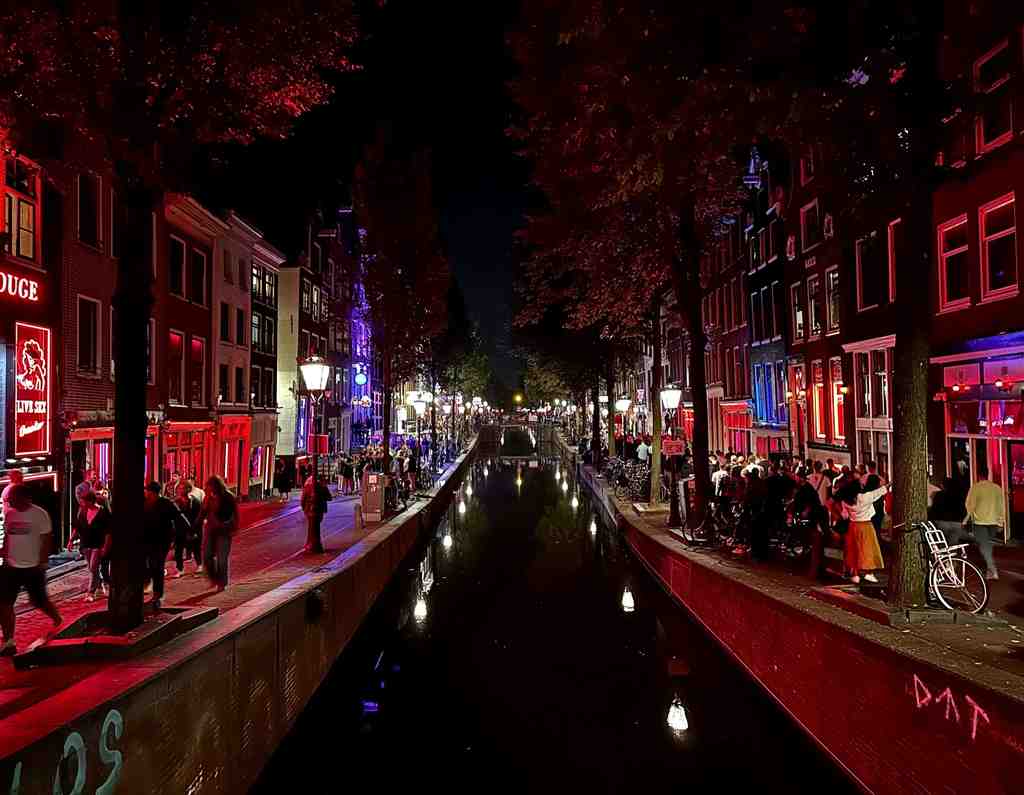
To spot De Wallen, look ahead across the canal and you’ll see rows of historic brick buildings glowing with vivid red and blue neon lights, reflected in the water below, while crowds drift along both sides of the bustling alleyway.
Alright, you’ve made it to the heart of Amsterdam’s most famous-and infamous-neighborhood: De Wallen! As you stand here, drink in the odd, electric glow washing over the old canal houses, each window flashing red or blue like an invitation and a secret all at once. There’s laughter and chatter all around, a lively buzz that doesn’t die down until well after midnight.
This district has seen nearly every side of Amsterdam’s wild history. Back in the 1200s, this was just a harborside street. Boats would drift into port on the Amstel River right here, bringing salty sailors hungrily searching for danger-and maybe a little fun. City leaders tried in vain to control the flow of goings-on, even banning priests and married men from wandering these parts. Some rules never seem to work, do they?
The real show started when the gambling houses got in on the act in the 1700s. Picture it: Wealthy men in velvet coats meeting clever women in candle-lit parlors, then sneaking down winding alleyways. For those who couldn’t afford quite so much velvet, there were plenty of other options, so long as you knew where to look-or which curtain to peer through. In those days, a sex worker might have to hide behind a tiny crack in fabric, hoping not to be caught by police while secretly checking out potential customers.
But Amsterdam’s “policy of tolerance” is nearly as famous as its canals. In the Napoleonic era, Napoleon’s sailors poured in and, perhaps for the first time, the city tried to turn chaos into order. Prostitutes were handed red cards: a strange passport that gave them permission to work-at least if they passed a terrifying health check. Rumor has it, if you failed, your next visit would be to a tub full of mercury. Let's just say that wasn’t a spa treatment you wanted on your vacation.
The scene kept changing, especially through the 20th century. Brothels were banned, driven underground, reimagined as massage parlors, or disguised with a bit of lipstick and nail polish. Even today, you’ll spot shopfronts sandwiched between bakeries and souvenir stands, each with its own vivid display. In the late 1900s, the city stepped in to try and clean up the district, closing down many of the oldest and flashiest establishments. But you can still see traces of the old windows in the brickwork-ghostly reminders of those wild days.
De Wallen is the biggest of several red-light districts here in Amsterdam, and not just for its neon glow. Almost 300 cabins line these narrow lanes, each lit by either a red light-if you’re looking at women-or a blue one, which signals that a transgender woman is on duty. The whole system is part show, part signal, and pure Amsterdam. It’s one of the few places in the world where you might find a nightclub next door to a cannabis coffeeshop, across from a sex museum, with a tour group gawking nearby.
Now, not everything here is as safe or glittering as the lights would have you believe. Behind the windows, real and complicated lives go on. Issues like human trafficking and exploitation have haunted the cobbles just as much as the echoes of laughter. It’s not all “cheeky fun”-there are stories of heartbreak and grit stitched into the fabric of this neighborhood. In recent years, activists have fought to make it safer for the workers themselves, building up support networks and even raising a statue at Oudekerksplein. The statue, called “Belle,” honors sex workers everywhere and asks passersby to show respect-imagine that as a gentle whisper in the chaos: “Respect sex workers all over the world.”
And, of course, what would De Wallen be without the mysterious aroma spilling out from Amsterdam’s legendary cannabis coffeeshops? These are legal, as long as you keep your cannabis and your drinks strictly non-alcoholic. Some shops are as old as the window displays. The balancing act between freedom, fun, and the city council’s many rules can sometimes feel like a circus-though the only clowns you’ll see here are tourists who walked into the wrong window by mistake.
So as you wander on, take in the bright lights and the laughter, but remember: every street here is layered with stories-some scandalous, some sad, and some that turned Amsterdam into the city of beautiful, complicated contradictions that it is today. Who knows? Maybe the next story here will be yours.
Intrigued by the location, sex work or the cannabis coffeeshops? Explore further by joining me in the chat section below.




