
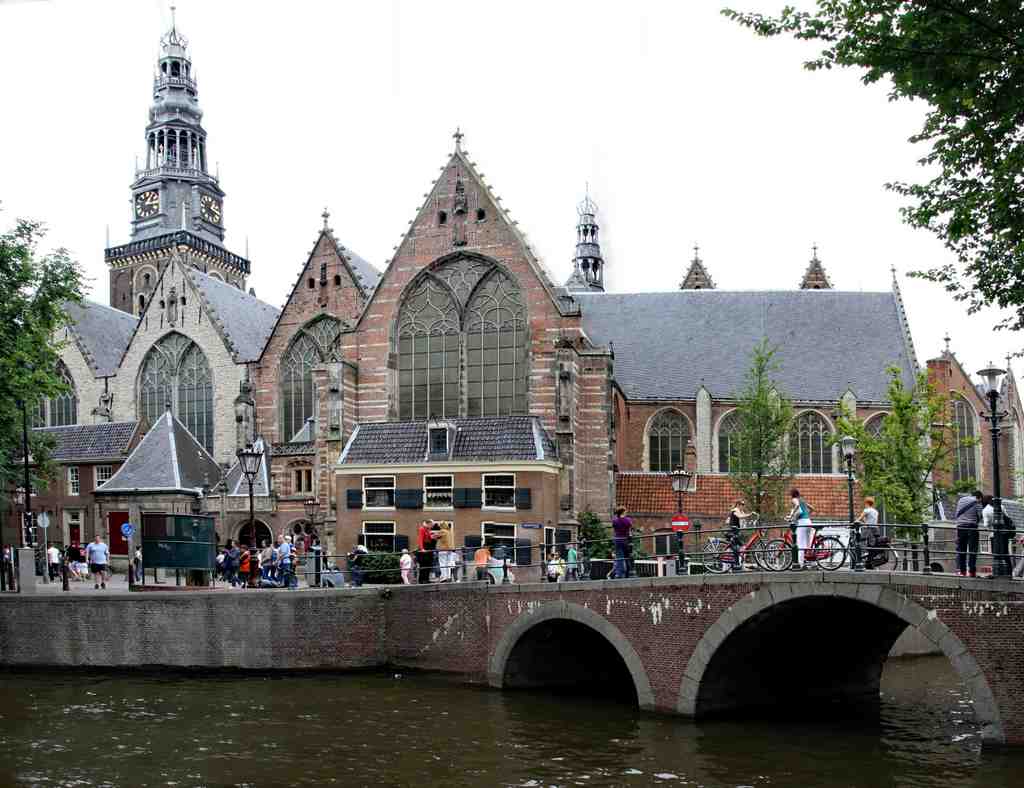
Look for a large, grand church with striking pointed arch windows and a tall, ornate clock tower that rises above the rooftops, just beside a peaceful canal - you can’t miss its mix of reddish brick and pale stone, right in the heart of the square.
Welcome to Amsterdam's oldest story in stone: the Oude Kerk, or Old Church! Imagine yourself stepping back over 800 years, to a time when Amsterdam was just a marshy village, and in the air hangs the damp scent of peat and wood smoke. Picture a small wooden chapel standing right where you are, shivering in the Dutch breeze back in 1213. Now, try to picture the voices of priests, bustling townsfolk, and bell tolls echoing across the settlement. By 1306, that humble chapel had transformed into this remarkable stone church, officially consecrated by the bishop of Utrecht-all under the loving watch of Saint Nicholas, the patron saint of Amsterdam and, believe it or not, sailors and thieves alike.
Even before Amsterdam had canals and stroopwafels, this church was the pulsing heart of the city. The building grew up with Amsterdam itself, lovingly renovated again and again by generations of Amsterdammers. Fires raged through the city in 1421 and 1452, causing chaos and nearly halting construction, until eventually, with stubborn Dutch gumption, builders wrapped the church’s aisles in a protective semicircle and added bold north and south wings, giving the church its cross-like embrace. By 1460, work had finished-although it’s fair to say the Oude Kerk has never stopped evolving.
Flash forward to the wild 1500s. The church was an island of calm for some, a shelter and trading hub for others-a place where locals gossiped, peddlers sold their goods, and beggars sought refuge from Amsterdam’s famously unpredictable weather. Imagine the babble of market traders, the shuffling of feet, the distant clatter of coins. Then, in 1578, everything changed. The Reformation-called the Alteratie in Amsterdam-swept through, and the church switched from being proudly Catholic to fiercely Reformed (Calvinist). Suddenly, the party was over for the marketeers and homeless. The Calvinists cracked down, cleaned house, and, in an almost poetic twist, fenced off the choir with a grand oak screen, inscribing upon it a rather dramatic message about God’s church finally being “undone again” by the fresh wave of reformers.
If you fancy a ghost story, here’s the secret under your feet: the floor you’re standing on isn’t just stone-it’s a rolling sea of gravestones. Some 2,500 of them, to be exact, covering the final resting place of around 60,000 Amsterdammers. So if you shiver, it’s either the Dutch breeze or the memory of 700 years of the city’s history under your soles.
You might also catch a musical echo, because Oude Kerk boasts the largest medieval wooden vault in Europe, made from ancient Estonian oak planks famed for their perfect acoustics. Listen close, and you may imagine the ghostly notes of the grand Baroque Vater-Müller organ, built in 1724, its pipes once described as “perfect.” Organist Jan Pieterszoon Sweelinck, who started here at just fifteen and became an international music star, is memorialized with a majestic bust inside. His music once drifted from the tower across all Amsterdam-picture the sound rolling over rooftops as the city woke to market day.
Rembrandt himself was a regular, bringing his children to be christened beneath these soaring rafters. His beloved wife, Saskia, is still here, buried beneath the stones, illuminated every year by the rising sun in March to mark their everlasting connection. If you feel a little sunlight and a chill at the same time, you’ll know you’re in the right spot.
Today, though, this is no longer just a church: it’s an art space, blending centuries-old tradition with cutting-edge installations, and each March it hosts a unique Catholic pilgrimage to honor the legendary “Miracle of Amsterdam”-a holy incident so mysterious it even survived a bit of fire and a good Calvinist cleaning.
So, as you stand here, gaze up at those ancient pointed windows, and let the echoes of the past and the hum of modern life flood in. Amsterdam doesn’t get older-or more alive-than this.




