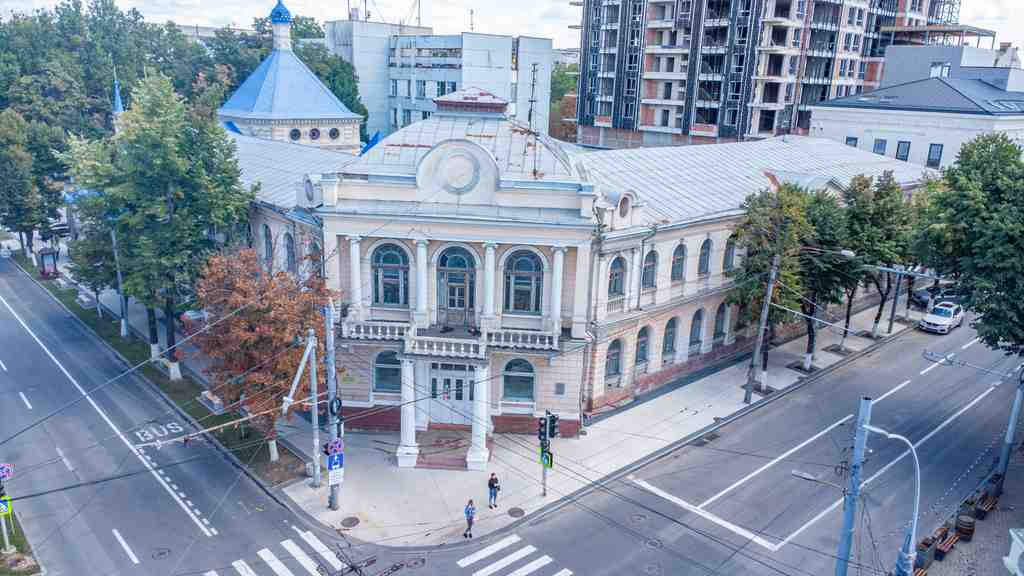
Chișinău Audio Tour: Echoes of Legends and Landmarks
Beneath the Soviet concrete of Chișinău lies a map of shattered empires and whispered conspiracies. You are standing on ground where revolutions were plotted in quiet corners and political scandals reshaped the future of a nation. Unlock these secrets with this self-guided audio tour. You will navigate beyond the facade, uncovering stories of forgotten rebellions and hidden history that remain invisible to the average traveler. Which bullet-riddled wall in the National History Museum hides a secret map? Why did the Zemstva Museum vanish from public memory for decades? What scandalous items remain locked within the basement of the National Library? Traverse through corridors of power and echo-filled courtyards. Experience the tension of past battles and the thrill of sudden discovery. Every corner turns a page of a darker, more vibrant narrative. Plug in your headphones and start your descent into the shadows of Chișinău now.
Tour preview
About this tour
- scheduleDuration 40–60 minsGo at your own pace
- straighten4.0 km walking routeFollow the guided path
- location_on
- wifi_offWorks offlineDownload once, use anywhere
- all_inclusiveLifetime accessReplay anytime, forever
- location_onStarts at National History Museum of Moldova
Stops on this tour
Look for a pale stone, two-story building with a long symmetrical facade, tall arched windows, and a central entrance framed by eclectic historic detailing. Standing here, you…Read moreShow less
Open dedicated page →Look for a pale stone, two-story building with a long symmetrical facade, tall arched windows, and a central entrance framed by eclectic historic detailing.
Standing here, you are facing a building with two biographies... one from the nineteenth century, and one from the late Soviet era. This museum opened as an institution in December of nineteen eighty-three, when Moldova’s culture ministry reorganized existing collections and placed the new history museum inside the former Chisinau Boys’ Gymnasium Number One. That school later became the boys’ lyceum named for B. P. Hasdeu, and after the war other institutions took over these rooms, including the Nistru frontier detachment and then the Polytechnic Institute. Each new tenant left a different idea of what knowledge, order, and citizenship should look like.
Then the building itself nearly disappeared. The earthquake of nineteen seventy-seven damaged the old structure so badly that restoration crews eventually judged it beyond repair. They demolished the interior and rebuilt from nineteen eighty to nineteen eighty-seven, but they kept the exterior face of the old monument. So what you see now is not a simple survivor. It is a careful reconstruction, a modern museum wearing the historic skin of the gymnasium. Even some decorative elements from the old assembly hall returned inside, echoed in three domed rooms.
If you glance at the image in the app, you can see that balance between memory and rebuilding more clearly in the facade on Thirty-first of August Nineteen Eighty-nine Street.
The institution kept changing too. In nineteen ninety-one, after independence, officials renamed it the National Museum of History of Moldova. In two thousand and six, it absorbed the Museum of Archaeology of the Academy of Sciences and took on the broader mission it carries now: telling the story of this land from prehistory to the present. Today the collections number more than three hundred twenty-two thousand items. They grew not only through excavation, research, donations, and purchases, but also through the transfer of objects from museums that no longer existed, including museums devoted to military glory, friendship among peoples, religion, the Komsomol youth movement, and Soviet-era heroes.
That layered collecting history matters. It means this museum does not tell one clean, simple national story. It holds competing memories under one roof... prehistoric pottery, medieval ornaments, Soviet posters, precious metals, weapons, and everyday objects that once belonged to people who never imagined they were leaving evidence for the future.
On your screen, the Cucuteni-Trypillian pottery offers a glimpse of that deep timeline. Those vessels come from a prehistoric culture, and they remind you that Moldova’s story did not begin with modern borders, or even with written records.
Inside, the museum stretches across twelve exhibition halls and a diorama. In nineteen ninety, it opened the large historical scene of the Iasi-Chisinau operation, and in nineteen ninety-four it added the Treasure-house exhibition of precious metal finds.
This place keeps asking the same quiet question: what does a nation choose to preserve when so much has been broken, renamed, or rebuilt?
If you want to go inside later, the museum is usually open Tuesday through Sunday from ten in the morning to six in the evening, and it closes on Mondays.
This is where Moldova gathers its fragments and gives them a shape.
Take a moment here, and when you’re ready, we can continue to the next stop.
On your left, look for the dark bronze she-wolf poised on a tall pale stone pedestal, with the small twin infants tucked beneath her body. This statue carries an old Roman…Read moreShow less
Open dedicated page →On your left, look for the dark bronze she-wolf poised on a tall pale stone pedestal, with the small twin infants tucked beneath her body.
This statue carries an old Roman legend into the heart of Chișinău. The she-wolf recalls Romulus and Remus, the abandoned twins whom legend says she nursed, and that image became far more than a myth... it became a statement about origin, language, and belonging. Here, the wolf speaks to the Latin roots that many in this region have claimed as part of their cultural inheritance.
What makes that powerful is not just the animal itself, but the way stories harden into public memory. Here, the wolf turns a Roman legend into a statement about origin, language, and belonging.
You can come by this monument at any hour.
Take one last look at the wolf and her twins. When you're ready, we can continue to the next stop.
On your left, look for a pale stone façade with a broad rectangular front, rows of tall windows, and the library’s name marking the entrance. A national library does not simply…Read moreShow less
Open dedicated page →
National Library of MoldovaPhoto: National Library of Moldova, Wikimedia Commons, Public domain. Cropped & resized. On your left, look for a pale stone façade with a broad rectangular front, rows of tall windows, and the library’s name marking the entrance.
A national library does not simply store books... it decides what a country refuses to forget. This one, the National Library of Moldova, carries that responsibility for the whole republic. Today it protects written and printed heritage, serves researchers and readers, and works under the principles of UNESCO, the United Nations Educational, Scientific and Cultural Organization. It also connects Moldova to the wider European Digital Library, so memory here does not remain locked on shelves.
Its official story begins in nineteen forty, but its deeper roots reach back to August of eighteen thirty-two, when officials of the Russian Empire opened the Gubernatorial Public Library of Bessarabia in Chișinău. The beginning was modest, almost fragile. Peter Manega, a doctor of law who came from Bucharest, searched for premises, arranged the lease, and helped assemble the first book fund. The first librarian, Gabriel Bilevici, was a local intellectual and teacher. Early holdings came from private collections, including books owned by Colonel I. P. Liprandi, along with donations from scholars and patrons. In other words, this great public institution began with a patchwork of private passion.
And the library did not begin in grandeur. It first occupied three small rooms in a merchant’s house. Then it moved again, into another rented building opposite the city boulevard, awkwardly placed without an entrance from the street. For years, librarians struggled to improve conditions. Finally, in the late eighteen fifties, Venedict Beller pushed hard enough to convince the governor that the library could not go on in a temporary state. In eighteen sixty, it moved into a far better space. Local newspapers celebrated that moment so warmly that they called the year “the year of Beller’s library.”
That story matters because it reveals something essential: libraries survive not by accident, but because particular people insist they must.
If you glance at the image on your screen, you can take in the full balance of the façade. Behind that calm exterior sits an enormous treasury: around two and a half million documents in thirty languages. The collections range from newspapers, maps, music, recordings, and art albums to rare books and manuscripts. Among the oldest treasures are two Aristotle volumes from the age of incunabula - books printed in the earliest era of European printing - linking Moldova’s collections to the great historic libraries of Europe. The library also holds old Romanian religious books, works by Dimitrie Cantemir, and volumes carrying the handwritten signatures of major writers and scholars.
In two thousand ten, the library launched Moldavica, its national digital library. That was more than a technical upgrade. It meant protecting fragile originals while opening Moldova’s written heritage to anyone with an internet connection. Alexe Rău, who directed the library from nineteen ninety-two until his death in two thousand fifteen, shaped much of that modern vision; he was not only a library scientist, but also a philosopher, poet, and essayist.
If you want to return and go inside, the library usually opens from nine in the morning to seven thirty in the evening Monday through Thursday, stays closed on Friday, and opens from nine to five thirty on Saturday and Sunday.
This building stands as one of Moldova’s quiet declarations that memory belongs to the public.
Take a last look here, and when you’re ready, we can continue to the next stop.
Show 11 more stopsShow fewer stopsexpand_moreexpand_less
On your right, look for a two-and-a-half-story facade with a sandstone ground floor, red brick upper walls, and a central pyramidal roof crowned by an airy little pavilion. This…Read moreShow less
Open dedicated page →
Clădirea fostului gimnaziu pentru fete fondat de principesa N. G. DadianiPhoto: Agenția de Inspectare și Restaurare a Monumentelor din Republica Moldova, Wikimedia Commons, CC BY-SA 4.0. Cropped & resized. On your right, look for a two-and-a-half-story facade with a sandstone ground floor, red brick upper walls, and a central pyramidal roof crowned by an airy little pavilion.
This building began in nineteen oh one as a girls’ gymnasium, a secondary school, founded under the patronage of Princess Natalia Dadiani. Before that, older buildings stood on this site until the state councilor Mitrofan Purișkevici sold the property to the school’s governing council in her name. That detail matters... because this place was not just another school. It was a statement that education for girls deserved a prominent address, serious architecture, and public dignity.
The architect, Alexandru Bernardazzi, gave it exactly that. He designed a facade that blends styles rather than obeying just one. You can see the mix in the rough horizontal stonework at street level, the warmer brick above, and the pointed Gothic touches borrowed from Florence in Italy. The main entrance does not shout for attention. Instead, a shaped arch and the balcony above it draw your eye upward, almost as if the building wants to lift you from the street into learning.
Look at the front as a whole and you can feel its discipline. The composition is symmetrical, with a large central section that projects forward and side sections balancing it. The windows change shape from one opening to the next, and some of their stone frames create a zigzag edge that gives the wall a quiet pulse. Near the projecting sections, sculpted figures once occupied arched niches, and above, a heavy decorative band of linked arches runs along the top like a final, deliberate sentence.
Natalia Dadiani led the school until her death in nineteen oh three. The gymnasium stayed here until the Second World War, when the upper part of the building suffered damage. After that, the building changed roles with the century’s shifting powers. It housed the central committee of the Communist Party of the Moldavian Soviet Socialist Republic until nineteen sixty-four. Then it became the Palace of Pioneers and Students, while the left wing hosted the republican Science Society. In nineteen seventy-six, officials remade the interior as a museum of Communist Party history. Few buildings reveal political change so plainly.
If the structure feels especially balanced, there is a reason: to enlarge the exhibition space, builders later added the right-side wing as a two-level mirror to the left. Since restoration, helped by a one million euro grant from the Romanian government in two thousand fourteen, the building reopened on the fourth of November, two thousand sixteen as the National Museum of Art of Moldova.
If you plan to return inside, the museum generally opens Monday through Friday from eight AM to five PM and closes on weekends.
This facade holds more than style; it holds the memory of changing ideas about power, education, and culture.
Take a last look at the brick, stone, and towered center... and when you are ready, we can continue to Saint Panteleimon Church.
On your right, look for a compact church of striped light and dark stone, crowned with rounded domes, with red brick stitched into the facade as a vivid decorative pattern.…Read moreShow less
Open dedicated page →
Saint Panteleimon Church in ChisinauPhoto: Rodion Gavriloi, Wikimedia Commons, CC BY-SA 4.0. Cropped & resized. On your right, look for a compact church of striped light and dark stone, crowned with rounded domes, with red brick stitched into the facade as a vivid decorative pattern.
Saint Panteleimon Church holds more than faith inside its walls... it holds a family memory and a whole community’s sense of home. In eighteen ninety-one, the architect Alexandru Bernardazzi designed it for the Greek community of Chișinău, and the brothers Iannis, also called Ivan, and Victor Sinadino gave the project its force and funding. They chose Saint Panteleimon as the church’s protector to honor their father, Pantelimon I. Sinadino, whose name day saint was Pantelimon.
What makes this church so striking is how deliberately it looks elsewhere for inspiration. The plan forms a Greek cross, which means all four arms are equal in length, unlike the longer body of many churches. The eastern arm holds the altar apse, the rounded sacred end of the church, while the western arm carries the bell tower. Above the center, four intersecting arches lift an octagonal dome... a structural idea with Armenian roots. Outside, the walls alternate bands of pale and darker stone, and Bernardazzi sharpened the effect with red brick details, arched window openings, and those full, lively towers with cornices that ripple like fabric.
Even the fence matters here: forged iron on a stone base, broken by posts topped with lion heads. This church was never ordinary; newspapers of the time praised it as one of the finest artistic works of its kind in the Russian Empire.
It still feels like a small, confident statement of identity in stone.
Take a moment here, and when you’re ready, we can continue to the next stop.
On your right, look for a two-story masonry mansion with a projecting central section, a triangular pediment, and a stone parapet lined with balusters. This is the…Read moreShow less
Open dedicated page →
Rîșcanu-Derojinschi Urban MansionPhoto: Rodion Gavriloi, Wikimedia Commons, CC BY-SA 4.0. Cropped & resized. On your right, look for a two-story masonry mansion with a projecting central section, a triangular pediment, and a stone parapet lined with balusters.
This is the Rîșcanu-Derojinschi Urban Mansion, one of Chișinău’s nationally significant architectural monuments, standing here on București Street in the historic center. It carries the dignity of a noble house... and the scars of a long political life.
In the eighteen seventies, Gheorghe Rîșcanu-Derojinschi, the marshal of the Bessarabian nobility, commissioned architect Alexandru Bernardazzi to design it. He and his wife Ecaterina lived here; she came from an influential family, the daughter of the boyar Alexandru Russo and Zoia Catargi. Bernardazzi gave them a house meant to impress. The façade was symmetrical, with a central section that pushed forward slightly - architects call that a projection - crowned by a triangular pediment. The main entrance faced București Street through an arched loggia, a covered porch with open arches, supported by heavy pillars and reached by broad steps. Above the ground floor’s carved, block-like finish, the upper level carried baroque-style window frames, Corinthian pilasters - flat decorative columns - and a cornice edged with small tooth-like details.
After Bessarabia united with Romania, the family sold the house in nineteen twenty to a wealthy Jewish buyer named Kogan for one million five hundred thousand lei, a fortune at the time, roughly the value of several million in today’s money. Then power changed again. In nineteen fifty-five, Soviet authorities reshaped the mansion, adding a wing with an amphitheater-style hall for meetings of the Presidium of the Supreme Soviet of the Moldavian Soviet Socialist Republic. Later, the Society “Știința,” the Philharmonic administration, the Foreign Ministry’s diplomatic service, and the Chamber of Commerce all passed through these rooms.
The hardest chapter came in the twenty-first century. After a controversial sale in two thousand ten, developers stripped out the interior walls and inserted concrete pillars while planning a massive hotel beside and behind the old structure. What survives most clearly now is the outer shell... a beautiful façade still arguing for memory.
This mansion reminds Chișinău how easily heritage can be preserved in name and altered in substance.
Take a last look, and when you’re ready, we can continue to the next stop.
On your right, look for the pale masonry building that wraps the corner in an angular shape, with rusticated stonework at street level and a chamfered entrance marked by columns…Read moreShow less
Open dedicated page →
The building of the former gymnasium for girls of the Bessarabian zemstvaPhoto: Rodion Gavriloi, Wikimedia Commons, CC BY-SA 4.0. Cropped & resized. On your right, look for the pale masonry building that wraps the corner in an angular shape, with rusticated stonework at street level and a chamfered entrance marked by columns and a balcony.
This building carries a very specific ambition: to give girls a serious education in a city that had long reserved that promise for boys. The story began on the eighth of March, eighteen sixty-four, when Liubovi Alexandrovna Beliugova founded a private girls' gymnasium - a full secondary school, not just a finishing school. After that first chapter, the school changed in eighteen seventy-one from a private institution into a public one under the Bessarabian zemstvo, the elected provincial council of the Russian Empire.
One of the strongest voices here was Matilda Lazo, who led the school from eighteen seventy-two to eighteen eighty-five. She fought for girls to study at the same level as boys, and she succeeded in opening an eighth class with a pedagogical profile, which meant girls could train as future teachers. That sounds simple now... but at the time, it was a direct claim on public life.
In March of eighteen eighty, the zemstvo bought this empty corner plot at what were then Gubernială and Podoliei Streets. On the twenty-fourth of May, eighteen eighty-one, they laid the foundation stone. G-F Lonsky drew the project and budget, and the architect Kurkovsky supervised the work until completion on the third of August, eighteen eighty-two.
The architecture makes that ambition visible. The main entrance sits on the cut corner, almost like the building turns toward the city and introduces itself. Two Doric columns - the plain, sturdy classical kind - hold the balcony above. Higher up, a loggia, an open recessed gallery, stands behind four Ionic columns with their curled capitals. Across the facade, you can spot round-arched windows, pilasters between them, and keystones above the arches. The ground floor looks heavier because of its rustication, those deep-cut blocks that give it weight, while the upper floor is smoother and more refined. It is disciplined, orderly, and confident... exactly the image a modern school wanted.
History did not leave it alone. During the First World War, the building served as a military infirmary in nineteen fifteen during the school break. Then, in nineteen seventeen and nineteen eighteen, White Guard troops from the Odessa military district occupied it, and lessons stopped altogether.
Later, the school became the Commercial Girls' Lyceum. In May of nineteen twenty, Queen Maria and Princess Elisabeta visited, and not long after, officials allowed the institution to carry the name Regina Maria on its frontispiece. After another wartime rupture, staff and pupils evacuated to Craiova under director Elena Apostol. Then came new names, new systems, and new rulers: Moldavian Secondary School Number One, then a mixed school after merging with a boys' school in nineteen fifty-three, then a Soviet-era renaming for Grigori Kotovski.
Today, the building belongs to the Gheorghe Asachi Lyceum, and it remains protected as a monument of national importance. A restoration project won approval in two thousand eighteen, a reminder that Chișinău still sees this place as worth repairing, not just remembering.
This former gymnasium matters because it turned education into a public argument about who deserved a future.
Take one more look at the facade, and when you're ready, we can continue on to Doctor Tumarkin's former hydrotherapy clinic.
Look for the pale masonry corner villa, low and rectangular, with an arched central bay and two winged stone dragons tucked above the former entrance. This place carries two…Read moreShow less
Open dedicated page →
The building complex of the former hydrotherapy clinic of Dr. TumarkinPhoto: Harold, Wikimedia Commons, CC BY-SA 4.0. Cropped & resized. Look for the pale masonry corner villa, low and rectangular, with an arched central bay and two winged stone dragons tucked above the former entrance.
This place carries two histories at once... the story of a private home, and the story of a medical experiment in modern life. In eighteen seventy-eight, a provincial secretary named Nicolai Ivanovich Kushkovski bought this plot at public auction from the city authorities. Over the next years, from eighteen seventy-nine to eighteen ninety-four, he shaped the corner with a one-story house over a basement, modest in scale but carefully arranged with six rooms.
Then, in eighteen ninety-seven, Doctor Lazar Tumarkin stepped in and changed the meaning of the site. Between eighteen ninety-eight and nineteen oh two, he built a hydrotherapy clinic here. Hydrotherapy simply means treatment with water: baths, showers, pressure, temperature, all used as medicine. At the turn of the century, that felt strikingly modern. Water promised discipline, recovery, and scientific control over the body. People considered Tumarkin’s clinic one of the most developed in the southern Russian Empire, which tells you how ambitious this address once was. By nineteen oh three, the recorded owners were Matei and Lazar Tumarkin.
The villa in front still hints at that ambition. Its design mixes styles in an eclectic way, borrowing from classical architecture and layering on ornament. You can see wall sections that push slightly forward, triangular crowns above some windows, and those remarkable winged dragons in stone above the former grand entrance. The entrance itself no longer functions as it once did; it was replaced by a window. That small change says a great deal. Buildings survive, but they rarely remain pure.
And this one changed again and again. The clinic building in the courtyard went through reconstruction in the interwar years, which altered both its structure and its main facade. The property also suffered destruction during the Second World War. Later restorations reshaped the villa in an Art Nouveau style, the curving early twentieth-century style, even though that differed sharply from the original design. In the nineteen nineties, another expansion damaged the old clinic further: workers removed decorative stonework and added a heavy roof level, with false brackets that made the facade feel strained rather than graceful.
Today the whole complex stands protected as a monument of national importance, part of Chisinau’s historic core, and restoration work on the villa resumed in two thousand fourteen under official heritage approval.
What you see, then, is not one frozen moment, but a layered record of care, damage, fashion, and repair.
Here, medicine and memory share the same walls.
Take one more look at those dragons, and when you’re ready, we can continue to the next stop.
On your left, look for the long stone one-story façade with a recessed central entrance, repeated round-arched windows, and a triangular pediment rising over the middle. This…Read moreShow less
Open dedicated page →
Zemstva MuseumPhoto: Agenția de Inspectare și Restaurare a Monumentelor din Republica Moldova, Wikimedia Commons, CC BY-SA 4.0. Cropped & resized. On your left, look for the long stone one-story façade with a recessed central entrance, repeated round-arched windows, and a triangular pediment rising over the middle.
This building carries more than one life inside it. It began as an orphanage. In eighteen forty-two, the city council set aside a large plot here for Chișinău’s orphanage, and by the middle of the nineteenth century the main block had taken shape. Builders raised the central building between eighteen fifty-four and eighteen fifty-seven, and they opened it in eighteen fifty-six. The plan was careful and practical: a long corridor ran through the whole structure, and on either side stood classrooms, work rooms for training through labor, and dormitories for fifteen boys and fifteen girls, their windows facing the inner yard.
There is something moving in that design. This was not only a shelter. It was an attempt to build order, education, and usefulness into a child’s daily life. Behind the buildings, the orphanage garden held another quiet first: the city’s first botanical garden. So this site cared for children and, in a way, for knowledge at the same time.
Architecturally, the place still speaks that language of discipline and symmetry. The main façade uses an eclectic style rooted in classicism, which means it borrows from older formal architecture but mixes details more freely. You can see it in the broad projecting sections around the entrance, and in those groups of three windows joined under one shared arch frame, called an archivolt. The long wings stretch outward with single arched windows, shallow pilasters, and rectangular attic-like tops that give the building a steady rhythm.
In eighteen seventy-five, builders added two matching one-story corner houses to the block, placed symmetrically at opposite corners. Then, in eighteen eighty-three, the orphanage buildings passed to the gubernial zemstva, the provincial council of the Russian Empire, a body that handled local administration. From that moment, the complex took on another identity. One room stored archives, another held insurance offices, and by eighteen eighty-nine these buildings also hosted agricultural and industrial exhibitions. Some of those objects stayed and became part of the permanent museum collection.
That layered identity matters. In nineteen eighteen, when Bessarabia entered Greater Romania, the zemstva stopped functioning, and the complex became fully museum space until nineteen thirty-two. After that, the agronomy faculty of the University of Iași moved in for several years. The last building added here came in the interwar period, in a Neo-Romanian style, with paired arched windows and a zigzag frieze under the eaves.
Even in the twenty-first century, this place refused to become silent. In two thousand ten, it entered the administration of the National Museum of Ethnography, and the sign “Zemstva Museum” appeared at the entrance. A year later, new exhibitions opened. Independent artists, cultural groups, workshops, theater, concerts, and film screenings filled the site and its back garden. Then came new restoration plans, a proposed handover to the Romanian Cultural Institute, and later, in two thousand twenty, the removal of the cultural groups using the space. So the story here is still unsettled: care, administration, study, art, and argument, all sharing the same address.
This is one of the rare places in central Chișinău where an entire historic block still survives as a whole.
Take one more look at its measured symmetry... and when you’re ready, we can continue to the next stop.
On your right stands a pale stone, two-story building with a symmetrical classical facade, three projecting sections, and four columns framing the entrance. This is the former…Read moreShow less
Open dedicated page →
Headquarters of the Country CouncilPhoto: Loraine, Wikimedia Commons, CC BY-SA 4.0. Cropped & resized. On your right stands a pale stone, two-story building with a symmetrical classical facade, three projecting sections, and four columns framing the entrance.
This is the former Headquarters of the Country Council, known in Romanian as Sfatul Țării, and its calm exterior hides one of the most decisive rooms in Moldovan history. Architect Vladimir Țîganco drew the plans in nineteen oh two in a French-influenced classical style, with balanced lines and restrained ornament. He first imagined it as an orphanage and boarding house for seventy boys from noble families. By nineteen oh five, the tsarist Ministry of Education took it over and opened Boys' Gymnasium Number Three here instead.
Then history kept changing the building's job. During the First World War, soldiers filled it as a military hospital. In nineteen seventeen, it became the seat of Bessarabia's parliament. Inside these walls, on the second of December, nineteen seventeen, delegates proclaimed the Moldavian Democratic Republic. Then, on the twenty-seventh of March, nineteen eighteen, they voted for the union of Bessarabia with Romania.
If you want, glance at the before-and-after image in the app; the facade stays almost the same, but the forecourt later gains the Capitoline Wolf, turning the scene into a statement about Romanian identity.
Afterward, the building served a boys' school again, then agronomic studies, then survived heavy war damage before architect Etti-Rosa Spirer reshaped it in nineteen fifty. Today it belongs to the Academy of Arts, still carrying memory and argument in the same walls.
This building remains one of Chișinău's clearest symbols of identity claimed in public. When you're ready, we can continue to the next stop.

A rare early view of the Sfatul Țării Palace before its political role, when it still stood as an elite school building designed in 1902 in French-inspired classical style.Photo: Unknown authorUnknown author, Wikimedia Commons, CC BY 3.0. Cropped & resized. 
The palace with the Capitoline Wolf in front, recalling the interwar symbolism of Romanian identity and the period when the building hosted the Sfatul Țării parliament.Photo: Unknown authorUnknown author, Wikimedia Commons, CC BY 3.0. Cropped & resized. 
The Sfatul Țării Palace in 1920, showing the building after it became tied to the 1917–1918 events that shaped the union of Bessarabia with Romania.Photo: Unknown authorUnknown author, Wikimedia Commons, CC BY 3.0. Cropped & resized. On your left, notice the pale brick facade, the tall horseshoe arches, and the Moorish-style tower that gives this museum its unmistakable silhouette. This museum began in…Read moreShow less
Open dedicated page →
National Museum of Ethnography and Natural History in ChisinauPhoto: Rodion Gavriloi, Wikimedia Commons, CC BY-SA 4.0. Cropped & resized. On your left, notice the pale brick facade, the tall horseshoe arches, and the Moorish-style tower that gives this museum its unmistakable silhouette.
This museum began in October of eighteen eighty-nine, when Baron A. Stuart turned the exhibits from Bessarabia’s first agrarian exhibition into something lasting. That beginning shaped everything... this was never only a room for curiosities. It started with the living world of the region: farming, animals, craft, and the habits of everyday life. As power changed, its name changed too, from the Agriculture Museum to the zoology and agriculture museum, then the Regional Museum of Bessarabia, and later the republican museum of the Moldavian Soviet Socialist Republic. Since nineteen ninety-one, it has carried its present name, and the building itself now holds national architectural status. Behind it, a historic garden survives as a protected landscape monument, almost like an outdoor chapter of the collection. It is usually open Tuesday through Sunday, with Monday closed. This place keeps Moldova’s memory in layers. Take a moment here... and when you’re ready, we can continue to the next stop.
Look for a straight promenade lined with red granite busts on both sides, with a bronze Pushkin rising at the far end on a granite column. This is the Alley of the Classics, a…Read moreShow less
Open dedicated page →
The Alley of the ClassicsPhoto: Giku, Wikimedia Commons, Public domain. Cropped & resized. Look for a straight promenade lined with red granite busts on both sides, with a bronze Pushkin rising at the far end on a granite column.
This is the Alley of the Classics, a sculptural gallery set inside Ștefan cel Mare Public Garden, and it tells a story about memory... and who gets remembered. In nineteen fifty-eight, Chișinău gave this avenue its name and placed twelve busts here. Later, after the Soviet Union collapsed, the city added writers and poets from Romania and Bessarabia whose work Soviet schools had pushed aside. Today, twenty-eight busts stand here, honoring literary classics alongside political figures important to Moldova’s public life.
At one end, the alley reaches toward Ștefan cel Mare Boulevard. At the other, it meets that bronze bust of Aleksandr Pushkin, lifted on granite in a design by Aleksandr Opekushin from eighteen eighty-five. If you want, take a quick look at the before-and-after image; the ceremonial axis feels noticeably more polished in the newer view. On your screen, image three captures that long, deliberate line beautifully.

Seen from Ștefan cel Mare Boulevard, this angle captures the alley’s central position in the park and its long sculptural axis.Photo: Gikü, Wikimedia Commons, CC0. Cropped & resized. This alley turns walking into remembrance. It is open twenty-four hours a day, so you can linger as long as you like. Take it in... and when you're ready, we can continue to the next stop.

Wide view of the Alley of Classics in Ștefan cel Mare Park — the monument became a major Chișinău landmark after being created in 1958.Photo: Giku, Wikimedia Commons, Public domain. Cropped & resized. 
A full-length view from the fountain side, showing the tree-lined promenade where busts line both sides of the alley.Photo: Gikü, Wikimedia Commons, CC0. Cropped & resized. 
A recent view of the monument complex, useful for showing the current state of the alley with its row of busts.Photo: Mixaur, Wikimedia Commons, CC BY-SA 4.0. Cropped & resized. 
A close look at one of the red granite busts — the alley originally opened with 12 busts before later additions expanded it.Photo: Zserghei, Wikimedia Commons, Public domain. Cropped & resized. 
Bust of Nicolae Iorga, one of the literary and cultural figures represented along the alley today.Photo: Gr8dude, Wikimedia Commons, CC BY-SA 3.0. Cropped & resized. 
Bust of Grigore Vieru, reflecting the post-Soviet additions of Romanian and Bessarabian writers once left out under Soviet rule.Photo: Gr8dude, Wikimedia Commons, CC BY-SA 3.0. Cropped & resized. 
An older documentary image of Ștefan cel Mare Public Garden, the park that contains the Alley of Classics.Photo: Agenția de Inspectare și Restaurare a Monumentelor din Republica Moldova, Wikimedia Commons, CC BY-SA 4.0. Cropped & resized. On your left, look for a tall bronze ruler standing on a pale stone pedestal, marked by Stephen’s raised cross and strong vertical silhouette. This monument honors Ștefan cel…Read moreShow less
Open dedicated page →
Statue of Stephen the Great in ChisinauPhoto: Myrabella, Wikimedia Commons, CC BY-SA 3.0. Cropped & resized. On your left, look for a tall bronze ruler standing on a pale stone pedestal, marked by Stephen’s raised cross and strong vertical silhouette.
This monument honors Ștefan cel Mare, Stephen the Great, who ruled Moldavia from fourteen fifty-seven to fifteen oh-four. Sculptor Alexandru Plămădeală shaped it between nineteen twenty-five and nineteen twenty-eight, but the metal itself carries an older memory: in nineteen twenty-seven, a Bucharest foundry cast the statue from bronze taken from six large Ottoman cannons captured in the war of independence of eighteen seventy-seven to eighteen seventy-eight. Even the material tells a story of victory reclaimed.
It first appeared here on the twenty-ninth of April, nineteen twenty-eight, on the tenth anniversary of Bessarabia’s union with Romania. The pedestal came from Cosăuți stone, cut into five giant monoliths, and Eugen Bernardazzi, son of Chișinău’s great city architect, designed it with engineer G. A. Levițchi. If you glance at the image in the app, you can see how firmly the restored statue commands its setting.

A clear view of the Stephen the Great Monument in Chișinău, the bronze statue restored and reinstalled in the city center after its long wartime relocations.Photo: Photobank MD from Chisinau, Moldova, Wikimedia Commons, CC0. Cropped & resized. Then history turned rough. In nineteen forty, officials carried the statue to Vaslui after the Soviet ultimatum, and they demolished the pedestal left behind. It returned, left again, and ended up in a park in Craiova, where Plămădeală’s student Claudia Cobizeva recognized it in nineteen forty-five and helped bring it back. In nineteen sixty-seven and again in nineteen seventy-two, authorities tried to push this “inconvenient” monument aside, but protests saved it. Another photo on your screen shows the dignified stone base restored in nineteen ninety, with the original inscription returned.

The monument with its formal stone base in the Public Garden, matching the restored 1990 setting and the statue’s central role in Chișinău.Photo: Gelu Purcelu, Wikimedia Commons, CC BY-SA 4.0. Cropped & resized. That is why this statue feels less like decoration and more like a survivor.
You can come back to it at any hour, and when you’re ready, we’ll continue on to the Theological Seminary of Chișinău.
On your left, look for a pale masonry building with a long rectangular front, tall evenly spaced windows, and a formal central entrance that gives it the gravity of an old school.…Read moreShow less
Open dedicated page →
Theological Seminary of ChisinauPhoto: Loraine, Wikimedia Commons, CC BY-SA 4.0. Cropped & resized. On your left, look for a pale masonry building with a long rectangular front, tall evenly spaced windows, and a formal central entrance that gives it the gravity of an old school.
This former Theological Seminary carries the weight of a very old idea: that a city shapes its future by deciding how it will educate its clergy, teachers, and thinkers. A seminary, in the simplest sense, trained future priests. But across Europe, places like this often did more than that. They taught language, philosophy, discipline, and public duty. In time, many of those religious schools became the seedbed of modern universities.
A revealing parallel comes from another seminary in Europe. There, in seventeen oh one, the theologian and pastor Jean-Frederic Ostervald began training future pastors. That teaching did not break for more than a century. In eighteen thirty-three, the pastors' company turned that living tradition into a formal Faculty of Theology. A year later, an older academic world began to gather around it. Back in seventeen thirty-two, the city had already created a chair of philosophy for Louis Bourguet, a scholar connected to the great European minds Leibniz and Reaumur, and soon after added a chair in belles-lettres, meaning literature and refined letters.
So the pattern is clear... theology first, then philosophy, then the wider life of the mind.
In eighteen thirty-seven, the government of Neuchâtel asked the King of Prussia, Frederick William the Third, to fund an academy. The money came in eighteen thirty-eight. The first official academic year opened in eighteen forty, the inauguration followed in eighteen forty-one, and by eighteen forty-three the academy awarded its first degree, a license in letters. Then history intervened. In eighteen forty-eight, politics, finances, and educational reform closed the academy altogether.
That could have ended the story. Instead, it sharpened it.
In eighteen sixty-six, a second academy opened with faculties of letters, science, and law. Theology rejoined in eighteen seventy-three. In nineteen oh nine, the academy became a university with the right to award doctorates. That change mattered. It marked the moment when older institutions of moral and religious training fully entered the modern research world.
If you glance at your screen, one image shows the humanities side of Neuchâtel, a reminder that language, history, and philosophy still grew from those earlier roots. Another shows the university entrance itself, much more modern in feeling, but born from the same long chain of decisions about what knowledge a society should protect.

The Institute of French Language and Civilisation at UniNE, showing the university’s humanities side linked to the large Faculty of Letters and Human Sciences.Photo: JoachimKohler-HB, Wikimedia Commons, CC BY-SA 4.0. Cropped & resized. The arc continued. In nineteen forty-three, Sophie Piccard became the first woman in French-speaking Switzerland to hold a full professorship at a university. In two thousand eight, Martine Rahier became the first woman to lead a university in that same region. By two thousand twenty-four, Neuchâtel counted four main faculties: law, letters and human sciences, science, and economics. It ran about eight hundred research projects at once, linked students to more than two hundred partner agreements abroad, and ranked among the world’s best small universities.
And yet one detail feels especially fitting here: in two thousand fifteen, Neuchâtel closed its Faculty of Theology.
That is the quiet lesson of this seminary. Institutions change their shape, sometimes completely. A seminary trains clergy. An academy trains scholars. A university trains a whole society. But each stage grows from the one before it. Standing here, outside this old house of formation, you are looking at the beginning of that long transformation.

The main entrance of the University of Neuchâtel — a clear view of the campus gateway on the lakeside and hilltop university site.Photo: Gre regiment, Wikimedia Commons, CC BY-SA 4.0. Cropped & resized.
Reviews
Frequently asked questions
How do I start the tour?
After purchase, download the AudaTours app and enter your redemption code. The tour will be ready to start immediately - just tap play and follow the GPS-guided route.
Do I need internet during the tour?
No! Download the tour before you start and enjoy it fully offline. Only the chat feature requires internet. We recommend downloading on WiFi to save mobile data.
Is this a guided group tour?
No - this is a self-guided audio tour. You explore independently at your own pace, with audio narration playing through your phone. No tour guide, no group, no schedule.
How long does the tour take?
Most tours take 60–90 minutes to complete, but you control the pace entirely. Pause, skip stops, or take breaks whenever you want.
What if I can't finish the tour today?
No problem! Tours have lifetime access. Pause and resume whenever you like - tomorrow, next week, or next year. Your progress is saved.
What languages are available?
All tours are available in 50+ languages. Select your preferred language when redeeming your code. Note: language cannot be changed after tour generation.
Where do I access the tour after purchase?
Download the free AudaTours app from the App Store or Google Play. Enter your redemption code (sent via email) and the tour will appear in your library, ready to download and start.
If you don't enjoy the tour, we'll refund your purchase. Contact us at [email protected]
Checkout securely with 



