
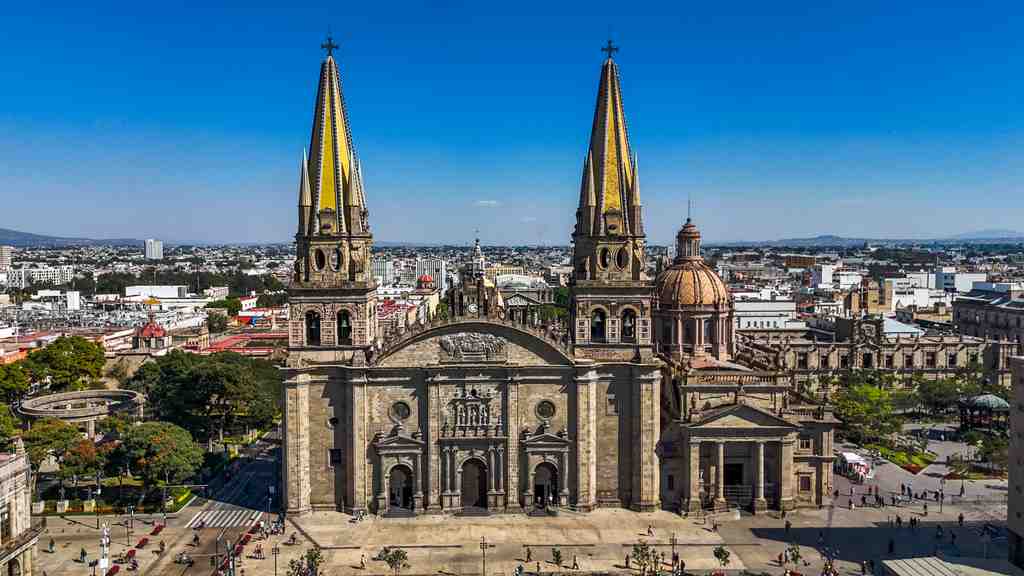
Look for the massive stone building with two tall, bright yellow spires reaching for the sky and a grand dome behind, right in front of you-it’s impossible to miss, towering over the square like a king wearing a golden crown.
Alright, time to travel through centuries-welcome to the spectacular Guadalajara Cathedral! Can you smell the faint incense in the air? Listen carefully-you might just hear the echoes of a bell toll, or maybe even the whispers of an old architect still arguing with the wind about spire height.
The story begins way back in 1541, when the very first church on this site was no more than humble adobe and palm, a far cry from the architectural showstopper in front of you now. Not long after, in true dramatic flair, gunfire from a raucous celebration fell back to earth and set the roof ablaze. If you’ve ever wondered how NOT to celebrate a holiday-well, there you go. With the church damaged, the city folks must have dusted off their hands and thought, “Let’s do this right,” leading to a cathedral worthy of the city’s dreams. That new cathedral, started in 1561 by the master Martín Casillas-on commission from the Spanish King himself!-would take nearly 60 years and plenty of patience, but it was finally completed in 1618.
But, as in all good stories, the cathedral’s troubles weren’t over. The night of May 31, 1818, brought a great earthquake that toppled the towers and the majestic dome, leaving the city’s pride in ruins. Imagine the dust, the shock, and then the resilient determination to rebuild. By 1849? Another quake. Those towers just couldn’t catch a break! It was Guadalajara’s own Manuel Gómez Ibarra-already famous for the impressive Hospicio Cabañas-who finally gave the cathedral its distinctive yellow spires in 1854 after three years of hard work and, I imagine, quite a few sighs of exasperation. The entire restoration cost 33,521 pesos; I’m not sure if that includes coffee for the workers, but it should!
Even after all this, the cathedral sits in a sort of geological soap opera. It’s survived earthquakes in 1932, 1957, 1979, 1985, 1995, and 2003-if those stones could talk, they’d probably ask for hazard pay! Today, the north tower leans just slightly and the dome shows scars from all its battles, but the building stands, still the beating heart of Guadalajara.
Now, take a closer look at its façade. The blend of Spanish Renaissance elegance with those pointy “neo-Gothic” towers makes it an icon. See those yellow tiles and blue accents sparkling in the sun? At ground level, the massive stone columns and the three huge front doors seem ready to swallow you into a world of history. Inside, the marble and silver altar gleams under beams of colored light from French stained glass. All around, chapels are dedicated to saints and miracles, each with its own story, and paintings done by celebrated Mexican artists depict tales of faith and wonder.
There’s a touch of tragedy and mystery too: the cathedral is home to the mummified body of Santa Innocencia, a young girl whose heartbreaking legend still stirs the local imagination. Bishops, cardinals, and even the assassinated Cardinal Posadas Ocampo rest here, deepening the sense of sacred memory.
So as you stand here, surrounded by the bustle and color of modern Guadalajara, feel how the centuries layer together-the drama of fires, the clatter of stones after earthquakes, the resonance of prayers, and the vibrant pride of a city that keeps rebuilding, no matter what history throws at it. And, if the towers tremble a bit the next time you visit, just remember, they’ve seen worse! Welcome to the living, breathing soul of Guadalajara.


