
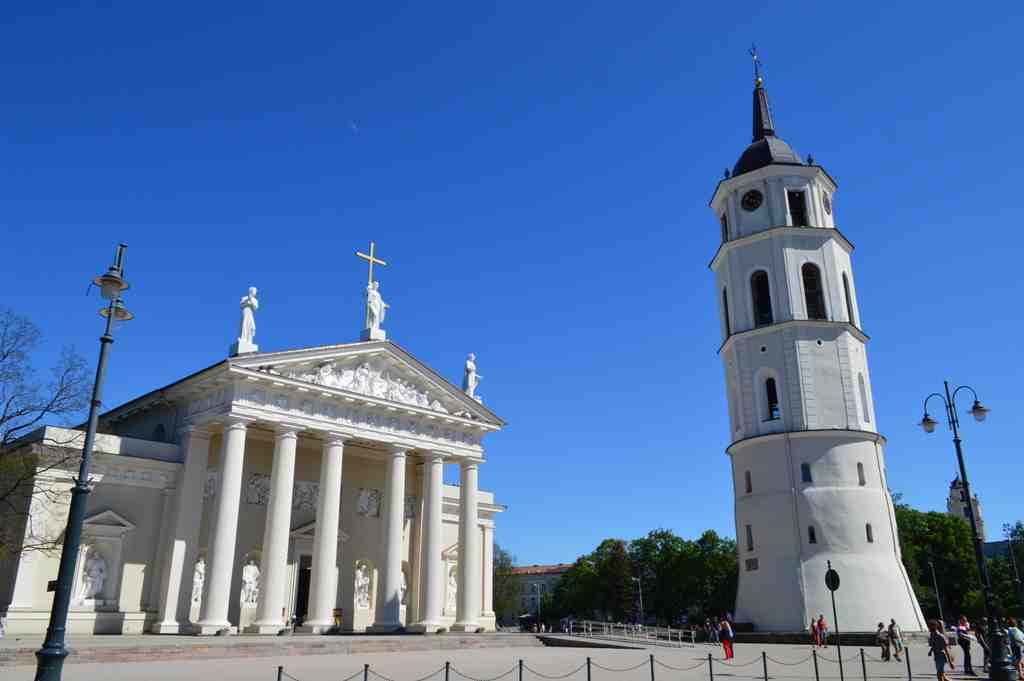
Directly ahead of you stands a striking white building with grand columns, three statues on its roof, and a tall, leaning belfry tower just to the right - you really can’t miss its Neoclassical beauty shining in the sunlight!
Now, take a deep breath, listen to the gentle hum of the square around you, and let’s step back in time together. Imagine yourself standing in this very spot over seven hundred years ago, when instead of marble saints and singing choirs, thunder might have boomed as worshippers prayed to Perkūnas, the old Baltic god of lightning, right here.
Suddenly, don’t blink, for King Mindaugas rides in around 1251. He’d just become Lithuania’s first and only crowned king, a Christian at that, and with all the pageantry fit for a Middle Ages Netflix episode, he ordered the very first cathedral built on this site. But Mindaugas didn’t get the happy ending. After his death, the cathedral switched back into pagan hands-imagine the candles blown out, the chants turning from Christian hymns to ancient invocations.
Fast forward to 1387, the year Lithuania officially converted to Christianity. You can almost see the bustle as craftsmen built a new cathedral, this time all Gothic arches and hopeful stonework. Sadly, it didn’t outlast the city’s many fires-cue the crackling and the smoke as, in 1419, flames reduced it to ashes.
But Vilnius Cathedral wasn’t one to give up easily. Vytautas the Great, eager to be crowned king, built it bigger and bolder than ever for his would-be coronation-though that crown never touched his head. Those thick walls and pillars you see today? Parts are survivors from that medieval rebuild, standing proud through centuries of intrigue, coronations, and royal drama.
Now listen closely: deep beneath your feet are crypts and shadowy chapels where legends now lie. Vytautas himself, saints, grand dukes, queens-resting in the cool darkness with secrets only whispered through the stones above. For centuries, rulers came here for their final sleep, and on special days, the cathedral would fill with the solemn clatter of armor and the soft flutter of silk as coronations unfolded beneath painted ceilings.
And then there’s the unexpected! In 1769, long after the fires had finally left it alone, a tower built during a rushed 1600s reconstruction came crashing down in spectacular, sadly fatal fashion. That’s when the cathedral took on its current Neoclassical look-thank Laurynas Gucevičius for the grand, strictly rectangular facade you see before you. And give a wave to the statues above the entrance: Saint Casimir (Lithuania’s own), Saint Stanislaus representing Poland, and in the middle, Saint Helena clutching an immense cross, all restored just in the last few decades.
Want a secret? Baroque lovers, peek around for the Saint Casimir Chapel. Built between 1623 and 1636 of Swedish sandstone and decorated by Italian sculptors and painters-Michelangelo Palloni’s frescoes, Pietro Perti’s intricate stuccowork-it’s a monument to the glories and heartbreaks of the Polish-Lithuanian Commonwealth. That chapel is about as glamorous as history gets, with more stories than a royal soap opera.
But the cathedral also tells stories of survival and silence. During the Soviet era, Mass was banned, and the echo of prayers was replaced by the scrape of boxes and crates-the house of worship turned warehouse. Only in 1988 did singing rise up again, cautious, hopeful, until at last, the cathedral emerged from the Soviet shadow, fully restored and ready to greet a new independent nation.
Inside, more than forty treasures-paintings, frescoes, and even the floor from Mindaugas’s day-await, some uncovered only in recent decades. The oldest fresco in Lithuania slumbers quietly on a wall below, while the altars recall a time when Christian and pagan traditions collided, merged, and mingled in mysterious ways.
Restoration work has never truly stopped here. Fresh paint gleams on the walls, statues once cast out are back in their places, and every so often, the wind howls through Cathedral Square-like in 2022, when it tore away a piece of the roof.
So as you stand here, let the grandeur soak in. Feel the weight of centuries, the mixture of faith, royalty, and resilience etched into every stone. And if you listen carefully, you just might hear the distant rumble of a king’s procession, the hush of sacred vows, or-if you’re really lucky-the leftover echoes from battles of gods and men, all right here in the heart of Vilnius.




