
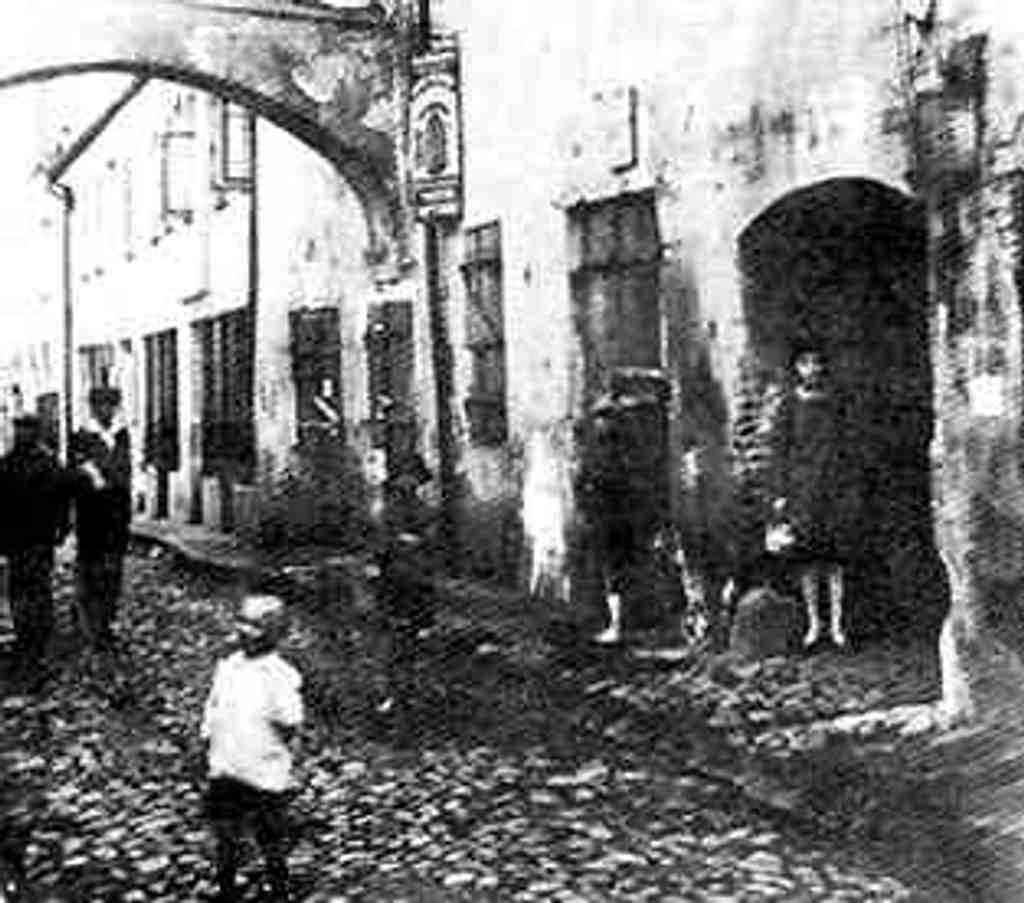
To spot the site of the Vilna Ghetto, look for a narrow cobblestone street lined with old, worn buildings and a stone archway stretching across above you; the remnants of history are woven right into these quiet, shadowed walls.
Now, step closer and imagine yourself transported back in time, right here in 1941, in the heart of Vilnius’s old Jewish quarter. These streets once echoed with laughter, bargaining at market stalls, and the shouts of children hopping between cobblestones-perhaps like that little boy you can picture dashing past, wanting to play in a world suddenly turned upside-down. But, just beneath the surface, you’d feel tension crackling in the air like electricity before a storm.
Before the Second World War, this area was a lively hub of Polish and Jewish culture. Vilnius was called “the Jerusalem of Lithuania,” famous for its culture and thinkers, its delicious bakeries, and its energetic gatherings in cafes. If you could peek inside one of these buildings, you might see a library of 45,000 books, poets standing on makeshift stages in the “House of Culture,” and parents whispering bedtime stories in Yiddish, hoping their children would sleep safely.
Everything changed when the German army marched in, and with them came the horror of the Nazi occupation. The ghetto was created almost overnight following a staged attack on German soldiers, a cruel trick to justify what came next. Suddenly, thousands of Jewish families were shoved out of their homes with almost nothing-if you couldn’t carry it, you lost it. The narrow streets of the old quarter were sealed off, forming the infamous Vilna Ghetto, splitting it into the “Large” and “Small” ghettos, with a corridor running right down the center where non-Jews went about their day, mostly ignoring the desperation only meters away.
Life inside was harsh, even deadly. So many people crammed together, the threat of disease was constant; a yellow sign screamed: “Attention! Danger of Infection!” Yet, partly thanks to the heroic ghetto doctors, major epidemics never struck. You can almost imagine the scratchy sound of a doctor’s heating pot as he tries to make soup from the very last potato, because hunger gnawed at everyone. But in the face of so much fear, people clung to culture, hope, and even humor wherever they could find it. If you listen closely, maybe you’ll hear a faint melody, a snatch of a song from one of the ghetto theatre’s many performances-111 in total!-that filled hearts with a flicker of courage.
At night, while the city slept, this ghetto pulsed with secrets. The resistance was born here, its motto loud and proud: “We will not go like sheep to the slaughter.” Men and women, many just teenagers, became partisans, right under the noses of the Nazis. Young Yitzhak Wittenberg, one of their leaders, was once smuggled to safety by his comrades right from this maze of streets. Tension was high, and sometimes, on the darkest nights, betrayal came from within, with families torn between trying to protect their own and those who fought back against the occupiers. Sometimes, a stone thrown, an angry shout, or sobs muffled by hands would echo off these walls.
As 1943 closed in and the Nazis decided to liquidate the ghetto, the air crackled with fear and heartbreak. Families hugged tight, whispering hurried goodbyes, as German boots thundered over these cobblestones, dragging thousands to camps or to the forests of Paneriai, from which most never returned. Only a few hundred of Vilna’s Jews survived, often by hiding in the forests or finding shelter with local Lithuanians. The ones that did survive-like Samuel Bak, a little boy who later painted his memories-carried these shadows for life.
After the war, the city slowly grew over the pain, but the story is still hidden in plain sight, right where you’re standing. Vilnius’s Jewish community nearly vanished, its vibrant life reduced to a few echoes, a handful of books, and the stories of those who outlasted the darkness. If a chill runs down your spine, that's the past brushing past you, reminding us: every stone here has a story worth remembering.
Want to explore the background, 1941: establishment of the ghetto or the 1942: quiet period in more depth? Join me in the chat section for a detailed discussion.




