
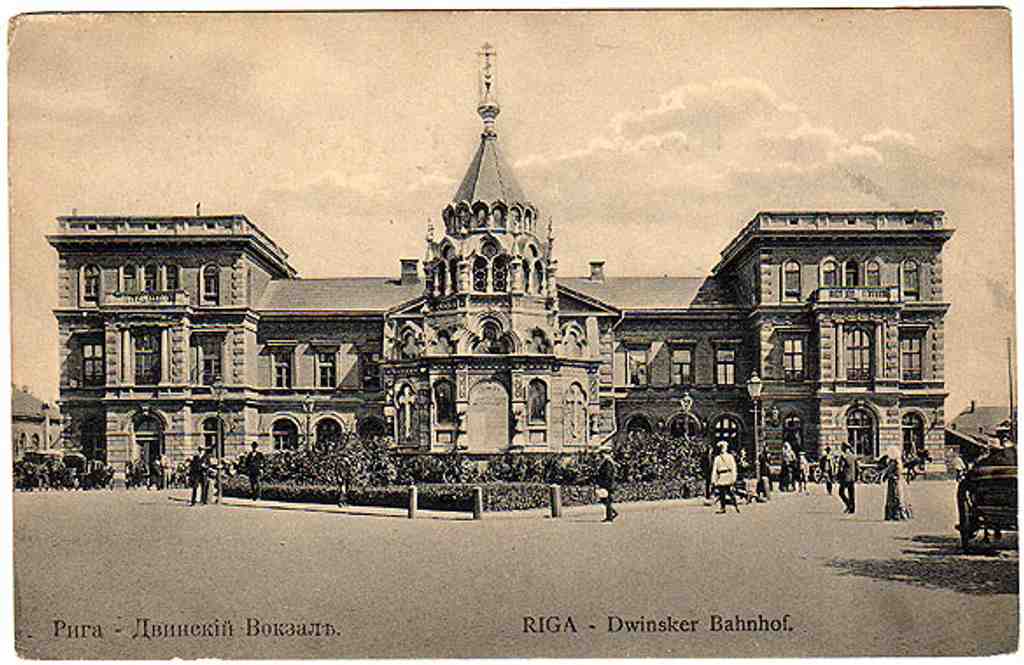
Picture a compact chapel of grey granite and white marble, shaped like a three-tiered pyramid and crowned by one gilded tented dome with eight smaller domes clustered around it.
You are standing at the site of a vanished landmark, and that absence is part of the story. Riga raised the Alexander Nevsky Chapel on the square before the Riga-Orlov railway station to commemorate the event of the seventeenth of October, eighteen eighty-eight. A year later, on the seventeenth of October, eighteen eighty-nine, Archbishop Arseny of Riga and Mitau consecrated it. What matters just as much is who paid for it: the whole city, the source says, without distinction of nation or faith. That is rather moving, especially in a place where identities often pulled in different directions.
The chapel looked like a tiny but very rich Orthodox church. Its lower level formed an equal-armed cross and ended in rows of kokoshniki, decorative gables shaped a bit like old ceremonial headdresses. In its four rounded niches, one became the entrance, two held coloured patterned glass, and the fourth carried a white Carrara marble plaque with a gilded inscription. Pairs of white marble and polished granite columns framed those openings. Above them rose an octagonal drum, the windowed section beneath the roof, ringed by eight columns and eight smaller gilded cupolas. Between them sat icons and mosaic glass. Higher still, sixteen more kokoshniki carried more icons, and all the metalwork, crosses, domes, coverings, even the icon panels, gleamed from gilded red copper.
Inside, visitors found a high dome, a hanging chandelier on a gilded chain, an iconostasis, a screen of sacred images before the altar, enamelled majolica tiles, and a mosaic floor. The builders used the strongest cement they could, because they meant this monument to endure for generations.
And yet, in late July and early August of nineteen twenty-five, the city demolished it as a reminder of tsarist rule.
So this stop asks you to imagine not only what stood here, but what a city chooses to remember and erase.
When you are ready, continue on toward the Palace of Culture of Railway Workers.




