
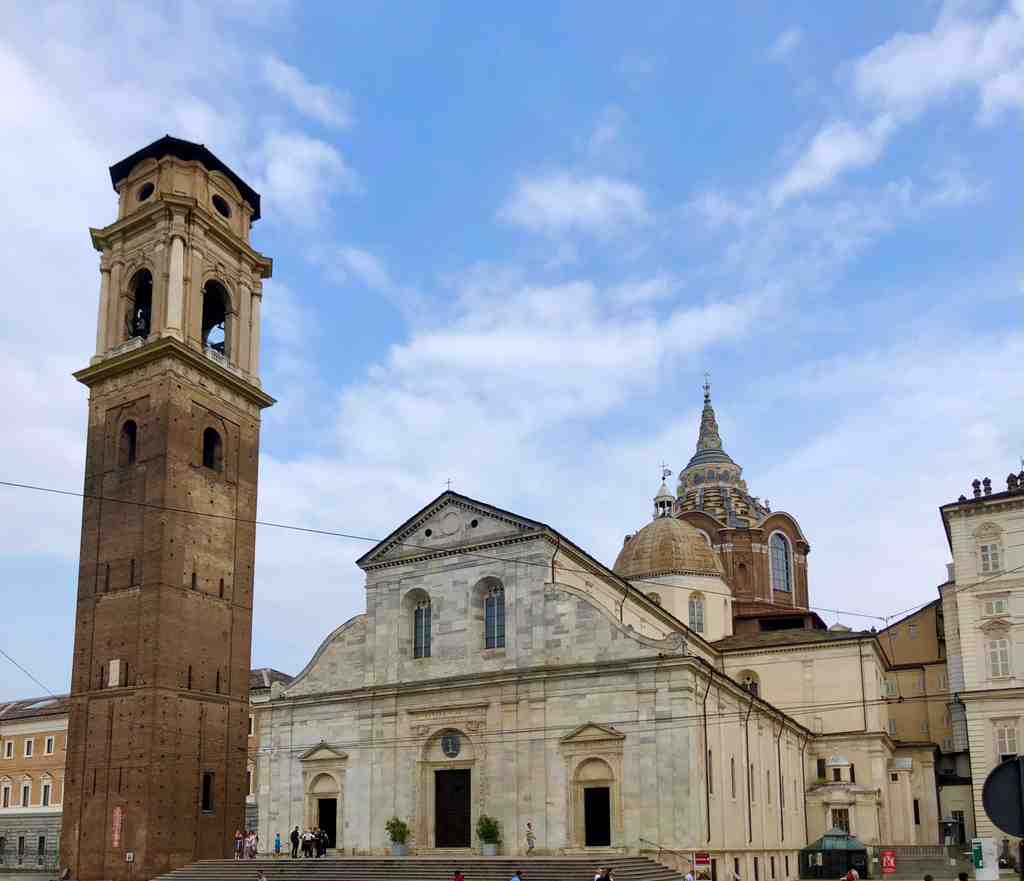
Right ahead, you’ll spot the Turin Cathedral by its crisp white Renaissance marble facade with three grand doors, and that tall, reddish-brown bell tower on the left-just look for the mix of white stone and ancient brick rising above the square.
You’re now standing in front of the magnificent Turin Cathedral, officially called the Cathedral of Saint John the Baptist-the heart of Turin’s spiritual life, and the kind of place where if walls could talk, they’d need their own epic fantasy trilogy. To give you a sense of scale, just imagine almost every important event in the city happening in this very spot over the last five centuries!
The adventure begins way back here in Piazza San Giovanni, a place layered with history. Before this marble giant existed, three ancient churches crowded this sacred space, probably built on top of even older Roman buildings and pagan temples. Each church had its own purpose: one for San Salvatore, one for Santa Maria di Domno, and one for-you guessed it-San Giovanni Battista, which was considered the star of the show. How did John the Baptist become so special here? Legend has it, it was all thanks to Queen Theodolinda, wife of King Agilulf of the Lombards. She thought, “Why not make John the Baptist the patron of the whole realm?”-and that’s how the dedication stuck.
But don’t worry, this place isn’t just about holy serenity. It’s also seen its fair share of royal drama and even bloodshed. Take a step back to the 7th century: after King Rodoald died, the city was swept up in a Game of Thrones-worthy power grab. Imagine Garibaldo, the duke of Turin, strutting into the old church on Easter Sunday, thinking he was clever enough to seize the throne. Suddenly--he was struck down by a mysterious avenger from a rival family, right while attending Mass! If these stones had memory, they probably wince just thinking about it.
Now let’s fast forward to the Renaissance. By 1490, those three old churches came down to make way for this stunning new cathedral-though the brick bell tower you see beside the church remains from just before, started in 1469, and carefully preserved. On July 22, 1491, Bianca of Monferrato, the regent of Savoy, laid the first stone of the new cathedral. The construction fell to a master builder named Meo del Caprino, who worked up until 1501. Talk about job dedication: he literally spent the last years of his life perfecting this church, which was finally consecrated in 1505. By 1515, thanks to a friendly pope named Leo X, this church wasn’t just another stop on the city map-no, it became a metropolitan cathedral.
Of course, no great building ever stays the same for long. By the 1600s, the cathedral was ready for an upgrade-a chapel big enough to keep Turin’s greatest treasure, the Holy Shroud. Architect Guarino Guarini came in swinging spreadsheets and ideas, building a dome so graceful you’d think it could float away. Twenty-eight years, stacks of black and white marble, and a few architectural disagreements later, his chapel was done in 1694-perfect for wowing any visitor who dared to look up.
Over the centuries, the cathedral kept collecting treasures-a stunning replica of Da Vinci’s Last Supper, painted by Luigi Cagna in 1835, so heavy that only the main wall could handle the weight; some grand marble statues; masterpieces by painters like Bartolomeo Caravoglia and Giovanni Martino Spanzotti; and even the monumental tombs of bishops and a countess, all tucked inside.
The good news is, even after a disastrous fire struck in 1997, destroying part of Guarini’s masterpiece, firefighters heroically saved the Holy Shroud. Architects swooped in for a massive restoration, both inside and out, and even created a specially controlled case for the precious relic-a labor of love that still shines today.
So right now, as you take in the Renaissance marble gleaming in the sunlight, the robust bell tower stretching skyward, and the delicate domes peeking out behind, picture all those centuries of crowded gatherings, whispered prayers, royal power struggles, ringing bells, and the soft echo of footsteps on cool stone. Turin’s cathedral isn’t just a building-it’s the city’s entire story, written in marble, mystery, and the occasional royal misunderstanding. And keep your ears open-sometimes, under the sound of today’s bustling crowds, you might just catch the ghostly notes of the cathedral’s 3,498-pipe organ or the distant thud of history, still unfolding.




