
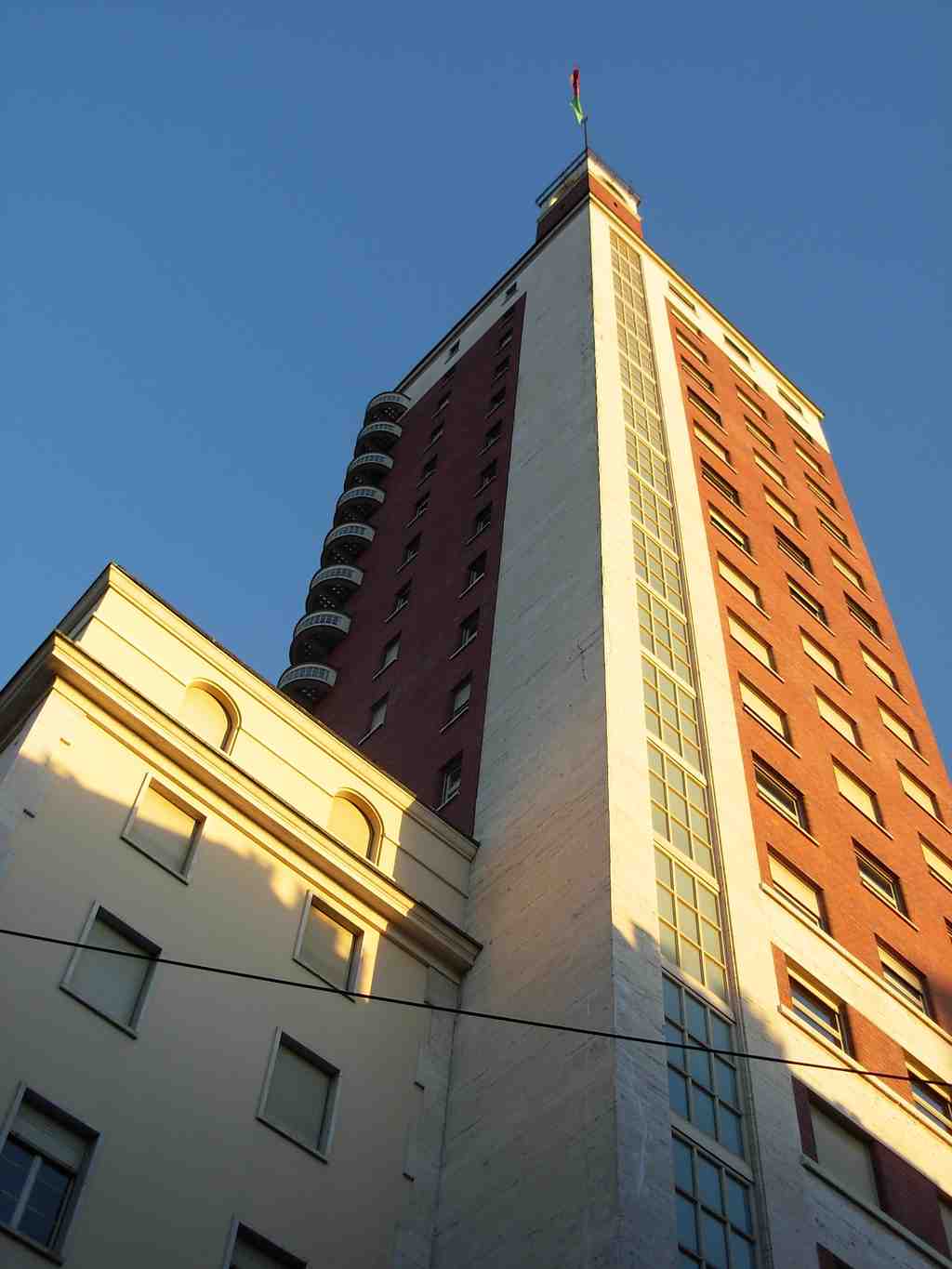
Look straight ahead and a little up-you’ll spot the Torre Littoria by its bold, sleek red-and-white facade, rising directly above the street with a sharp modern edge and a flag waving proudly at the very top.
Now, let me take you back to the early 1930s. Picture Turin buzzing with excitement and industry, the air full of ambition, as workers hurried through the city streets while concrete mixers and iron hammers echoed through the city blocks. Here, right where you’re standing, they built what looked at the time like something out of a science fiction novel-a skyscraper! Not just any tower, but the first real residential skyscraper of Turin, and, for a glorious while, the tallest in all of Europe. Imagine the skyline in 1934 when Torre Littoria, as it was called then, shot up over its neighbors like an adventurous child on stilts, eager to see the world.
You might think its location was pure chance, but there’s a bit of playful rebellion in its address. Original plans placed it far from here, in Piazza XVIII Dicembre, but the final spot, just steps from the baroque and royal Piazza Castello, was no accident. There was a bit of symbolic chest-thumping here! Some say the engineers wanted the modernist “finger” of the new era to poke the old royal order right in its stately ribs-a striking, vertical poke among Turin’s classic curves. And here comes the twist: it was designed to be the proud headquarters of the National Fascist Party. But in true Italian plot-twist fashion, the party never moved in! Instead, Reale Mutua, the insurance company that helped pay for it, took over-and you can still spot their giant sign shining from the top.
Picture the construction: frantic, relentless work that didn’t stop even at night. The team behind it was Armando Melis de Villa and Giovanni Bernocco, already famous for their bold ideas. By 1934, the building was complete. It quickly became both a symbol of hope and a conversation starter-if buildings could talk, this one would definitely brag to its neighbors!
On the ground floor, people would gather at the Bar Impera, famous across Turin, run by the Chazelettes-yes, the same family that gave the world their famous vermouth. During World War II, the rooftop of Torre Littoria had a dramatic job: one of Turin’s 58 air raid sirens was planted right up there, its wailing cry echoing over the rooftops whenever danger approached. The building itself got away with just a few scrapes during the air raids of July 1943, like a boxer dodging most of the punches.
The style is unmistakable: check out the glass blocks, red brick bands, and those quirky round terraces. The materials were downright futuristic for the 1930s-glass cement, clinker, linoleum. It was Italy’s first high-rise built with a welded steel skeleton, more like a New York skyscraper than any Italian palazzo. Even its relationship with Turin’s other icon, the Mole Antonelliana, became something of a good-natured rivalry-the old brick-and-mortar champion versus the new metal upstart.
The tower stretches 109 meters into the sky, 19 stories above the city-the apartments above were, and still are, the dream home for many. As you look up, notice the different layers: nine stories stretch almost lazily along Via Viotti, until the main tower suddenly shoots upward. The east side balconies show off gleaming glass curves, now rimmed at night by blue light, making the building glow like a beacon after dark.
Let’s be honest, not everyone loved this modern marvel at first. Locals gave it nicknames: “the eyesore,” “the cellphone,” “the Duke’s finger,” or-my favorite-“the arrogant tower.” But love it or not, the Torre has always housed dreamers and doers: offices, studios, luxurious apartments, and, rumor has it, some of the most intriguing personalities in Turin.
Today, after a major renovation in 2020-think new concierge, fancy gym, and sparkling blue lights-it’s looking sharper than ever. There's even been talk of epic rooftop bars and restaurants, though those plans remain tantalizingly out of reach. Perhaps, as you gaze up at the flag snapping in the breeze far above, you’ll sense the stories, arguments, jokes, and history sealed in every brick and pane of glass.


