
Torino Audio Tour: Bridges, Knowledge, and Mysteries Between History and Modernity
Torino's streets hide secrets older than the fog that often envelops them. Between the majesty of Porta Palatina and the austere grace of the Chiesa di San Gioacchino lies a tale of forgotten revolts and hidden symbols, waiting only for those who dare to truly see them. Embark on a self-guided audio tour through the historic districts and lesser-known alleys of Aurora. Discover stories and details that escape the eyes of hurried tourists. What happened the night the gate of Porta Palatina was hastily sealed? What mysterious figure roamed the church's naves during a now-legendary vigil? Why did men armed with keys meet every Thursday in a certain square in the Aurora district? From one monument to another, every step shakes the dust of time and ignites wonder. Let the secret Torino unveil itself before your eyes. Press play and start the adventure.
Tour preview
About this tour
- scheduleDuration 30–50 minsGo at your own pace
- straighten4.0 km walking routeFollow the guided path
- location_on
- wifi_offWorks offlineDownload once, use anywhere
- all_inclusiveLifetime accessReplay anytime, forever
- location_onStarts at Campus Luigi Einaudi
Stops on this tour
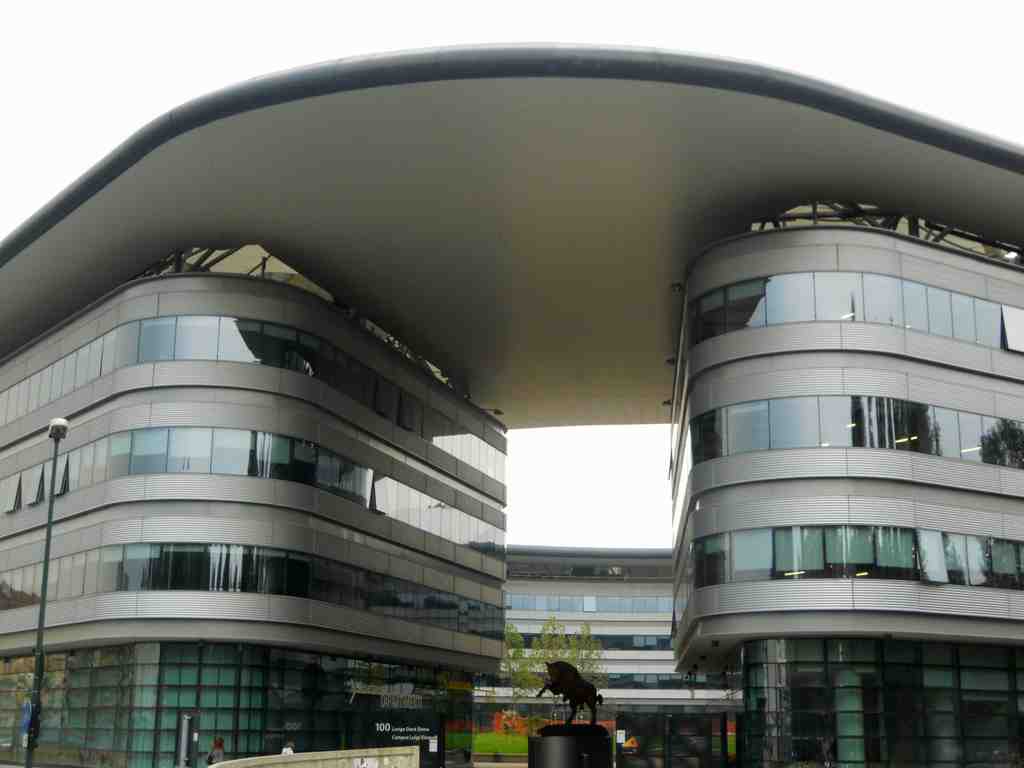
Before you, a curious structure unfolds, almost like a floating white cloud suspended above modern buildings with large glass windows: to spot it, look towards the large roof that…Read moreShow less
Before you, a curious structure unfolds, almost like a floating white cloud suspended above modern buildings with large glass windows: to spot it, look towards the large roof that stands out between the greenery and the Dora river! We are at the Campus Luigi Einaudi, where Torino enjoys playing its futuristic part! This place was once dominated by smoky factories: Italgas ruled here, and people worked hard in the Vanchiglietta district. Then, one fine day, the winds of transformation arrived here, along with the signature of Norman Foster, an architect who, apparently, never had a straight compass - because there's not a straight line in sight! Thus, in 2012, this campus was born, which CNN ranked among the ten most beautiful university buildings in the world: quite an achievement! Imagine participating in an urban revolution where past, present, and future high-five each other. The structure is a true glass labyrinth: seven buildings all facing a circular piazza, connected by walkways that invite students and professors to exchange ideas, jokes, or simple smiles (and, occasionally, some life-saving coffee at the cafeteria). And don't forget the roof, clear as whipped cream, which seems to touch the sky and reflects light from every side, making the campus visible even to the most distracted Torinesi. Here, the windows are so large that it almost feels like you're studying immersed in nature. It's a campus that breathes with the city: it opens towards the Dora river, looks directly at the green hills, and even manages to wink at the Mole Antonelliana and the Basilica di Superga. Inside, among classrooms, study rooms, and laboratories, you'll also find a sloped auditorium, underground parking, and, above all, the famous Biblioteca Norberto Bobbio with its 650,000 volumes: a mountain of knowledge! The Campus Luigi Einaudi is dedicated to legal, political, and economic-social sciences, and is designed for energy saving. If it seems almost too good to be true, consider that just a few years ago, only the whistle of factories could be heard here. Now, however, you can hear the curious murmur of a changing city.
Open dedicated page →To immediately recognize the Biblioteca Norberto Bobbio, just look for a modern entrance with large glass windows and a striking orange sign reflecting on the door: it's hard to…Read moreShow less
To immediately recognize the Biblioteca Norberto Bobbio, just look for a modern entrance with large glass windows and a striking orange sign reflecting on the door: it's hard to miss! So, welcome to the Biblioteca Norberto Bobbio, the queen of Torino's libraries! This isn't just any library: it's the largest in Piedmont, and to house it, the University of Torino even transformed an old industrial area on the Dora river into what is now the futuristic Campus Luigi Einaudi, designed by the famous architects of Norman Foster + Partners. Imagine being here a few decades ago: instead of students and books, you'd see Italgas workers with dirty hands rushing back and forth amidst the fumes and factories. Now, however, the peace of scholars reigns, with ecological materials and plenty of wood that still smells new, adhering to the strictest standards for forest protection... nature thanks you! Upon entering, you'd find yourself in a 'kingdom' of over 10,000 square meters and three floors, packed with books and academic mysteries, divided into five sections, each dedicated to a legend of Torino's knowledge. But we're not talking about simple shelves; here are true stories of passion and... a touch of bookworm madness! Let's start with the section dedicated to Salvatore Cognetti de Martiis, a true wizard of economics. With his collection, the Cognetti de Martiis library was already the richest in Italy for social sciences! Investigations, monographs, mountains of statistics: in short, everything a sociologist could dream of. Then you lift your head and emerge into the Federico Patetta section. Be careful: here, among ancient books, military maps, and even satirical periodicals from bygone eras, you might get lost and find yourself in the company of illustrious jurists and historical professors, like Francesco Ruffini, who also left a strong mark in his section! Ruffini wasn't just an academic; he was also a rebel: one of the few Italian university professors to say 'no!' to the oath of loyalty to fascism in 1931. And the best part is that his library awaits you with piles of law books that grow like mushrooms every year. And what about Gioele Solari? A professor of legal philosophy, in his section you can find everything: sociology, cultural anthropology, prison and gender studies... And it's all in bodies C2 and C3: it almost sounds like an alchemist's magic formula! But the youngest section - and the most European! - is Gianni Merlini's, where there are books from collaborations with research institutes like the Centre for Federalism Studies and the European University Institute. A perfect collection for those who want to discover how Europe was built step by step, book by book, perhaps wondering if today's politicians use even half of those massive volumes as doorstops! And we can't forget the treasure of treasures: the Ancient and Rare Sector. Here, the silence is almost religious - I'd dare say even bookworms tiptoe in - because unique specimens, rare donations, and volumes that smell of the past are preserved. Some say that late at night, among these ancient pages, you can still hear the whispers of scholars from long ago… but perhaps it was just the librarian snoring! In short, this library is not just a place of study, but a true time machine, where you can explore history, culture, revolutions of knowledge, and, if you wish, even the mysteries of Torino. Are you ready to get lost in its halls? But not too lost, because the next stop awaits us!
Open dedicated page →Before you, you see a white Baroque facade with majestic columns and two statues that seem ready to welcome you right above the main entrance, next to tree branches that cast…Read moreShow less
Before you, you see a white Baroque facade with majestic columns and two statues that seem ready to welcome you right above the main entrance, next to tree branches that cast strange shadows on the wall. This church has a history that almost seems like a Torino soap opera! Imagine: it's 1885, and the old basilica of the Confraternita del Santissimo Nome di Gesù is literally razed to the ground to make way for a new street: Via Pietro Micca, freshly designed with revolutionary ideas, but no mercy for the ancient walls. So the confraternity finds itself homeless, but - plot twist - this new church is born in the Vanchiglietta district, like a phoenix rising between Corso Regina Margherita and a neighborhood that was then still waiting to be discovered. The turning point arrived in 1903, when the confraternity, struggling with empty wallets and too many worries, ceded the property to the Curia. From then on, the church's 'destiny' changed: it was no longer just a refuge for a few, but became a parish, the living heart of the community. Note: in 1926, the bell tower was added, designed by Paolo Napione - some say its spire competes with the nearby trees! But the church didn't stop growing: in 1951, it transformed again, expanding from a single nave to three, thanks to pillars and arches that resemble a Baroque dance choreography. Inside, a central nave with a barrel vault and splendid restored frescoes: a small art museum preserved within its walls. The statues of angels sculpted by Giacomo Buzzi Reschini keep you company near the main altar; the columns outside, however, support Saints Processus and Martinianus, in memory of ancient times. And today? The church hosts the Missionary Sisters of Mary Help of Christians and the Carmelites of Saint Teresa. So remember: even if you just enter to look around or seek a little peace, there's always someone here ready to welcome you… with open arms (and wings)!
Open dedicated page →
Show 8 more stopsShow fewer stopsexpand_moreexpand_less
Before you are two tall, twin buildings, with red brick facades and gray plaster, featuring squared shapes and pinnacles at the top: just look towards the crowded intersection,…Read moreShow less
Before you are two tall, twin buildings, with red brick facades and gray plaster, featuring squared shapes and pinnacles at the top: just look towards the crowded intersection, and you'll feel like you're seeing two gigantic 'sugar bowls' guarding the piazza! Now, pause for a moment: you're in the heart of Rondò Rivella, where the city always seems to wear a slightly sly smile. These two towers, born way back in 1929, bear the signature of architect Eugenio Vittorio Ballatore di Rosana, a legend in Torino, especially among those who loved the Art Nouveau style and grand architectural feats. But here, Ballatore introduced a twist: he wanted to reinterpret the monumental entrance of the great 19th-century urban streets, like Via Roma or Corso Gabetti, but with an extra gear, all Art Deco and ultra-modern for its time! And do you know why they're called Torri Rivella? The credit goes to Francesco Rivella, a brilliant fur entrepreneur, who moved his famous atelier here. Imagine the scene: amidst vintage cars, elegant ladies, and the rustle of minks, clients from all over the world arrived in droves. Francesco wasn't just a merchant; he was a true advertising pioneer: he dyed beaver furs according to the boldest fashions and drove newspapers and magazines wild with his ads everywhere - far more than any influencer! It's also curious to think that the towers, despite appearing identical, are very different in their Art Deco details, the shape of their pinnacles, and the atmosphere they convey. Walking here, you can feel a kind of architectural elegance competition between them, even as they observe the Mole and the Duomo's dome from afar, like two guardians in tailcoats ready for a grand ball. And let's face it… who hasn't wished to live at least one day in such a chic sugar bowl?
Open dedicated page →Before you, you see a large, decorated iron and glass building, with a circular clock towering at its center, and many colorful stalls bustling right beneath the structure: look…Read moreShow less
Before you, you see a large, decorated iron and glass building, with a circular clock towering at its center, and many colorful stalls bustling right beneath the structure: look closely, you can't go wrong, you're in the beating heart of Porta Palazzo! Welcome to Torino's living legend, the realm of stalls and voices: here, under the majestic clock canopy, you are exactly where flavors, stories, and different dialects mingle every day, in a market that feels like an open-air theater! But let's take a leap back in time: the Porta Palazzo area, today one of the most recognizable symbols of the Aurora district, was anciently the northern entrance to Roman Torino, with the prodigious Porta Principalis Dextera - today only ruins remain, but in those days, people passed through here to enter the heart of Julia Augusta Taurinorum, twenty-eight years after Christ... Have you ever heard of a gate that spreads word-of-mouth for two thousand years? Well, this one is trying! Today, however, the real spectacle is the octagonal piazza you're standing on, the largest in the city: 51,300 square meters of pure vitality, known as Piazza della Repubblica but loved by all as Porta Palazzo. It was Duke Vittorio Amedeo II, a kind of 18th-century construction influencer, who called upon the brilliant Filippo Juvarra to transform it into that crossroads of streets, arcades, and dreams that we can still admire today. Imagine that time: the newly born avenues, the crumbling walls, and the desire for modernity that permeated everywhere. In the 20th century, the clock canopy became the symbol of this piazza: a metal structure from 1916, capable of withstanding wars, bombings, and - no joke - even the 'lies' of vendors! Oh yes, outside this canopy, the so-called mercà dij busiard, or the market of liars, where products of every type and quality could be found, at prices that would make even chickens laugh. But beware: the market isn't all here, quite the opposite! You are in the center of Europe's largest open-air market, a mosaic of cultures, where accents from all over the world - African, Asian, Southern Italian, and many more - resonate daily, selling everything from fresh vegetables to clothing, from pots to roses. Curiosity: in 2011, the Palafuksas, a modern glass and metal shopping center, was born here, while digging into the foundations, ancient underground ice houses were found, relics from when ice was made using the waters of the Dora Riparia. What a difference compared to today's freezers, right? More effort, but also much more adventure! But Porta Palazzo is also a place of stories of misery and hope. In the 1960s, it became a sentinel of Italian immigration: people came here on Sundays to look for work as laborers, and dreams and the noise of full buses shared the space, while alongside, solidarity associations like SERMIG and churches open to those in need emerged. Over time, other migrants from all over the world arrived, transforming this area into a true melting pot of cultures, colors, and scents. And speaking of scents… it's impossible not to mention the fish market, the meat market, the historic Galleria Umberto I, ennobled by glass and iron, which connects the piazza with the Basilica Mauriziana. And if you're lucky, you might even hear some elderly person singing one of the many Piedmontese songs born here - or perhaps you'll end up humming a verse by Gipo Farassino, the famous Gioanin 'd Pòrta Pila! In short, this piazza is like a gigantic time machine: every day, history is made, people eat, talk, and dream among its stalls. Have you already chosen what to taste? Maybe some seirass, as they used to sing? Come on, I'll wait for you at the next stop! Eager for further insights into the toponym, the piazza, or the market? Dive into the chat section below and ask away.
Open dedicated page →Before you stands a large church of light stone, with an imposing facade of horizontal lines and a central rose window, while its tall bell tower proudly points towards the sky:…Read moreShow less
Before you stands a large church of light stone, with an imposing facade of horizontal lines and a central rose window, while its tall bell tower proudly points towards the sky: look straight ahead, you'll see five large arches and, just past the driveway, the majestic entrance doors. Alright, now close your eyes for a moment and let yourself be transported back in time… Imagine Torino at the end of the 19th century: the sound of carriages on Corso Giulio Cesare, the cheerful chatter of the Porta Palazzo market, and, right in front of you, an open space where a building was about to rise that would become a fundamental part of the neighborhood. It was 1876, and the parish priest Giovanni Cairola, a stubborn and somewhat visionary man, wanted to give his people a new place of prayer. He turned to engineer Carlo Ceppi - yes, the one who designed churches as if they were castles! - and thus was born the idea for this monumental Chiesa di San Gioacchino, dedicated… drumroll please… also in honor of the Pope of the time! Yes, Leo XIII, born Gioacchino Pecci - what a coincidence! When, after years of work, the doors first opened in 1882, Torino paused for a moment. The building was enormous by the standards of the time: 57 meters long, 26 meters wide, with a bell tower a good 45 meters tall - taller than many palaces! It's said that the sound of the eight bells, cast in 1884, made even the coffee cups in the nearby bars tremble. The choice of style? A connoisseur's mix: Ceppi combined ancient and modern, drawing inspiration from Abruzzese Romanesque and early Renaissance, perhaps because choosing just one was too easy! The stone for the facade came from Sarnico, robust and luminous, while a beautiful central rose window, decorated with wrought iron, still captures sunlight today as if it were a magnet for dreams. But it doesn't end there! The church's history is full of twists and turns. In December 1942 and then in July 1943, during World War II, bombings severely damaged it. The ceiling was semi-destroyed, columns knocked down, the large crucifix torn from its place… But the Torinesi did not give up: between 1946 and 1959, they rebuilt every stone, every cornice, as if it were a gigantic game of Tetris with God watching from above. Even the cornice was redone in reinforced concrete, which is as popular in Torino as bicerin! Inside, the space opens into three naves, supported by eighteen columns of red Verona marble. The ceiling, divided into ninety coffers, was originally made of American larch wood, but after the war, it was rebuilt, retaining its original stucco decorations. If you look at the apse, you'll find eleven niches: here, in addition to San Gioacchino, saints of all kinds keep company, including San Giovanni Bosco and the Cottolengo - who are beatified in the statues, but weren't even saints at the time, a spoiler quite ahead of its years! And if you love hidden details, go near the door: on the left, you'll see a broken column, left just as it was to commemorate 1943, while on the right, there's a bust of the legendary parish priest Cairola. Oh, and beneath your feet, hidden by the raised floor, an ancient mosaic reads 'venite adoremus': an invitation that has withstood centuries. Also not to be missed are the large frescoes on the walls, works by famous artists of the era, and the two side chapels dedicated to the Sacred Heart of Jesus and the Immaculate Heart of Mary, adorned with precious marbles, small temples, and paintings. And on the left, there's even the chapel of the Madonna Addolorata, with its Neo-Gothic altar that seems straight out of a Nordic fairy tale. I must also mention the organ built in 1964 by the Mascioni company, powerful enough to make even the bell tower vibrate on festive days! And imagine, there's everything down here: an oratory, halls, a student house, and even a five-a-side football pitch, because in Torino, there's never a shortage of sports. In front of this church, listen to the sound of the city and let its history speak to you: amidst wars, miracles, saints, and a few laughs, San Gioacchino remains the beating heart of a neighborhood where faith and life mingle every day. And now… ready for the next stop? For a more complete understanding of its origin, construction and architectural structure, or description, interact with me in the chat section below.
Open dedicated page →Before you, you can recognize Aurora by its large green park framed by modern residential buildings on the right and the view of the Alps in the distance; to orient yourself, look…Read moreShow less
Before you, you can recognize Aurora by its large green park framed by modern residential buildings on the right and the view of the Alps in the distance; to orient yourself, look towards the large grassy expanse with young trees and pathways, right at the foot of the white buildings. You are in the heart of one of Torino's most authentic, lively, and talked-about neighborhoods: Aurora, or as the Torinesi call it, 'el Borgh dël'Aurora'. Do you hear the rustling of leaves? It's the sound of a neighborhood that changes, transforms, but never stops telling stories. Aurora is not just a geographical place but a mosaic of stories: a neighborhood that flows along the Dora Riparia, embracing five different nuclei and even two souls in perpetual dialogue - between tradition and innovation, between old factories and new nightlife. There's Borgo Dora, the oldest, where even today the Balon, the flea market, attracts curious visitors and collectors among narrow alleys and workshops; here, the Piccola Casa della Divina Provvidenza, known as Cottolengo, has welcomed those most in need for almost two centuries. To the west, however, Valdocco resonates with bells and laughter thanks to the Santuario di Maria Ausiliatrice and Don Bosco's oratories: in short, if you want to find where 'being together' was invented, you've got plenty to explore here! And Porta Palazzo? Forget the silence! It's Europe's largest open-air market: a kaleidoscope of languages, scents of spices and exotic fruits, waving arms... Even the new PalaFuksas structure brings a touch of contemporary art to this turbulent and colorful corner. You won't miss anything even by walking through Borgata Aurora: once the beating heart of Torino's industry, amidst canals, workshops, and textile factories, of which now only vibrant urban art galleries and converted spaces remain. Even 'Casa Aurora,' modern and playful, stands where there was once a farmhouse, then a factory, and finally an office and gym complex. And think: the name Aurora comes precisely from that 19th-century farmhouse! The neighborhood has experienced everything: from the Middle Ages of watermills powered by the Dora, to 18th-century workshops, to pioneering Savoy silk factories, to the days when it was called Italy's 'working-class district.' In the 19th century, throngs of workers poured into the factories here, and the streets lived to the rhythm of sirens and trams. Aurora, however, never surrendered to the grayness of the factory. In the 80s, when many industries disappeared, another story was born: that of the Arsenale della Pace (Arsenal of Peace): a former arms factory that, with the painstaking patience of many volunteers, became a refuge for those seeking hope, bread, and perhaps even just a smile and a corner of peace at all hours. The feeling, the drive? It's the magic of SERMIG. Today, Aurora is divided between an eastern zone accelerating towards the future, rich in university projects, the Nuvola Lavazza attracting hundreds of minds, and the rebirth of old industrial structures into museums, offices, and bistros; and a western zone, where accents of a thousand languages, scents of Africa and Asia coexist, along with the challenging beauty of encounter and daily toil. You'll be amazed to know that those who live and work here witness continuous revitalization experiments, new gardens, social services, schools for young and old, and the famous Biblioteca Italo Calvino just waiting for curious readers. And if you meet an old Torinese, ask them about when the Turin Eye hot air balloon used to ascend around here, to see Torino from above - just those 150 meters of breathtaking views, just to understand how incredibly... evolving the Aurora district is, every single day! Well, keep your eyes and nose wide open: every street here has something to tell… and maybe some 'balonista' ready to give you a good discount if they like you! Let's move on: the city doesn't wait. Intrigued by its development and location, the origin of its name, or its services
Open dedicated page →Before you is the Ponte Mosca: to recognize it, look towards the river where you'll see a wide bridge of light stone with a large, flattened arch connecting the trees and streets…Read moreShow less
Before you is the Ponte Mosca: to recognize it, look towards the river where you'll see a wide bridge of light stone with a large, flattened arch connecting the trees and streets on both banks. Imagine being here two hundred years ago, amidst the sounds of hammers and wheelbarrows, with the Dora Riparia flowing impetuously beneath a shaky old wooden walkway. Torino needed something safer and grander to welcome those arriving from the historic contrada d'Italia-which today we call Via Milano-and so the project for this monumental access to the city was born. It was in 1818 that, amidst Napoleonic dreams and Savoy will, the city decided to take itself seriously. 'Let's build a bridge that will make the whole Kingdom talk!' This must have been more or less the government's thought, which entrusted the undertaking to a certain Carlo Bernardo Mosca-no, he wasn't Russian, and yes, the pun comes naturally, but he was very much from Torino! After various projects, discussions, and a few bureaucratic headaches (nothing new under the Piedmontese sun!), finally in 1823 the first stone was laid, complete with an official ceremony, authorities, royals, and, not to miss anything, even some coins hidden under the foundations as good luck charms. The work was certainly no walk in the park: it was slowed down, suspended, delayed-you could almost hear the sighs of the ancient masons today if you leaned on the balustrade. Yet, on August 15, 1830, after seven long years, the bridge was finally inaugurated and immediately earned a reputation as a great feat of engineering courage for 19th-century Torino. Although everyone admired the audacity of the structure at the time, many feared collapses and disasters: it was then that, according to an anecdote, architect Mosca decided to put on a show and demonstrate the solidity of his creation by placing himself under the bridge, in a boat, along with his entire family. In short, if it was going down, at least it would make history… or the news! In the end, the bridge demonstrated extraordinary tenacity: even today, after almost two hundred years, it stands there, in splendid form, resisting the passage of cars, buses, and trams (today line 4). And to think that originally, to build it, they even had to modify the natural curves of the Dora, as if Torino had decided to comb its river for the occasion. Built entirely of Malanaggio stone, 45 meters long but reaching 129 meters with its plazas, and as wide as Via Milano (13.70 meters): in short, a true feat for its time! The sidewalks are made of precious Cumiana stone, and the vault is composed of no less than 93 blocks worked with almost maniacal precision: far more intricate than LEGO. Its story doesn't end here: in 1868, a year after the architect's death, it was named after Mosca. And over the years, the bridge has remained a symbol of the city's northern entrance, even more striking today when it lights up at night, offering a magical atmosphere, almost suspended between past and present. Who would have thought that a simple crossing over the Dora could transform into a monument that tells the whole ambition and creativity of Torino? Of course, be careful not to confuse it with a 'Russian' bridge: here, we only speak Torinese… and of resistant stone!
Open dedicated page →Before you, you'll find a large, modern steel-colored structure, composed of imposing metallic arches that follow one another like giants in a row above the Dora: to spot it, look…Read moreShow less
Before you, you'll find a large, modern steel-colored structure, composed of imposing metallic arches that follow one another like giants in a row above the Dora: to spot it, look where the wooden walkway embraces the river and the rhomboidal beams seem to form a futuristic tunnel. Now let yourself be carried away by the history of this bridge, because the Ponte Carpanini is a true urban shapeshifter: it might seem like just a modern bridge, but it hides a talent for weightlifting! Think about it: the next time the Dora gets angry and starts to swell, this bridge performs magic and in a few minutes lifts itself 1.30 meters off the ground, thanks to powerful hydraulic jacks hidden like muscles beneath its steel skin. The metallic sound of the mechanisms alerts the entire Aurora neighborhood that the bridge is preparing for its performance: no cars, no bicycles, just a huge leap to save itself from the water. But the Carpanini bridge rises from the ashes of another bridge, the one named after Princess Clotilde of Savoy. In 2000, the Dora transformed into a fury and swept away that old 19th-century bridge, leaving an open wound in the neighborhood. It took engineer Pecco for the old one, and architects De Ferrari and Ossola for the new one, along with teams of workers from SAICAIM Spa and SISEA Spa, to give Torino a bridge worthy of its name. Imagine the bustling construction site for sixteen months, the large steel beams transported like the bones of a newly resurrected dinosaur, the stones recovered from the demolished bridge re-placed in the new abutments of the Carpanini as ancient protective amulets. Today, the bridge bears the name of Domenico Carpanini, a former deputy mayor with a big heart, and crossing it is a bit like walking on the past and future together: cars, cyclists, and pedestrians neatly divided on lanes and walkways, and every now and then, a seat on the wooden steps towards the river, while the bridge watches, ready to rise again if the Dora decides to tell us a new aquatic adventure.
Open dedicated page →Before you, you see a neoclassical building with a three-arched portico and a large central iron gate: it is indeed the Cimitero di San Pietro in Vincoli; just look towards the…Read moreShow less
Before you, you see a neoclassical building with a three-arched portico and a large central iron gate: it is indeed the Cimitero di San Pietro in Vincoli; just look towards the driveway framed by stone spheres to be absolutely sure you've found it! Imagine the scene: it's Torino in 1777, and suddenly King Vittorio Amedeo III decides that people can no longer be buried in churches because… let's face it, the air wasn't exactly fresh! Thus, the city's first truly 'modern' cemetery was born right here, the work of a certain architect Dellala di Beinasco. The location? Outside Torino's walls, isolated, but not for long. As soon as it was built, it was so small that after a few years it seemed like the subway at rush hour: there was no shortage of crowds! In summer, it must have been an… olfactory experience: the buried, placed somewhat haphazardly, created an aroma that no Torinese wanted to smell from their balcony. The cemetery also became famous for a particularity: those executed were also buried here, and in fact, the Torinesi called it by an affectionate nickname (so to speak!), San Pé dij còj, meaning Saint Peter of the cabbages, due to a funny pun with 'Vincoli,' which in Piedmontese sounds like 'cavoli' (cabbages). And woe betide anyone who made a mistake here, because there was even a separate area for the unbaptized, suicides, and… executioners! More than a cemetery, it already seemed like a detective novel. In 1852, however, the nearby military arsenal's powder magazine exploded, and BOOM! The cemetery suffered severe damage and was permanently closed shortly after. Since then, it has endured everything: vandalism, black masses, even strange ghost stories. The most famous statue that welcomed visitors was the 'Veiled Death,' so evocative that it truly seemed to 'live' behind its marble veil. You can now find it at the Galleria di Arte Moderna, no risk of sudden scares! Today, however, there are no more tears here: the cemetery has become a vibrant cultural space. Among porticoes and courtyards, you can find theatrical performances, artists at work, and workshops. And note well: don't forget to observe the capitals adorned with winged skulls and garlands… because, you know, the trick to living long is to take life with a pinch of irony! Intrigued by the cultural space, the structure, or the popular name
Open dedicated page →Before you is a large, vibrant red building, with many regular windows and a modern glass and metal structure on the right side: to recognize it, just look past the trees towards…Read moreShow less
Before you is a large, vibrant red building, with many regular windows and a modern glass and metal structure on the right side: to recognize it, just look past the trees towards the building that seems to smile amidst the surrounding palaces! You are right in front of the Biblioteca civica Italo Calvino, a true guardian of stories… and what a story it has too! Imagine being in this Valdocco area a few centuries ago: no books or silence, but a continuous noise of mills, the Molassi, crushing grain since the Middle Ages. Then came the tanneries, the smell of fresh leather, and many factories that, from the 17th century onwards, grew like yeast in bread! You can hear the carts passing through the narrow streets and the water of the Dora flowing nearby, helping artisans and workers, under the gaze of King Vittorio Amedeo III who, unknowingly, gave impetus to an increasingly lively neighborhood. Towards the mid-19th century, the main protagonist emerged: the Durio Tannery. Imagine the Durio brothers, with skilled hands and big mustaches, even inventing rapid tanning, a small revolution that made their name famous throughout Italy. Inside here, amidst leather and noisy tools, there was never a shortage of work. And as often happens, when a place works, it expands: new sections in 1882, then more in 1912 and 1915. An ambitious project aimed to transform everything in 1920, but bureaucracy threw a wrench in the works, and nothing truly changed. As the years passed, the factories emptied, the machinery fell silent, and the area fell into a somewhat sad silence, amidst dilapidated walls and broken windows: it seemed as if history had turned off the light… but surprise! In the 2000s, a new life took shape. Some imagined seeing not tanneries here anymore, but books and readers! So, after demolishing the worst parts, only a piece of the building right on the Dora's edge was saved and transformed, adding modern elements, into this colorful and welcoming library. When you enter, you'll find bright spaces, a conference room where events are organized even after hours (so, if you forget to leave, you might find yourself a guest at a surprise evening!), areas for children, and, for the most curious, contemporary artworks by Giorgio Griffa and Marco Gastini, while two statues by Luigi Stoisa watch over the outdoor piazzas. In short, here where leather was once worked, new ideas are cultivated today… and who knows, maybe even a new passion for reading!
Open dedicated page →
Frequently asked questions
How do I start the tour?
After purchase, download the AudaTours app and enter your redemption code. The tour will be ready to start immediately - just tap play and follow the GPS-guided route.
Do I need internet during the tour?
No! Download the tour before you start and enjoy it fully offline. Only the chat feature requires internet. We recommend downloading on WiFi to save mobile data.
Is this a guided group tour?
No - this is a self-guided audio tour. You explore independently at your own pace, with audio narration playing through your phone. No tour guide, no group, no schedule.
How long does the tour take?
Most tours take 60–90 minutes to complete, but you control the pace entirely. Pause, skip stops, or take breaks whenever you want.
What if I can't finish the tour today?
No problem! Tours have lifetime access. Pause and resume whenever you like - tomorrow, next week, or next year. Your progress is saved.
What languages are available?
All tours are available in 50+ languages. Select your preferred language when redeeming your code. Note: language cannot be changed after tour generation.
Where do I access the tour after purchase?
Download the free AudaTours app from the App Store or Google Play. Enter your redemption code (sent via email) and the tour will appear in your library, ready to download and start.
If you don't enjoy the tour, we'll refund your purchase. Contact us at [email protected]
Checkout securely with 


