
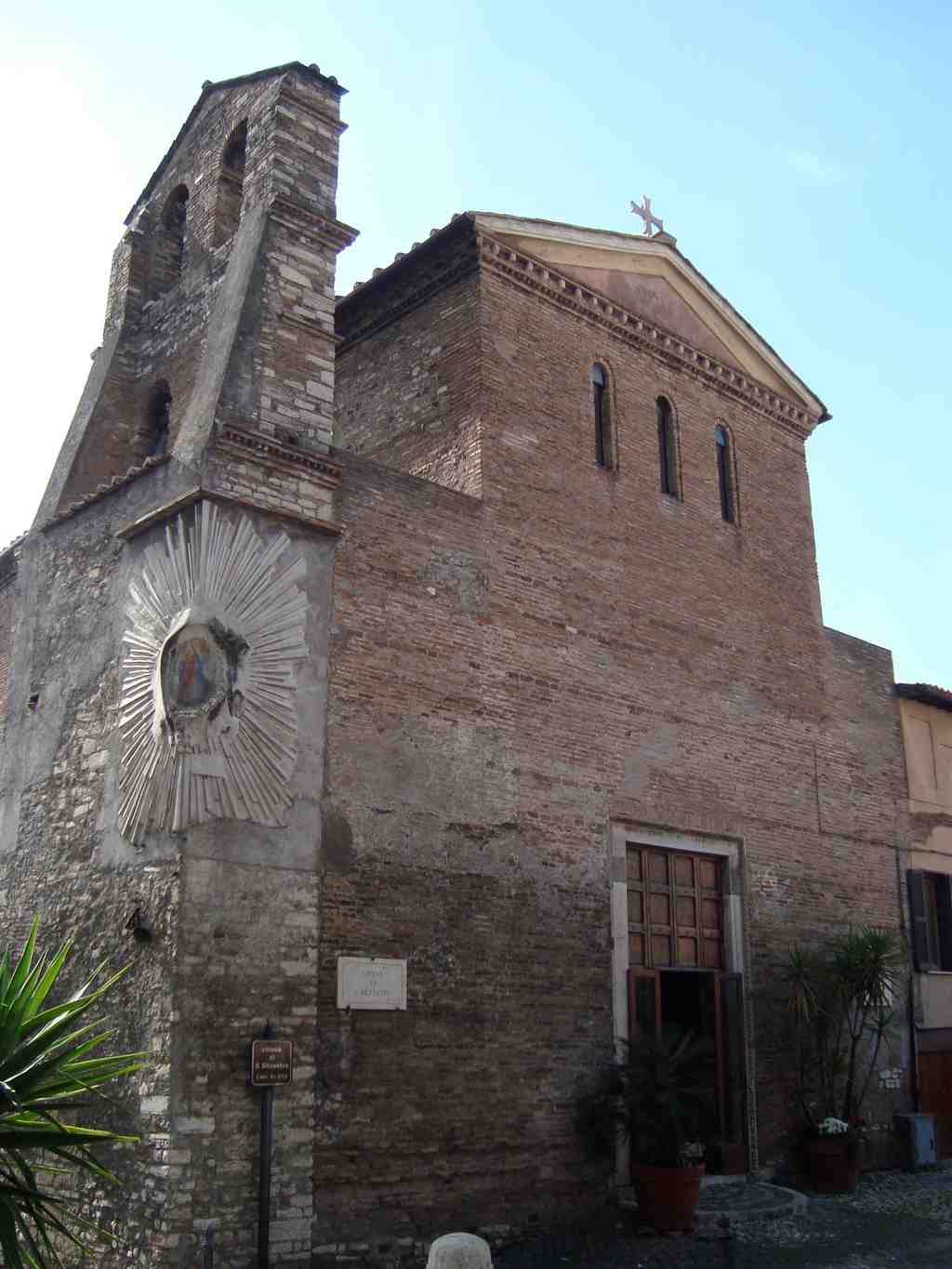
Look to your left to spot the Church of San Silvestro, an ancient building easily identifiable by its flat brick facade, its bright white marble doorway, and a strangely squashed bell tower resting on the roof. Assuming you are standing about twelve meters back from the right side of the building, go ahead and plant yourself right there while we unpack the rather ruthless history of this place.
This church is another monument built by Pope Simplicius, the native son we met at the cathedral, who continued his trend of Christianizing the landscape. Originally, the interior featured three naves, which are the long, parallel halls where the congregation stands, divided by twelve spectacular columns of cipollino marble, a prized ancient stone known for its striking pale green and white swirls. The dedication to Saint Sylvester was highly symbolic, meant to celebrate the definitive triumph of the new Christian faith over the crumbling Roman past.
But reverence for the past rarely lasts here. Fast forward to the sixteenth century, and the powerful Cardinal Ippolito the Second d'Este, who was busy building a lavish villa nearby, casually sliced this church's square bell tower in half and flattened it into a sail shape simply because the original design did not suit his own aesthetic whims.
That was just the beginning of the butchery. In the seventeenth century, the church was literally carved to pieces. The side naves were completely demolished just to widen the street and build a parish house. By seventeen sixty-seven, the church was deeply in debt, prompting the local parish priest, Benedetto Nicolai, to take shocking measures. Because earlier renovations had raised the floor, the twelve precious ancient marble columns were half buried in the ground and awkwardly walled up, so Nicolai ripped them out and sold them. He pawned them off to a wealthy cardinal for a mere two hundred and sixty-five scudi, which translates to roughly thirty-five thousand modern American dollars, an absolute steal considering each column was appraised at over triple that amount. Truly brilliant financial management.
Yet, despite centuries of petty alterations and deliberate destruction, a massive treasure survived hidden inside. In nineteen eleven, restorers chipped away thick layers of plaster to reveal spectacular frescoes from the thirteenth century. These paintings stretch ten meters high into the apse, the vaulted semicircle at the back of the church.
They feature incredibly theatrical legends from the life of Pope Sylvester. In one scene, a magician named Zambri tries to prove his power by whispering a secret word into the ear of a ferocious bull, striking the massive animal dead instantly. Not to be outdone, Pope Sylvester stepped up, whispered the name of Christ, and resurrected the bull right in front of everyone, converting the stunned crowd. The cycle ends with a delightfully dark legend where Sylvester descends into a cavern under the Roman Forum to face a dragon whose venomous breath was killing hundreds of men a day. He boldly tied the beast's jaws shut, a vivid metaphor for silencing the old pagan ways.
It is a miracle those frescoes survived the wrecking crews. To get a better sense of what this church's original medieval architecture looked like before the centuries of demolition took their toll, let us walk over to San Pietro alla Carità, which is just a five minute walk away.


