
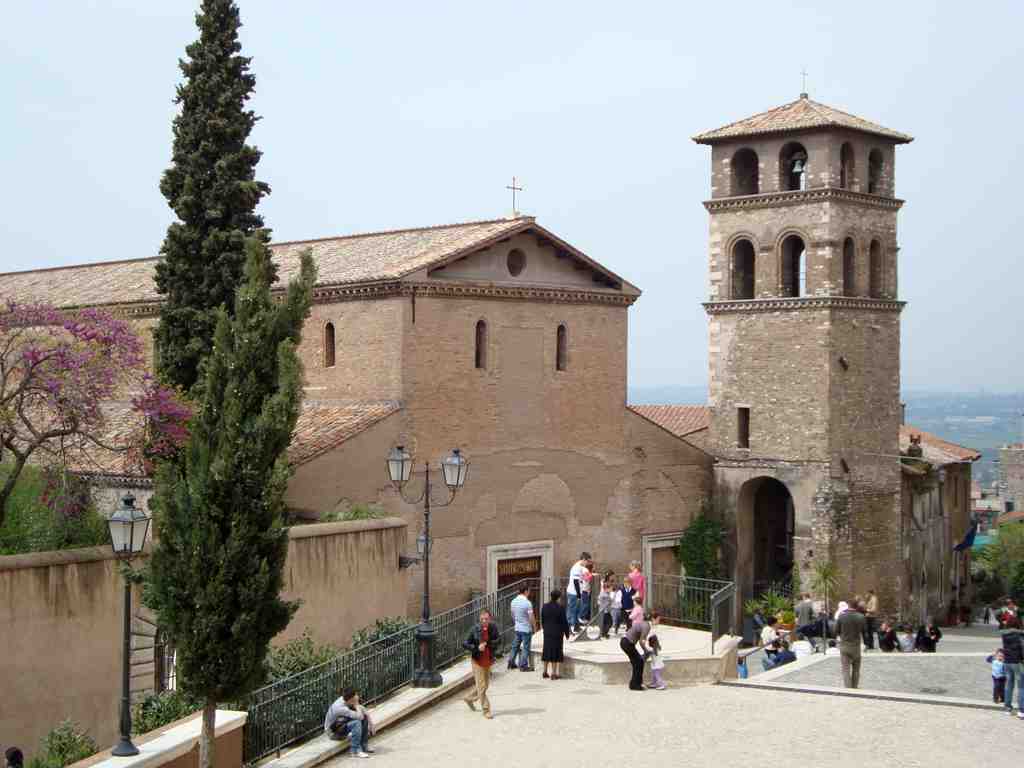
Looking to your left, you will spot the San Pietro alla Carità, a simple brick structure with a prominent square bell tower featuring open arched windows, and a modest facade boasting three white stone doorways, though the outer two are completely sealed shut.
This modest exterior hides a stubborn survivor. Its story perfectly captures how the past here refuses to be buried, no matter how many times people try to build over it. Once again, we find the legacy of Pope Simplicius, determined to establish a Christian Tivoli, building this church directly on top of the ruins of a massive ancient Roman villa. In fact, inside the nave, the soaring central hall of the church, you will see eleven columns made of cipollino marble. Those were scavenged straight from the Roman rubble beneath the floorboards.
Over the centuries, the church lived many lives. By the Middle Ages, its walls and apse, the semi circular space behind the altar, were entirely covered in vibrant frescoes. It even housed the highly revered thirteenth-century wooden sculpture of Christ being taken down from the cross, kept safely here until sixteen forty-one when it was moved to the Cathedral we saw earlier.
But survival here is never guaranteed. In the sixteenth century, the church almost vanished. An ambitious architect named Pirro Ligorio was drawing up plans for the grand gardens of the adjacent Villa d'Este. Ligorio wanted a blank canvas, so he planned to just bulldoze this church and clear out the old town. Luckily, the Pope stepped in and forbade the destruction, forcing a very frustrated architect to build his garden around the medieval structures instead.
Later, Carmelite monks completely overhauled the interior, covering the medieval stonework with lavish Baroque stucco. That opulent disguise lasted until nineteen forty four, when devastating Allied bombings severely damaged the building. Left in ruins, the city had a choice to make. During the rebuilding in nineteen fifty one, restorers made the drastic decision to strip away every last piece of the damaged Baroque plaster to expose the original medieval bones. That aggressive restoration is why the two side doors on the facade are permanently sealed today.
Despite war, ambitious architects, and changing tastes, pieces of its original beauty survive today. Inside, you can still find vibrant fragments of those original medieval frescoes, and walk across the intricate, geometric marble mosaic of the historic cosmatesque floor.
It is a quiet, resilient place. But just a five minute walk away, we will see what happened when that frustrated architect finally got to build his masterpiece. Let us head over and prepare for the ultimate expression of wealth and power at the spectacular Villa d'Este.


