
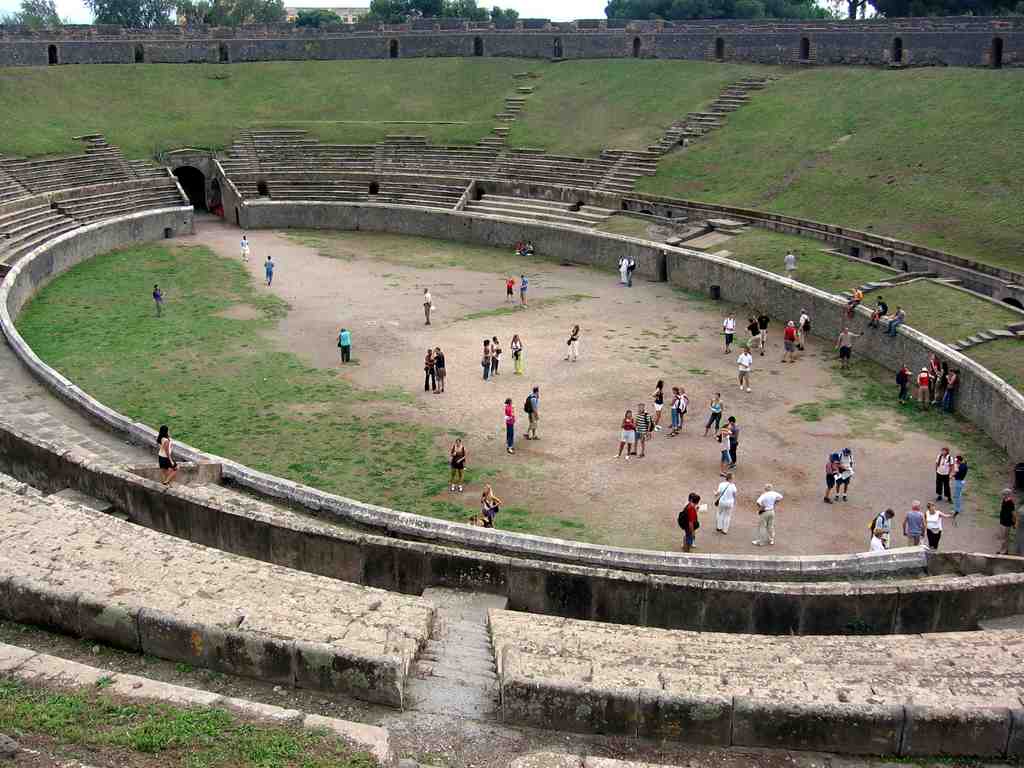
Dating back to around 70 BC, the Amphitheatre of Pompeii is one of the oldest surviving Roman amphitheatres. Can you believe it's been standing for over 2000 years? It's located in the ancient city of Pompeii, near Naples, and was buried by the catastrophic eruption of Mount Vesuvius in 79 AD, along with the entire city of Pompeii and the neighboring town of Herculaneum.
During excavations, six bodies were discovered within the amphitheatre, reminding us of the tragic events that unfolded here. But let's focus on the awe-inspiring history instead!
Back in its glory days, this amphitheatre was known as a spectacula rather than an amphitheatrum, as the latter term wasn't widely used at the time. It was built with the private funds of two generous donors, Gaius Quinctius Valgus and Marcus Porcius. They had a noble motive, "to demonstrate the honor of the colony," possibly indicating the role of this grand structure in establishing Roman influence in Pompeii.
Now get ready for some astonishing numbers! The Amphitheatre of Pompeii was designed to accommodate upwards of 20,000 spectators. The layout was considered near-optimal by modern crowd control specialists. And the design of the lower entrances for higher-class citizens was truly exceptional. As they entered the amphitheatre, they would be struck by both the beams of light flooding through the dark tunnel and the deafening roar of the crowd, creating an electrifying and unforgettable experience.
One unique feature of this amphitheatre is that it was one of the earliest built entirely of stone, as previous versions were constructed with wood. This meant that, unlike later amphitheatres, there were no underground areas for the gladiators. Instead, the quadriporticus (a colonnaded courtyard) was built above ground and close to the arena. After events concluded, the dead would be taken through a large door named the Porta Libitinensis for proper disposal.
Can you believe that even the washroom facilities of the amphitheatre had an impact on modern stadium design? The nearby palaestra's washroom has been cited as an inspiration for better bathroom arrangements in today's stadiums.
The amphitheatre measures an impressive 135 meters long and 104 meters wide, with the arena (or pit) located 6 meters below ground level. Inside, you'll find a corridor that runs along the circumference of the amphitheatre, providing access to the arena. This architectural detail has helped us gain valuable insights into the gladiatorial culture and events that took place here.
Imagine walking through the corridors and witnessing the vibrant frescoes on the walls. These painted posters depict gladiators with accompanying slogans and nicknames, reminiscent of our present-day posters and billboards of sports stars and celebrities. Some of these posters would even be repainted to announce the outcomes of major events. Can you imagine the excitement that filled the air?
The amphitheatre has had its fair share of dramatic moments too. In 59 AD, a deadly brawl erupted between Pompeiians and residents of Nuceria during a game here, leading to a 10-year ban on such events. However, beast hunting and athletic competitions were still allowed as a compromise. It's believed that the intervention of a prominent citizen and a local magistrate played a role in these exceptions.
The amphitheatre suffered damage from an earthquake in 62 AD, but thanks to the efforts of magistrate Cuspius Pansa and his son, it was restored to its former glory. The 10-year ban on events was lifted, and the amphitheatre continued to be a hub of entertainment once again.
In more recent times, in October 1971, the Amphitheatre of Pompeii served as a stunning backdrop for a concert film by the legendary band Pink Floyd, titled "Pink Floyd: Live at Pompeii.


