
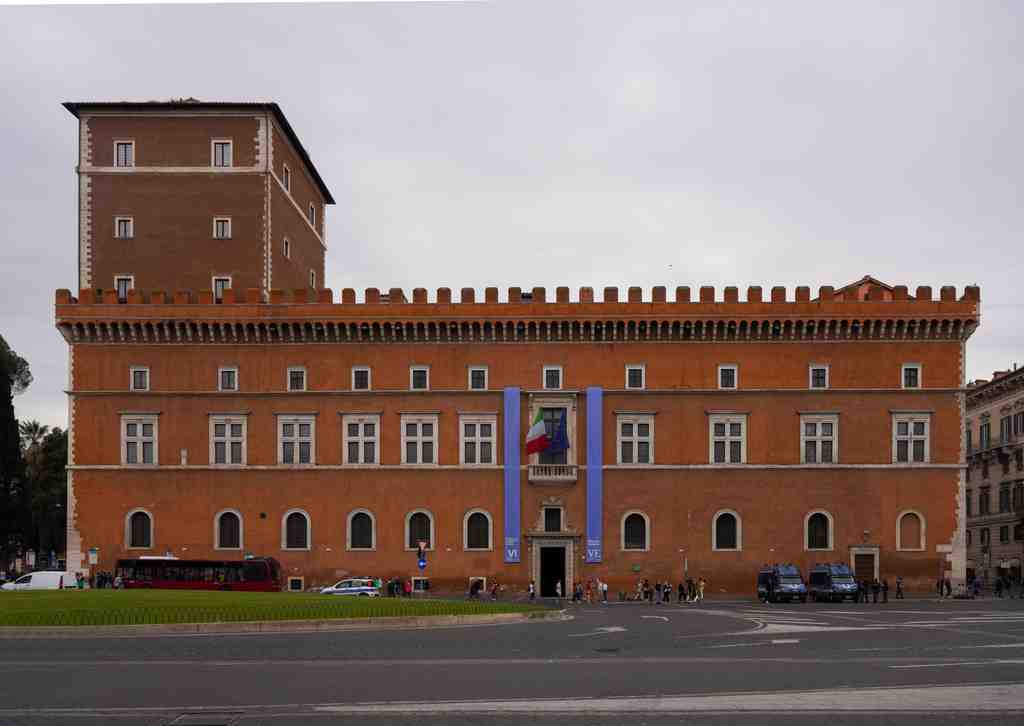
To spot the Palazzo Venezia, just look for a huge, almost fortress-like building of reddish-brown brick stretching out along the side of Piazza Venezia, with rows of arched windows, a tall square tower at one end, and its big, forbidding main entrance looking right at the square.
Before you, the Palazzo Venezia stands in all its massive, Renaissance glory-but if you think it looks more like a medieval fortress ready for a siege than a delicate Italian palace, well, you’re right on track! Take a deep breath and imagine the past echoing around you-horse hooves, flag bearers, shouts from the square. Now add a little drama, because this palace has hosted popes, emperors, ambassadors, and even a notorious dictator who liked to keep the lights on at night just to seem busy. I guess you could call it history’s first “I’m still working” notification!
It all started with a cardinal named Pietro Barbo-Venetian by birth, lover of art and antiquities, and future Pope Paul II. Back in the 1450s, Rome was still shaking off its medieval look, and Barbo wanted to make a statement. So, he transformed a rather humble cardinal’s house into the mighty Palazzo di San Marco, layering on the Renaissance style, but let’s be honest, the place still looks ready to repel invaders. Just picture piles of stone being hauled from the Colosseum-not for gladiator games, but to build up these thick walls. That’s recycling, ancient Roman style!
But this was no ordinary palace. Barbo decided he didn’t need Venice’s carnival when he could throw a cultural festival right here, amassing statues, tapestries, and a treasure trove of art. When he became Pope Paul II, the palace got another serious upgrade-fortifications, gardens to stroll in, and the famous Biscia Tower, whose name may come from a snake-like sculpture hidden in its walls. On the west, it snuggles up to the ancient Basilica of Saint Mark, as if keeping an old friend close by.
If you had arrived here in 1536, you might have witnessed the Holy Roman Emperor Charles V strutting through a triumphal arch, greeted by Pope Paul III himself. The atmosphere would have buzzed with intrigue as they discussed how to respond to the Reformation, holding a secretive, high-stakes meeting behind these stone walls. The popes clearly loved a grand entrance-carving out the Palazzetto, a lush, three-tiered garden cloister at the southeast corner (which was later moved down the road to make way for your next stop, the Victor Emmanuel II Monument).
And let’s not forget the Venetians! In 1564, Pope Pius IV, trying to charm the Republic of Venice-because who doesn’t want Venetian friends?-gave them a huge chunk of this place for their embassy, as long as they promised to let the local churchmen crash here, too, and maybe fix up a wall or two. There’s even a whole wing named after the Cibo family, which you can spot off Via del Plebiscito, if you’re keen to venture further.
Fast forward to the 20th century, and the grandeur of Renaissance art had given way to something entirely different-fascist footfalls and political theater. Benito Mussolini moved in, dragging his family, his favorite mistress, and a chestful of ambitions. He made this palace his personal HQ, and from the iconic balcony above you, he delivered thundering speeches while thousands of people crammed the square below, waving flags and hanging on every word. Imagine the roar:
Mussolini liked to project the image that he never slept-so he left the lights blazing in his office all through the night, a beacon of political drama. Yet, the palace witnessed not just triumphs, but drama’s final curtain: in 1943, in the grand Hall of the Parrot, Mussolini’s own party voted him out. Talk about a plot twist! The palace’s halls, which had echoed with power for centuries, suddenly fell silent as the regime ended.
Even after the fall, this place kept secrets. As recently as 2010, workers uncovered a “most secret” unfinished bunker beneath the building-Mussolini’s very own escape plan, left hidden and unfinished. Who knows what else lurks in these shadowy halls?
Today, Palazzo Venezia is a museum filled with Renaissance art and ancient artifacts, its rooms heavy with stories and memories-each whispering a different tale. So as you stand before its imposing walls, picture emperors, popes, Venetian ambassadors, and a dictator pacing late into the night. Every stone here has a story, and every story, a twist. That’s Rome-where history loves to throw a surprise party!




