
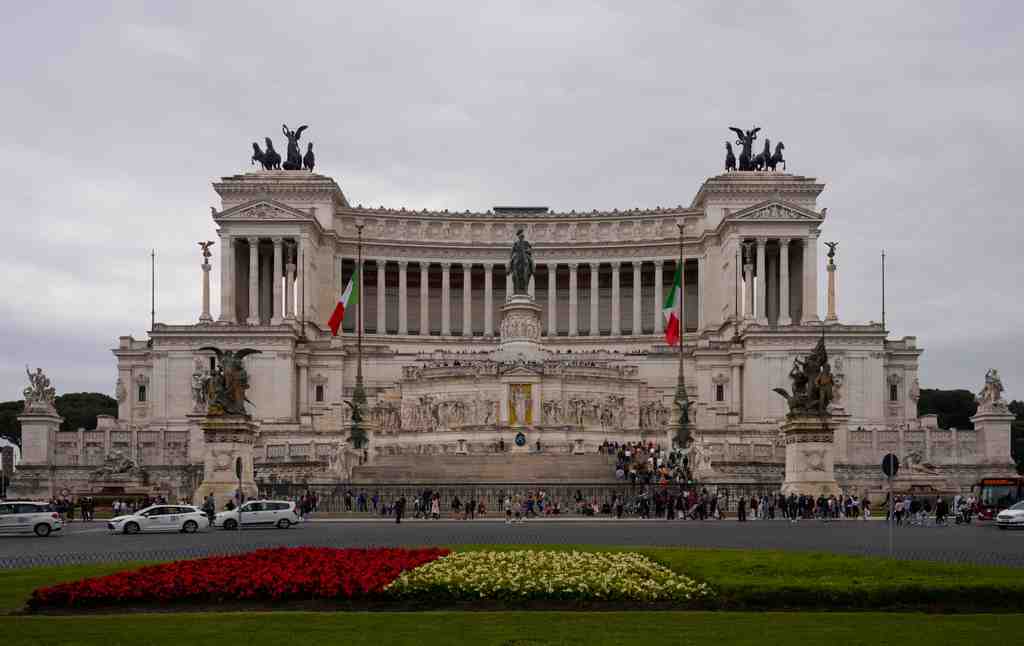
Look straight ahead for a massive, brilliant white marble structure rising above the city, with sweeping staircases, towering columns, bronze horse-drawn chariots on the roof, and the enormous statue of a man on horseback right in the center-if you feel like you’ve been invited to Rome’s fanciest wedding, you’ve spotted the Victor Emmanuel II Monument!
Congratulations, you’ve reached the final and perhaps flashiest stop on our Roman adventure: the Victor Emmanuel II National Monument, or, as the locals like to jokingly call it, “the Wedding Cake”. If you’re feeling a little underdressed, don’t worry-this monument does have a habit of outshining everyone!
Imagine yourself standing amidst the grandeur of the early 1900s. Men in uniforms and women in lace stroll around, the whole city buzzing about the latest symbol of Italian pride being built right here, layer by extravagant layer. Designed by Giuseppe Sacconi and constructed between 1885 and 1935, this colossal structure honors Victor Emmanuel II, Italy’s very first king-the man who stitched the country together like a tailor fitting a patchwork quilt, uniting all the different “states” into one proud nation. But building this wonder wasn’t just a matter of putting up marble and calling it a day. Sacconi wanted to say, “Hey, we’re Italy, and we’re here to stay!”-with the kind of confidence that only 243 steps and a finishing touch of chariots can provide.
Right now, as you look up, picture crowds gathering, soldiers marching, and an orchestra playing a patriotic tune to dedicate this new heart of the city. Where you see those huge curved stairways, that’s not just architecture-it’s a modern Roman forum! On three magnificent levels, you’re invited to climb, discover, and relive the drama of unification. Each tier, each column whispers stories of valor, hope, and strength.
Here’s a fun tidbit for you: the Romans nicknamed it “The Typewriter” for its shape-or, my personal favorite, “The Wedding Cake”, because let’s face it, nothing says ‘commitment’ like 17,000 square meters of white marble, tons of gilded bronze statues, fountains, and enough stairs to make even the fittest gladiator sweat. It’s as if all the styles of Ancient Rome, Greece, and a pinch of modern panache got together for an all-you-can-build marble buffet! The marble glows bright in the sunlight, almost blindingly white, so don’t forget your metaphorical sunglasses-no refunds on eyes gently dazzled by Italian pride.
Walk up the steps and on either side, you’ll spot fountains representing Italy’s two coasts-the Adriatic and Tyrrhenian seas. Straight ahead is the Altar of the Fatherland, guarded by eternal flames and a pair of respectful soldiers. Just beneath the imposing statue of the goddess Roma, the Unknown Soldier rests-a young man lost to war, chosen by a grieving mother so his sacrifice could stand for all those Italians whose names were taken by history. This simple tomb, always watched over, is the heart of so many powerful moments-every Republic Day, Liberation Day, or Armed Forces Day, presidents and families pause here to lay laurel wreaths and remember the costs of freedom.
Now, if you’re curious about the man of the hour, Victor Emmanuel II himself rides above on a gigantic bronze horse. Italian artists from all over the country contributed to this statue-so huge, rumor has it that they once hosted a celebratory lunch inside the horse’s belly before sealing it up. Talk about a king-sized picnic!
Behind King Victor, the colonnade stretches out, curving like a theater for the city below. Each column stands for one of Italy’s regions, and atop each wing sit bronze chariots racing into the sky, celebrating “unity of the homeland” and “liberty of the citizens.” Just think: when the monument was first conceived, Italy wanted to show off its new place among Europe’s great capitals-Berlin had its Brandenburg Gate, Paris its Opéra Garnier, but only Rome could deliver this breathtaking marble mountain topped by winged victories charging into the clouds.
During Fascist times, this spot was the stage for grand military parades and passionate speeches. But after World War II, the monument reclaimed its original, hopeful spirit-transforming again into a place for every Italian, every visitor, to remember and celebrate what it means to come together as one.
And don’t forget the views: climb the stairs or take the glass elevator added in 2007, and 196 steps (or a quick ride) will reward you with a 360-degree panorama of Rome. Below, the city throbs with traffic and stories, but up here, you stand between the past and the present, on marble dedicated not just to a king, but to the very idea of Italy.
So, as the breeze stirs and crowds murmur around you, take a moment to let it all soak in: the glory and complexity, the losses remembered, the victories celebrated. The Victor Emmanuel II Monument isn’t just Rome’s gleaming wedding cake-it’s the altar, the stage, and the heart of a nation still telling its grand story.
To expand your understanding of the general description, tomb of the unknown soldier or the names, feel free to engage with me in the chat section below.




