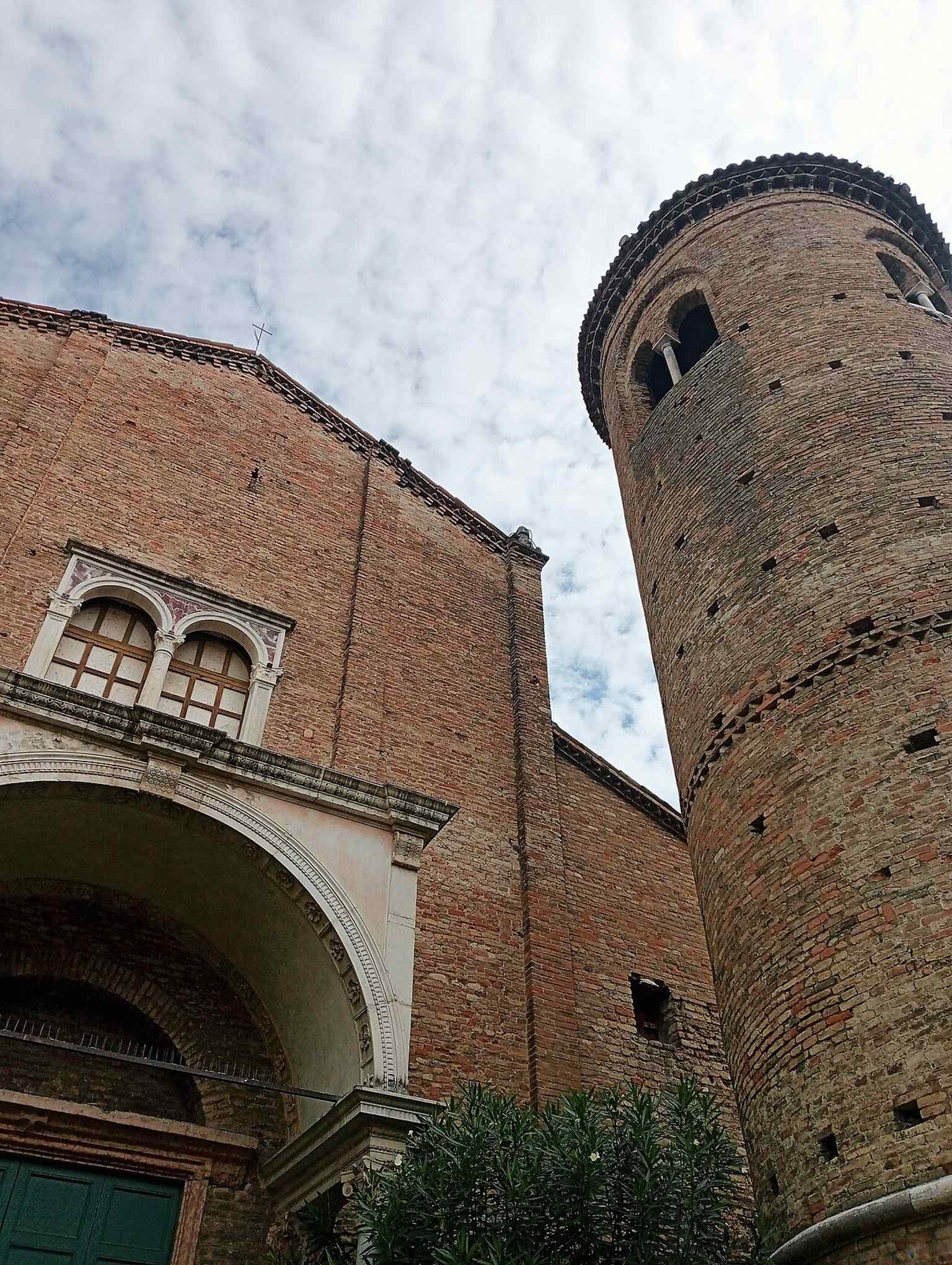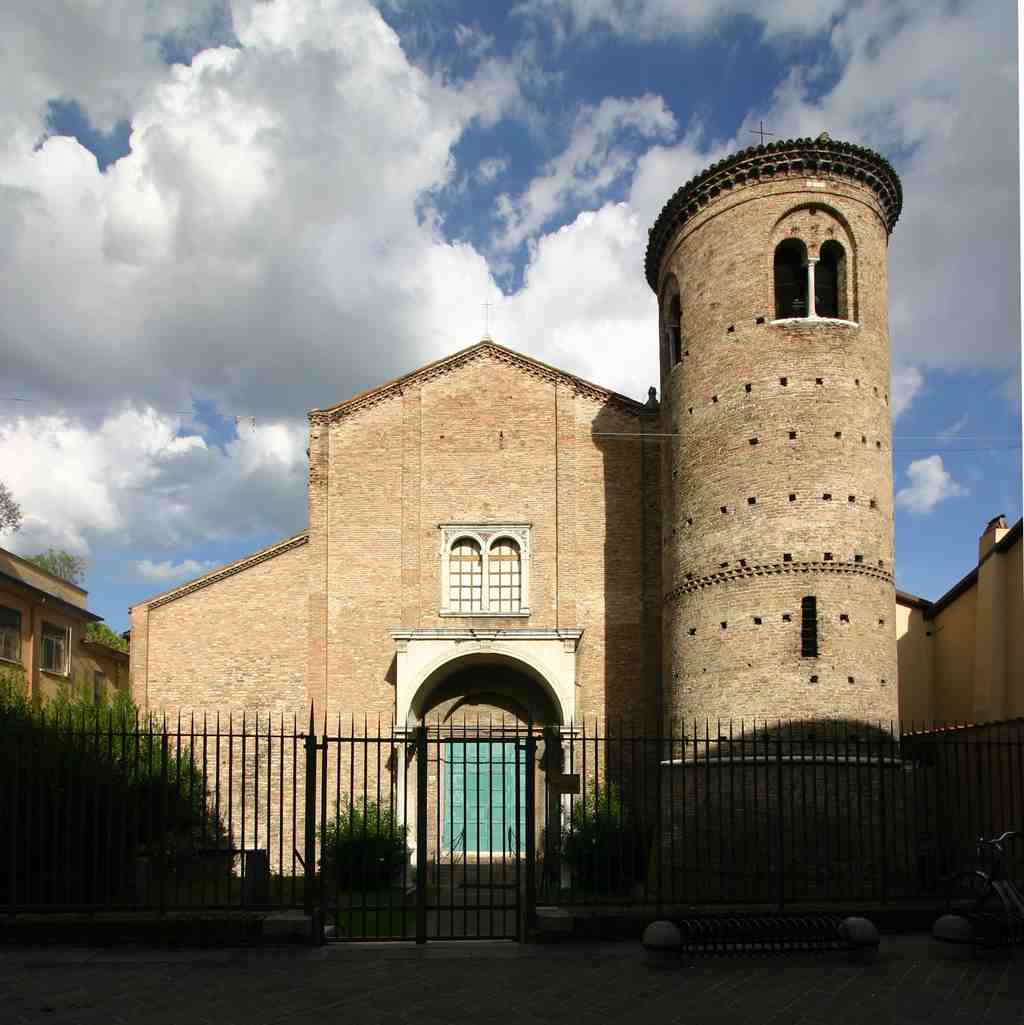
Look for the broad brick facade with its higher central gable, the little stone porch jutting from the main doorway, and the stout round bell tower standing on a curious conical base.
Sant'Agata Maggiore keeps one of Ravenna's most revealing secrets in plain sight. This is one of the places where the city shows you its vertical history most clearly: the original church floor lies about two and a half metres below the one used now. Ravenna does not only preserve the past; in places like this, it has quite literally risen above it.
The basilica began in late antiquity, probably under Bishop John the First in the fifth century, with Bishop Peter the Second close behind; his monogram still survives inside as a small signature in the great central hall, the nave, where the congregation gathered. The apse, the rounded eastern end behind the altar, likely came later, under Bishop Agnello, helped by the banker Giuliano Argentario, the same formidable financier who supported San Vitale. Even in its earliest life, then, this church was already a layered enterprise.
Now look at the ground line. The garden before the facade sits a little lower than the church, and that difference matters. Once, a quadriportico stood here, a four-sided courtyard in front of the basilica. Later centuries dismantled it, and in the sixteen hundreds and after, the whole relationship between church and street changed. After the earthquake of sixteen eighty-eight destroyed the apse mosaic and damaged the building, people raised the floor by those remarkable two and a half metres. The old side doors sank beneath the new level; their lintels still linger near the ground like half-buried memories.
And so the question slips in rather quietly: when a city lifts its churches and streets above earlier centuries, is it hiding its past, or sheltering it?
The answer here is deliciously complicated. In the late fifteenth century and early sixteenth, builders raised and remade much of the basilica. In fifteen sixty they added the cylindrical bell tower you see beside it. Then the early twentieth century arrived, and with it another act of rewriting. Corrado Ricci ordered the houses and shops that had clung to this facade to come down. He gave the church back its face, yes, but he also erased part of the lived-in neighbourhood that had grown around it. Soon after, Giuseppe Gerola excavated the ground in front. He uncovered sarcophagi, fragments, old burials, and turned this forecourt into a kind of open-air lapidarium, a garden of stone memory. Their letters from nineteen fifteen reveal sharp disagreement as well: even saving Ravenna could be a battle of temperaments and visions.
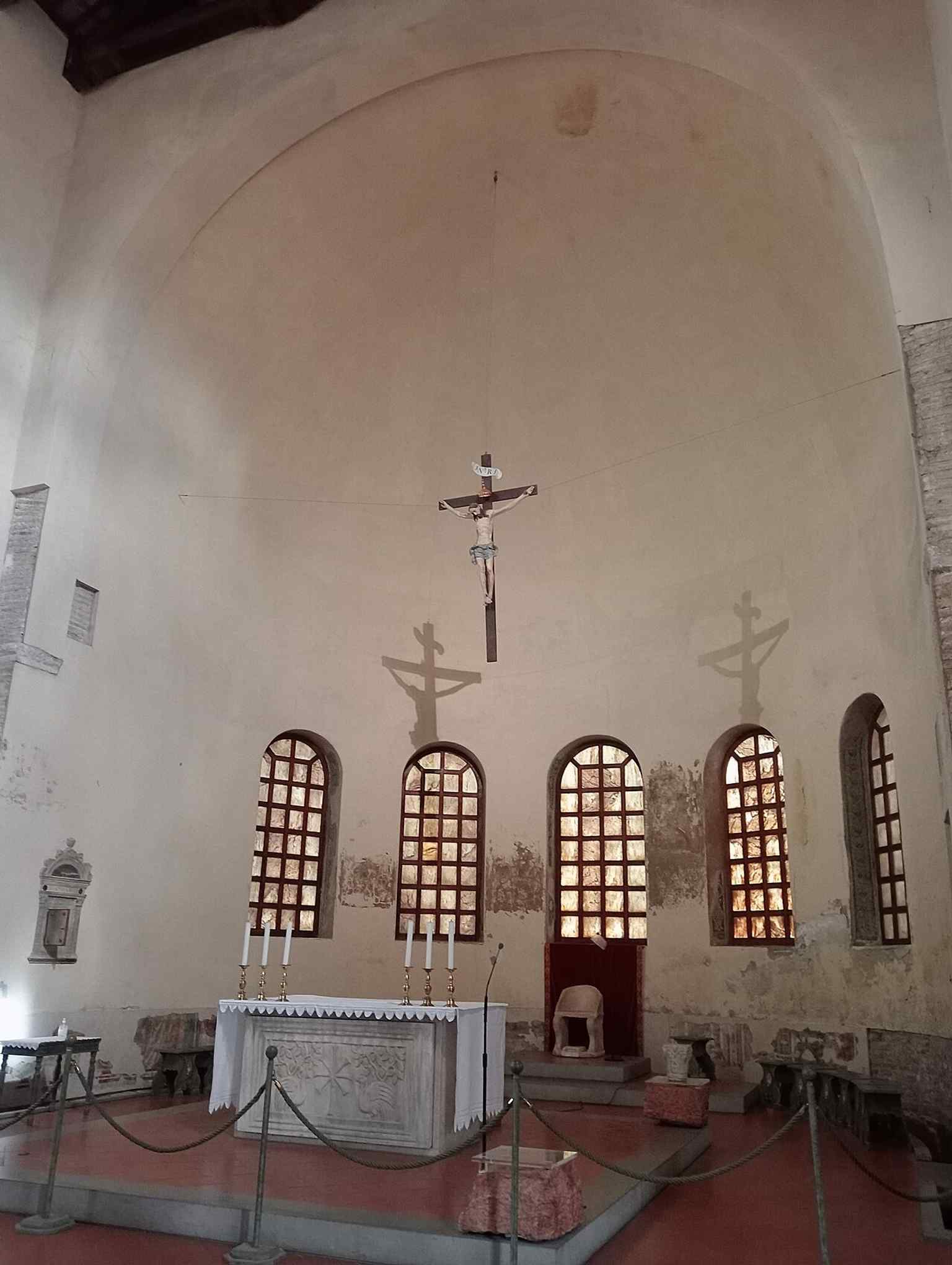
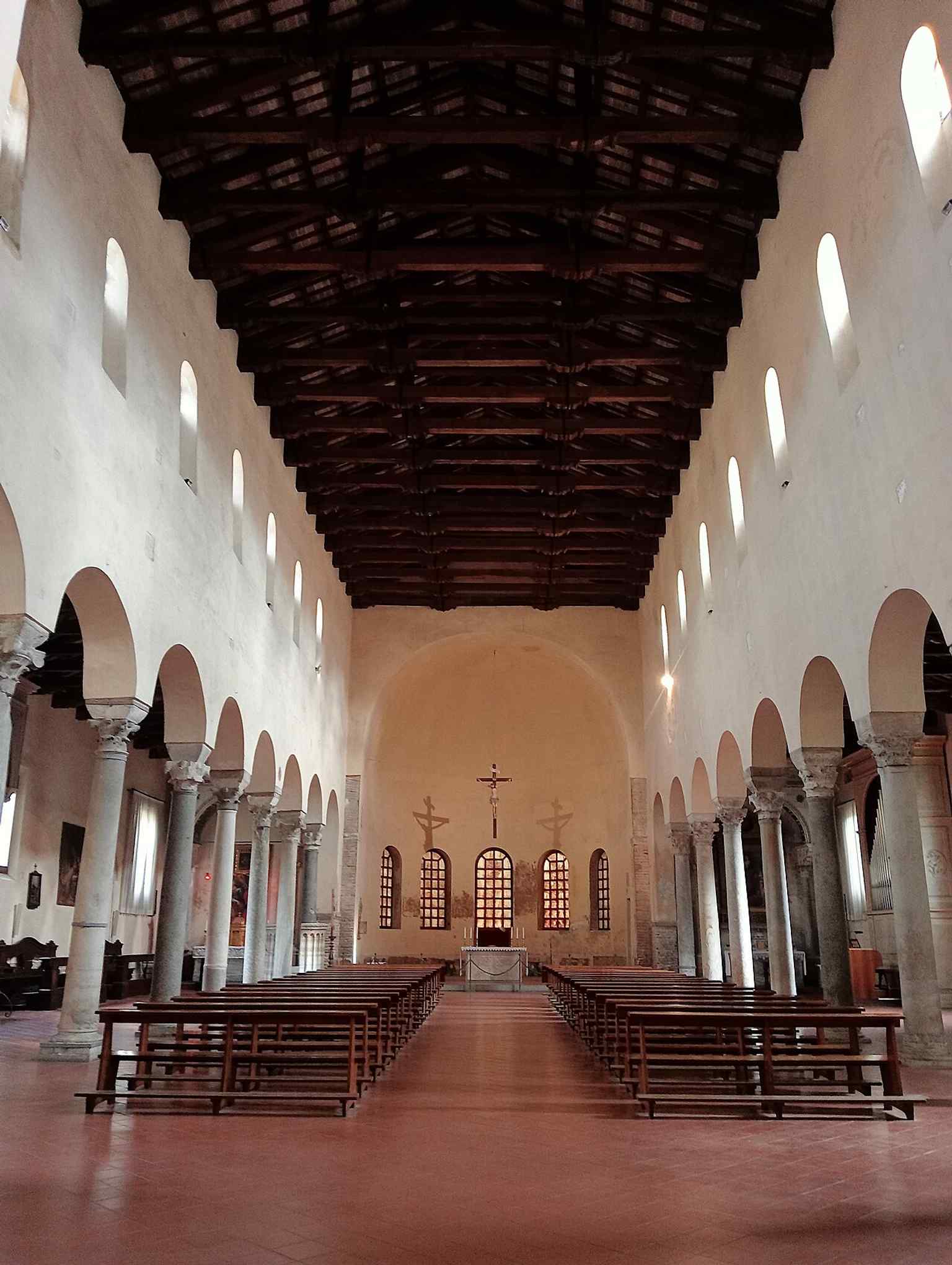
If you glance at the image on your screen, you can see the interior they helped shape: three aisles, spare walls, and mismatched ancient columns reused from earlier buildings, all carefully steered back toward an early Christian feeling. Another image shows how stark that restored atmosphere became after Baroque additions were stripped away. One more ghost lingers here. The lost apse mosaic, known from an old drawing, once showed Christ in scarlet on a throne between archangels, with Bishop John below at the altar. Had it survived, today's raised floor would cut part of that vision in half.
Carry that vertical imagination with you as you continue to the Church of San Romualdo, about a two-minute walk away; in Ravenna, every step may rest on older ground. If you want to go inside, it is generally closed Monday through Thursday, then open Friday and Saturday from nine to one and Sunday from nine to five.