
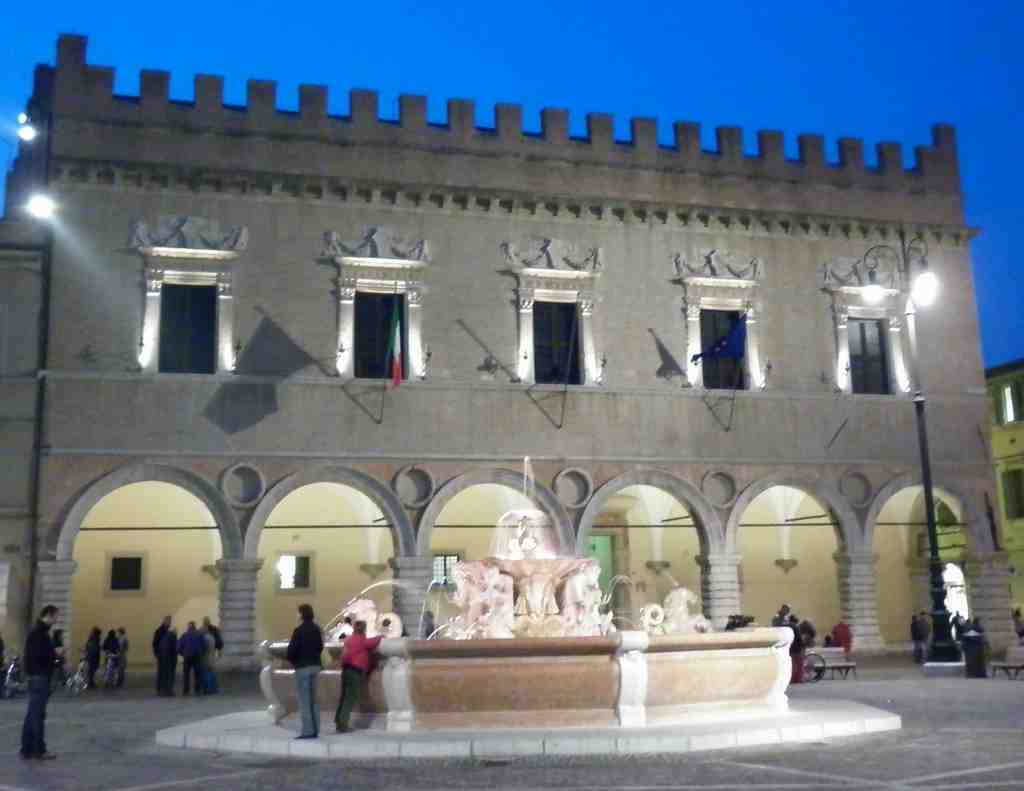
In front of you is a pale stone Renaissance facade with a deep six-arched portico, rough-cut pillars, and a crown of swallowtail battlements along the roofline.
This palace does not hold just one moment of Pesaro's past... it gathers several and lets them sit side by side. Alessandro Sforza began it around the middle of the fifteenth century on an older Malatesta core, and the dukes of Urbino carried the work forward. That means the building in front of you is already a small lesson in the city itself: one family builds over another, and later generations reshape what they inherit rather than starting fresh.
Alessandro Sforza wanted more than a home. He wanted a declaration. In fourteen seventy-five, the great hall here, the Salone Metaurense, then known as the Sala Magna, became the stage for the wedding celebrations of Costanzo Sforza and Camilla of Aragon. Picture banquets, spectacle, music, and noble guests moving through rooms designed to make one family look destined to rule.
Now let your gaze climb from the heavy portico up to that jagged roofline... can you feel the building pulling in two directions, solid and protective below, theatrical above?
That little tension matters. Those split-tail battlements at the top, called Ghibelline crenellations, seem medieval, and most visitors assume they have always been there. But Luigi Serra added them in the nineteen twenties during a restoration, using an old wood inlay in Sant'Agostino as his guide. Many critics still see that choice as a historical distortion, because it gave the palace a more dramatic silhouette and quietly altered its Renaissance truth.
And then, behind all this ceremony, there was a young woman trying to survive court life. Lucrezia Borgia lived here during her first marriage to Giovanni Sforza. These walls witnessed that marriage fail when Pope Alexander the Sixth forced an annulment, and Giovanni later argued that the marriage had not been consummated before fleeing the reach of the Borgia family. So even here, where power dressed itself in elegance, fear and humiliation lived close by.
Later rulers, the Della Rovere, revised the palace again. In sixteen sixteen they replaced the old Sforza ceiling of the Salone Metaurense with a coffered ceiling by Giovanni Cortese that praised their own symbols instead. In Pesaro, memory rarely disappears outright... it gets retouched.
Now let your attention widen from the palace to the open square around it, because courtly power is about to spill into civic space. When you're ready, we'll continue about two minutes to Piazza del Popolo. The palace now serves as the Prefecture and generally opens on weekday mornings from eight to two.




