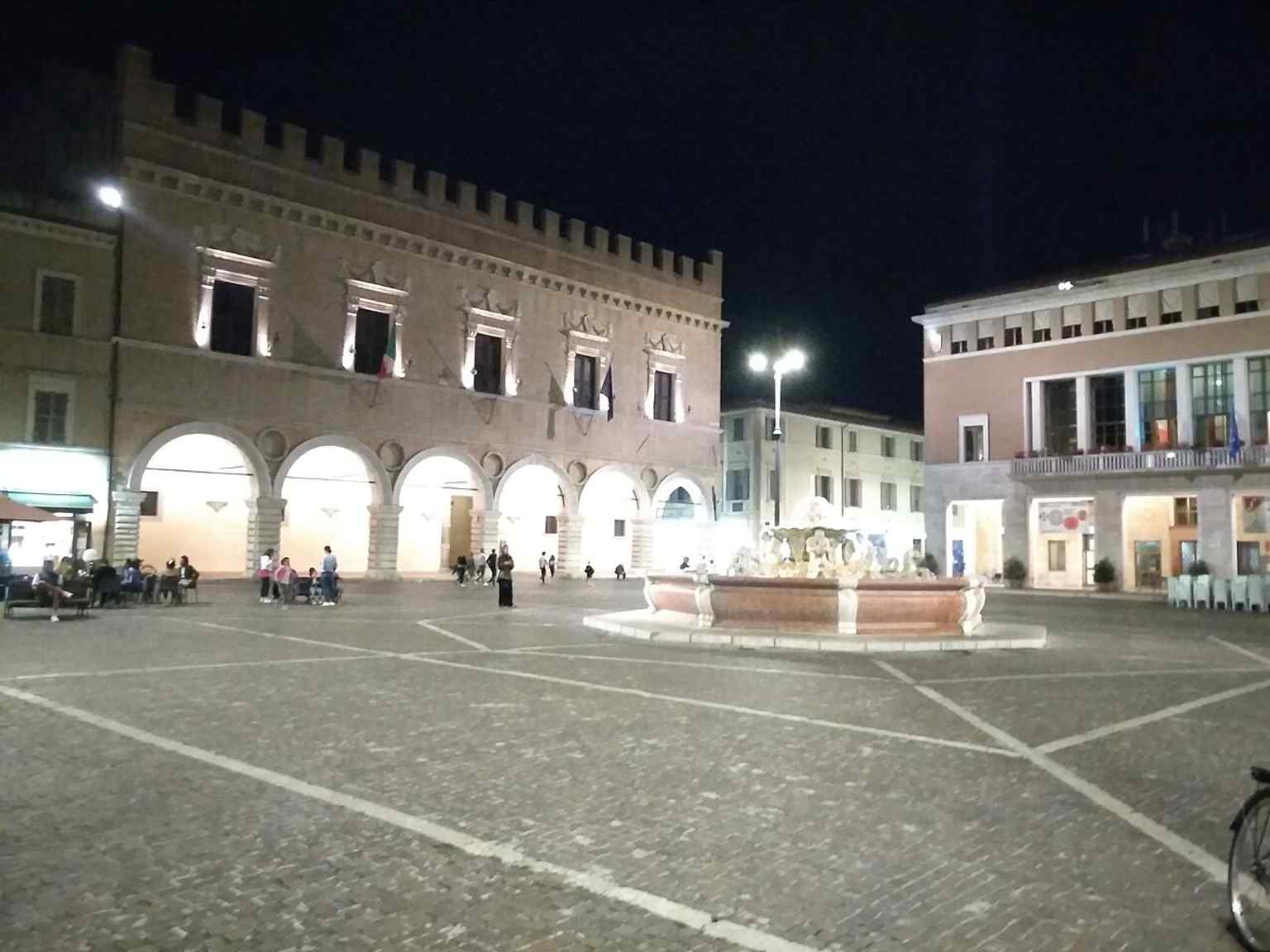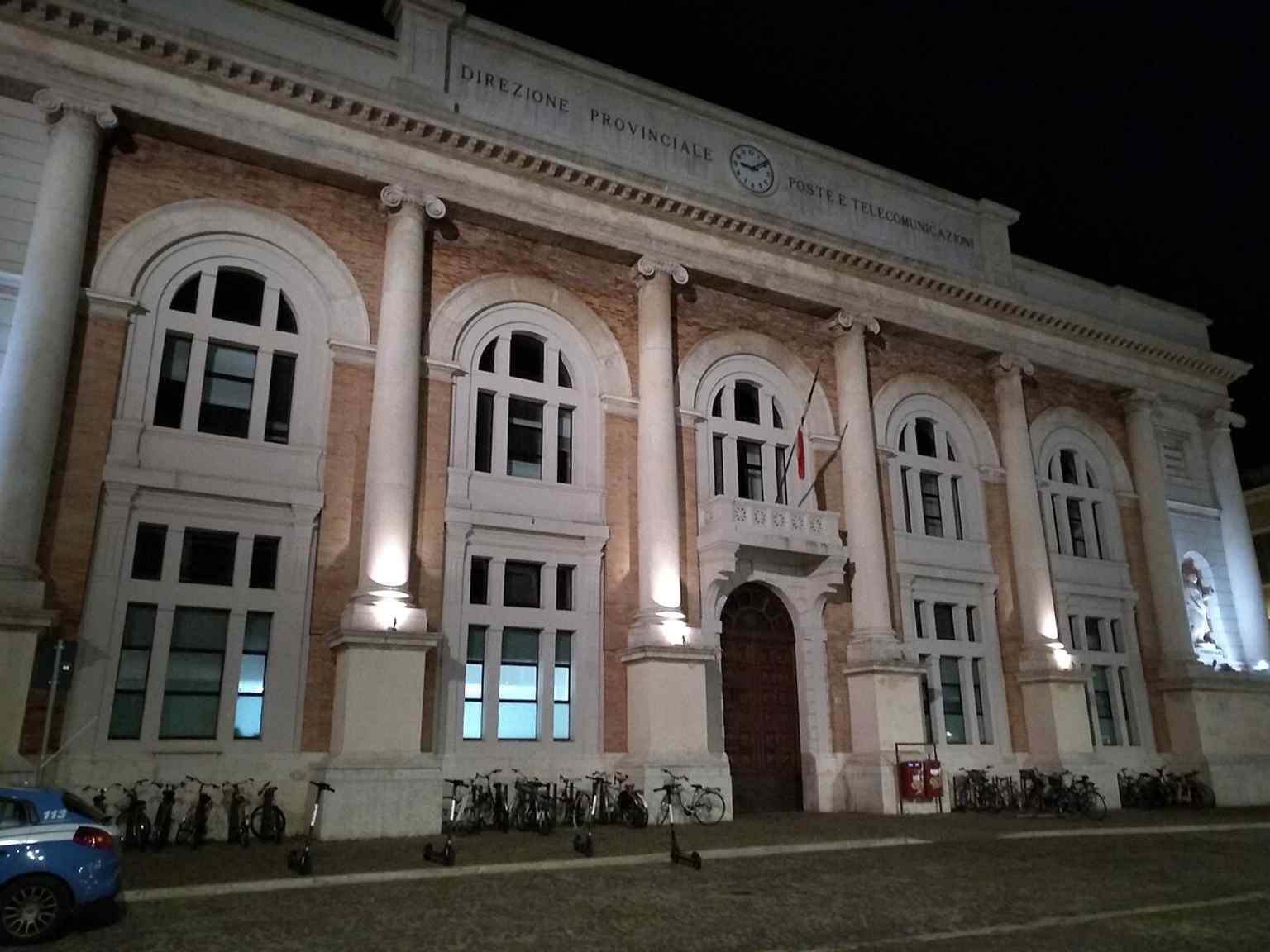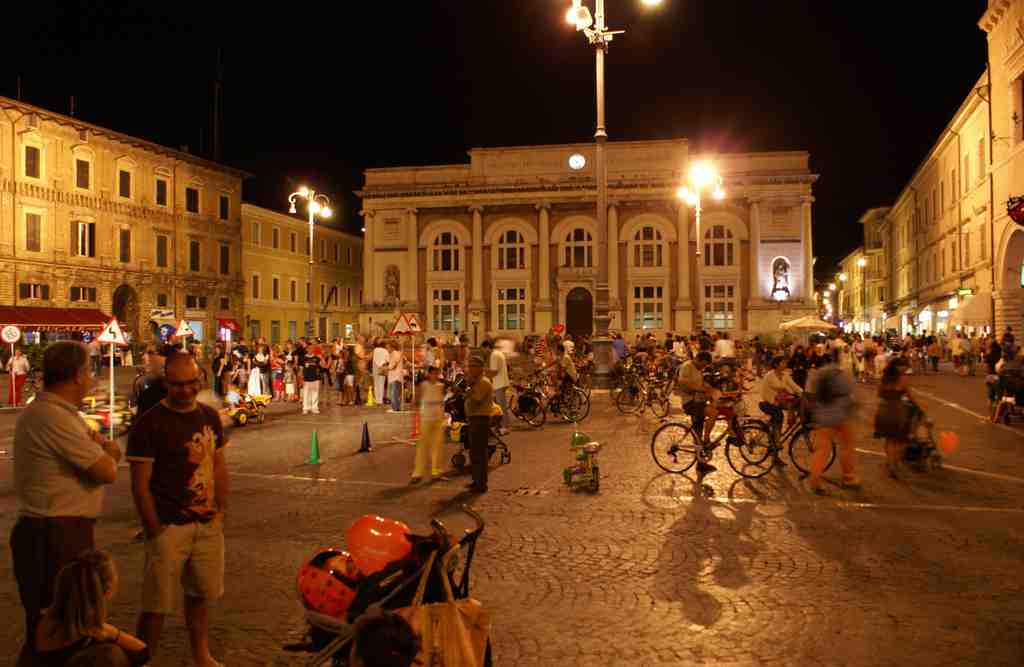
On your right, Piazza del Popolo opens as a broad brick rectangle framed by pale stone palaces, with a round central fountain set like an eye at the center.
This is the civic stage of Pesaro... the place where public life, meaning government, ceremony, and ordinary gathering, has met in the open since the Middle Ages. People came here for decisions, announcements, arguments, celebrations, and the quiet habit of crossing the city’s heart.
What feels orderly now took intention. Around fourteen fifty, Alessandro Sforza gave the Palazzo Ducale its facade, helping turn power into something visible. Then, in the mid-sixteenth century, Duke Guidubaldo the Second looked at this space and wanted more than a practical square. He asked the architect Filippo Terzi to enlarge and reorganize it so the buildings would speak the same language. A few decades later, in sixteen twenty-one, Niccolo Sabbatini took over the project and fixed the square in the form we still recognize, especially for the wedding of Federico Ubaldo Della Rovere and Claudia de’ Medici. For that court marriage, court meaning the ruler’s household and political circle, workers paved the piazza in brick and laid marble bands that drew the eye inward toward the fountain.
If you peek at the wider view on your screen, you can really feel that pull toward the middle.
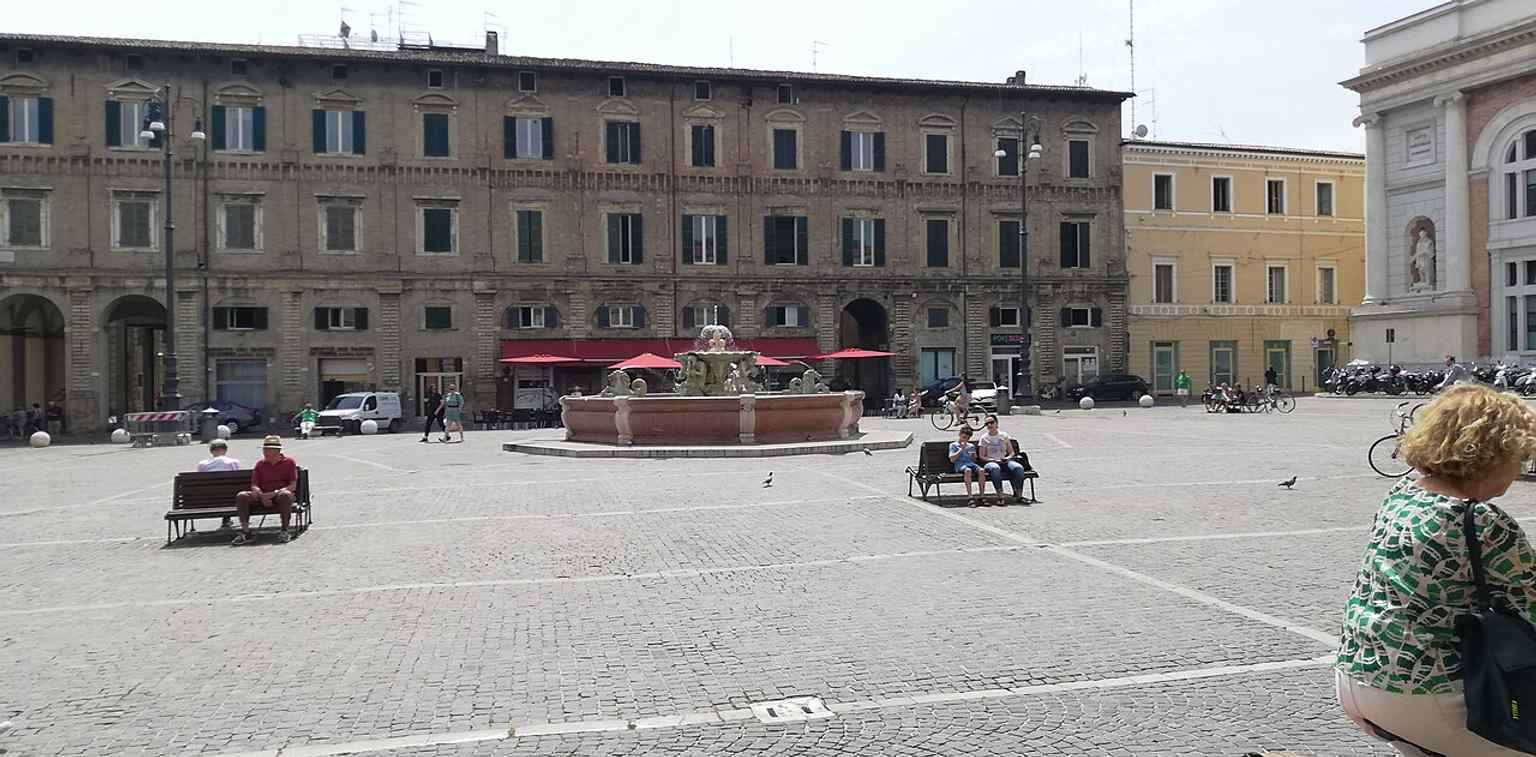
And there it is... the fountain locals once called the pupil of Pesaro. Bernardino Baldi used that name, and it fits beautifully. Francesco Maria the Second della Rovere set the fountain here in fifteen ninety-three. For the wedding in sixteen twenty-one, craftsmen added bronze dolphins and richer ornament. But here’s the part many people miss: this fountain did not live just one life. In sixteen eighty-four and sixteen eighty-five, the sculptor Lorenzo Ottoni reshaped it in a more baroque style, more dramatic and flowing, yet it still kept the same job... to watch over the square and hold it together.
Then came August of nineteen forty-four. Retreating German forces blew up the fountain, along with other city buildings, to block the passage of armored vehicles. Pesaro rebuilt it in nineteen sixty, faithful to the older form, and restored it again in nineteen eighty-eight, bringing back the colors of Istrian stone and Veronese marble.
Around you, the square still carries layers of service. The town hall stands on a site used for communal government since the thirteenth century; its older civic tower once held the town clock and bell, and those survive inside the present building. The Paggeria, designed by Filippo Terzi in fifteen sixty-four, housed pages, the young attendants who kept ducal life running behind the scenes. Even ceremony needed helpers.
Take one more look across the whole space from above in the app. You can see how power arranged this square carefully... but not everything in Pesaro speaks in such a public voice. From here, we’ll leave the city’s formal stage and walk toward a place shaped by quieter faith, the Sanctuary of Our Lady of Graces.