
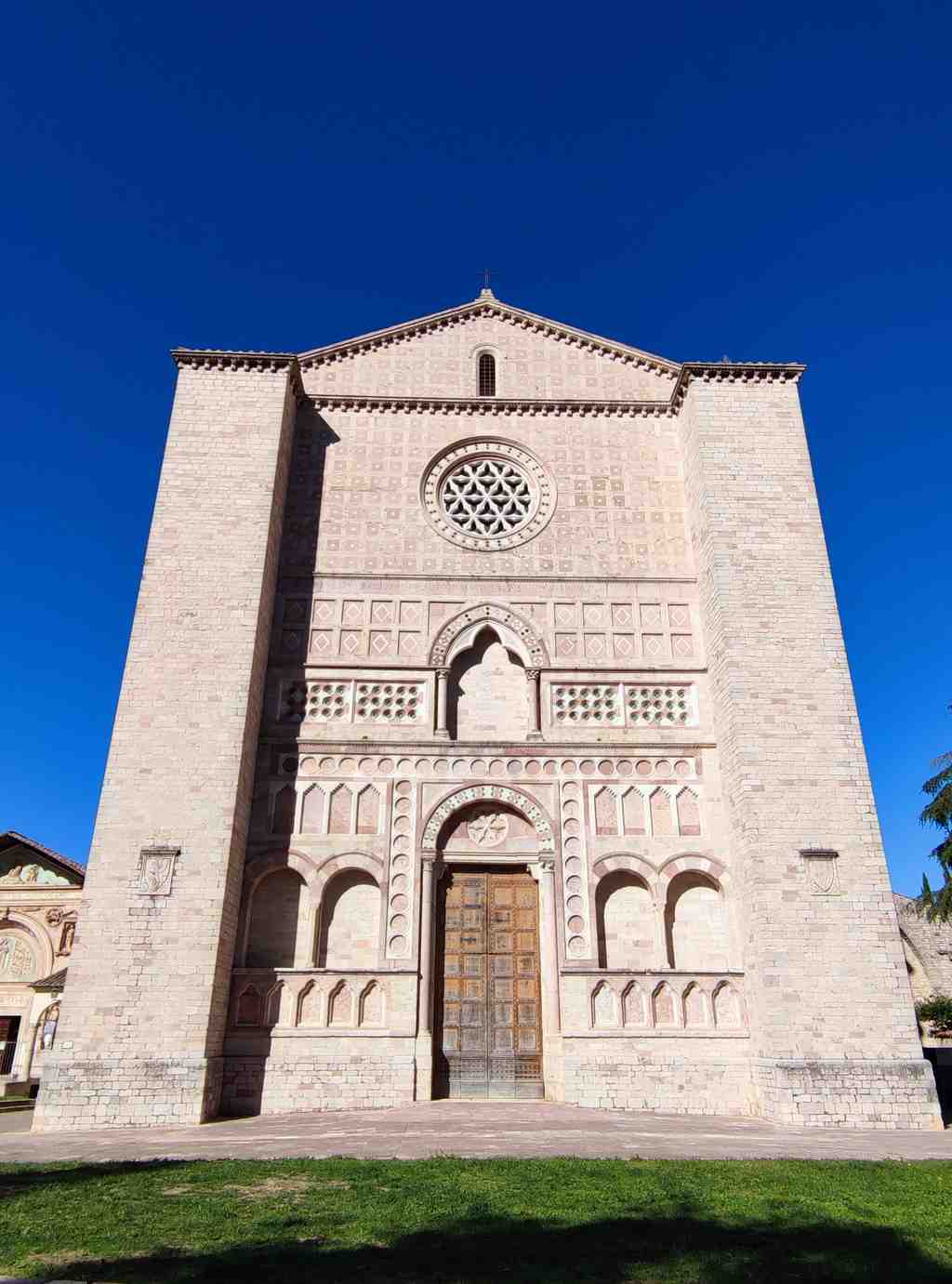
Look straight ahead for a tall, light-colored stone church with a beautifully patterned facade and a big round rose window-the great door, framed by arches, makes it impossible to miss!
Welcome, traveler, to one of the most dramatic survivors in Perugia’s story-the Church of San Francesco al Prato. Imagine a field where vegetables grew and farmers worked the soil, and now, standing tall in the sunlight, is this striking church, whose face is elegantly checkered with pink and white stone and crowned by a rose window looking like a giant wheel of lace.
But don't let its peaceful look fool you-this church has weathered more drama than a soap opera. Constructed back in the 1200s as one of the very first big Franciscan churches after St. Francis himself passed, it was a magnet for Perugia's powerful families, famous scholars, and even legendary warriors who chose this place as their eternal VIP lounge (let’s call it the “Pantheon” of Perugia).
The soil beneath your feet once held bits of an even older church-St. Susanna-from the 1100s! The Franciscans cleverly stacked their new church right above the old, just like the twin basilicas in Assisi. Hidden underneath, there was even a secret crypt, filled with relics and art, drawing pilgrims like moths to a holy flame. People worried someone might snatch up the remains of Blessed Egidio, St. Francis’s third main companion, so they hid the crypt behind walls. Don't try sneaking in now; you’d get lost under centuries of history and probably a layer of dust thicker than your guide’s joke book.
As the centuries passed, San Francesco al Prato became the place for Perugia’s aristocrats and the city's most notable folks to be buried, like a local hero bingo card-there’s Braccio da Montone, a famous noble, Bartolo da Sassoferrato, a jurist whose words echoed in the university halls, not to mention whole lines of Baglionis, Oddis, and della Corgnas. Family feuds were so heated here, you almost wonder if someone buried their hatchets-or at least their family rivals-in the crypt!
Yet, the ground itself seemed to have a grudge against the church. Landslides, earthquakes, and shaky soil turned the place into the leaning tower of Perugia. Vaults collapsed, leaving the church open to the sky for years-just imagine coming to Mass with an umbrella! Over the ages, parts were rebuilt or restored, the most famous being the colorful cosmatesque facade you see, revived in the 1920s with original stones under the eyes of architect Pietro Angelini.
And as times changed, so did the church: it lost its sacred status, then watched its interior get ripped out, its priceless art shipped to France or museums, its famous altarpieces by the likes of Raphael now wowing visitors in Rome or Paris. For years, San Francesco al Prato was a poet’s ruin, roofless, wild, and windswept.
Today, the church has been reborn again-as an auditorium! Art and echoes now bounce off its ancient walls. Restoration is ongoing, and just in 2024, the Oddi chapel opened after years of careful work, reuniting remains and memories. Digital wonders project lost masterpieces where altars once stood, marrying old Perugia with new technology.
So next time you spot a patch of sky where there shouldn’t be one, or hear a distant note of music wafting from these old stones, remember the Church of San Francesco al Prato-where saints and soldiers once rested, and where Perugia’s history sings on, vaults or not.
Eager to learn more about the description, former convent or the image gallery? Simply drop your inquiries in the chat section and I'll provide the details you need.




