
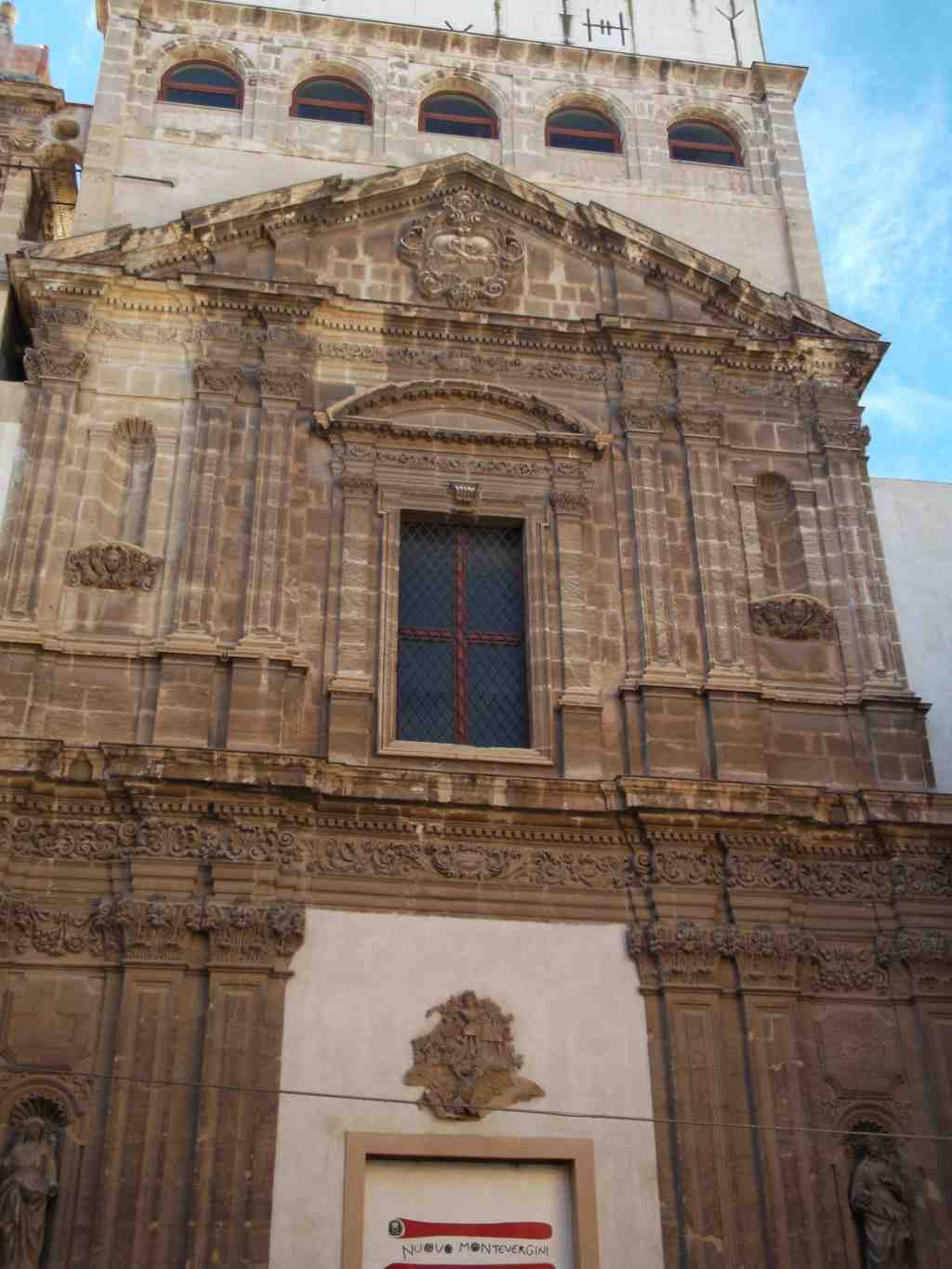
Look for a grand stone facade with sculpted columns, statues in deep niches, and a row of elegant arched windows near the top-Teatro Nuovo Montevergini’s intricate entrance is directly in front of you as you stand on the narrow street.
Now, let me whisk you back through centuries of Palermo history, right here on this spot. Picture the year 1498, when this very site first heard the soft tread of cloistered footsteps-a time when the area was just being transformed into the Monastery of Santa Maria delle Grazie di Montevergini, founded by a determined woman, Luisa Settimo, with a special papal license from Pope Alexander VI. Of course, back then, the air was thick with the sounds of daily prayers and whispered secrets, not the applause of the theater!
Originally, what you see now grew from many layers-quite literally. Centuries after its founding, the monks and nuns here watched walls rise and fall, as the original church of Sant’Elia merged with Santa Maria Maggiore, and even the noble home of the Marquis of Geraci was absorbed into the ever-evolving compound. It was a bit like historical Jenga, each ruler adding or taking away blocks, balancing piety with political intrigue.
Fast-forward to the bustling 17th century. Picture Spanish soldiers fortifying the neighborhood, local clergy scrambling to find new homes, and clever nuns, with sturdy shoes and even sturdier wills, coming back again and again despite the turbulence. In 1668, those persistent nuns reclaimed their monastery after the order of canons was abolished-imagine their laughter echoing through these halls as they settled in, determined that no king or bishop could keep them away for long!
Construction reached its elegant peak in 1687, with architect Lorenzo Ciprì designing that strong, beautifully adorned front you see-notice the statues of Saint Rosalia and Saint Clare in those lower niches. At the center above your head is a crest with two arms crossing-the symbol of the Franciscan order: the bare arm of Christ, the robed arm of Saint Francis, their hands together on the cross. That’s not just art, that’s a symbol of total faith and determination.
By the mid-1700s, the views from the rooftop loggias looking out over the Cassaro would have been breathtaking-if you bribed the right nun, maybe you could earn a peek! And inside, the church was filled with lush frescoes by Guglielmo Borremans, crystal clear bells calling the faithful, and the shimmering green-and-yellow tiles of a majolica dome catching the afternoon light.
History, of course, is full of twists. When the Italian state suppressed religious orders in the 19th century, the old complex was confiscated by the government and put to all sorts of earthly uses-classrooms echoed where prayers once did, while the church itself even became a courthouse! And if these walls could talk, they’d have a few crime stories for you-from the dramatic post-war trial of Gaspare Pisciotta and Salvatore Giuliano, infamous bandits of Sicily.
After years of neglect and dust, the city finally decided to bring music and life back to this building. Beginning in 1997, an ambitious transformation unfolded-hammers swinging, designers arguing, a proper Sicilian renovation! But what emerged from all that chaos was something brilliant: a modern theater with superb acoustics and, most importantly, total respect for the building’s reversible history. Today, the stage is precisely where the grand church’s apse once crowned sacred celebrations.
Imagine stepping inside: a single, barrel-vaulted nave painted with clouds and saints, golden light pooling on Borremans’ masterpiece, and high above your head, painted saints and the grand “Glory of the Franciscan Order” swirling in the dome. On one side you’d find the Chapel of the Crucifix with a painting of the Madonna gifted by Count Roger himself-so old it’s practically humming with secrets. On the other side, a striking marble Madonna. And at the very end, the apse shimmers with gold and intricate scenes, from the Israelites’ Exodus to the Last Supper-heavenly drama in paint and plaster.
And now, of course, Teatro Nuovo Montevergini welcomes not nuns, but audiences-about 150 lucky people at a time-to enjoy concerts where no two performances ever sound quite the same, thanks to the legendary acoustics. The stage may be smaller than some-seven by eight meters-but its history and atmosphere are larger than life. As you stand here, think of all those centuries packed beneath your feet: Romans, medieval workers, noble families, rebellious nuns, bandits-and now you, enjoying the mystery and magic of Palermo.
Ready to move on? I promise, the next stop has stories that can compete-though maybe with less drama and fewer nuns per square meter!
To expand your understanding of the external, internal or the monastery, feel free to engage with me in the chat section below.




