
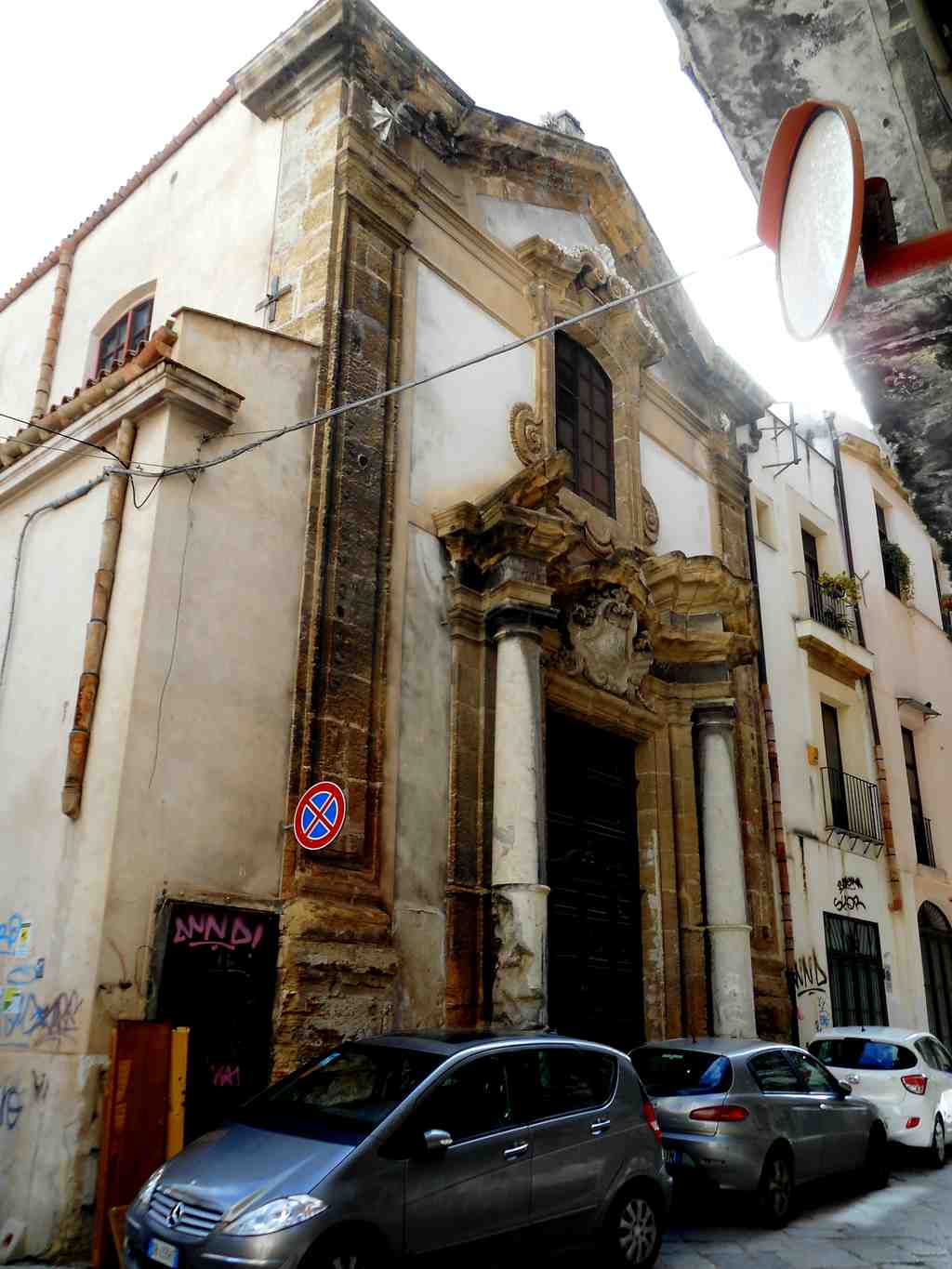
You’re looking for a weathered, sand-colored church pressed tightly between old apartment buildings; just ahead, its tall, baroque façade rises up with grand columns around the doorway and a large, rectangular window above - keep an eye out for its swirling stone decorations and broken pediment just under the roofline.
Now, as you stand here at the corner of Via Montevergini, let’s travel back through layers of mystery, splendor, and drama. In the 11th century, this spot wasn’t even known as the Church of the Three Kings - it was called San Giorgio lo Xheri and it boasted a lookout tower. Imagine this street in Norman times, with nobles stalking by, crusader knights, and even spies peeking from the tower’s windows. Over the centuries, it changed hands, caught up in the chessboard of Sicilian power, until, in 1398, King Martin I of Sicily handed it to a Barcelona nobleman, Berengario Ruiz, after snatching it from the powerful Aragona family.
But the church’s true legend began in the 15th century, when the Compagnia dei Tre Re, or the Company of the Three Kings, made this their headquarters. Now, don’t be fooled by the regal name - these Three Kings weren’t kings at all, but a guild of shopkeepers! That’s right: Palermo’s bourgeoisie wanted a little royal glam for themselves. In 1545, Pope Paul III gave indulgences to anyone who helped fund the church’s restoration - sort of like spiritual crowd-funding, but less about likes and more about saving your soul.
Come around 1580, the church was completely rebuilt, and the Compagnia’s influence transformed it into one of the city’s finest. The new Baroque façade you see now dates to 1758, designed by Francesco Ferrigno, a student of the great architect Andrea Palma. Just look at those curly stone decorations on the portal - Ferrigno was determined to outdo his master, and he gave Palermo a building so grand that even the street seems to step aside and bow.
Meanwhile, inside, things got truly spectacular. Picture yourself stepping in: a single wide nave unfolds, its walls once bursting with stucco and allegories. In 1750, the famous Serpotta family of artists let loose their imaginations here - Nobility and Astrology by the door, Obedience and Wisdom near the altar, each represented by elegant, female figures. Sadly, vandalism has left these sculptures headless, but if you close your eyes, it’s not hard to imagine them bantering about the mysteries of the stars or the best cake shops in Palermo.
The ceiling above was transformed into a celestial parade by painter Vito d’Anna. Look up, and you would have seen ‘The Triumph of the Magi,’ three kings parading in all their baroque wonder, watched over by putti and flanked by medallions of Virtues. If you listen carefully, even now, you might hear the distant rustle of noblewomen’s skirts from the side galleries - called matronei - designed to give Palermo’s ladies privacy as they kept an eye on both the ceremony and each other.
This church has seen centuries of drama: wars, earthquakes, bombs. During World War II, the church was badly hit by bombings, and for a while, it stood as a hollow shell, the sound of footsteps replaced by the lonely drip of water and, perhaps, the echoes of prayers. Then, in the late twentieth century, thieves and vandals tried to cart off its treasures - or, failing that, shattered statues with hammers. Artworks vanished, ceilings crumbled, rumors swirled about lost paintings tucked in shadows. Eventually, the authorities sealed the building, walling up the doors, as if to hush the church’s secrets until better days.
Yet, for all its wounds, the Church of the Three Kings still stands. Its battered façade keeps watch over Palermo’s stories of ambition, loss, and survival - a royal guardian for shopkeepers, astrologers, and mystery-lovers alike. No matter what, it always waits for a new visitor like you, ready to share its next chapter.
Intrigued by the facade, internal or the nave? Make your way to the chat section and I'll be happy to provide further details.




