
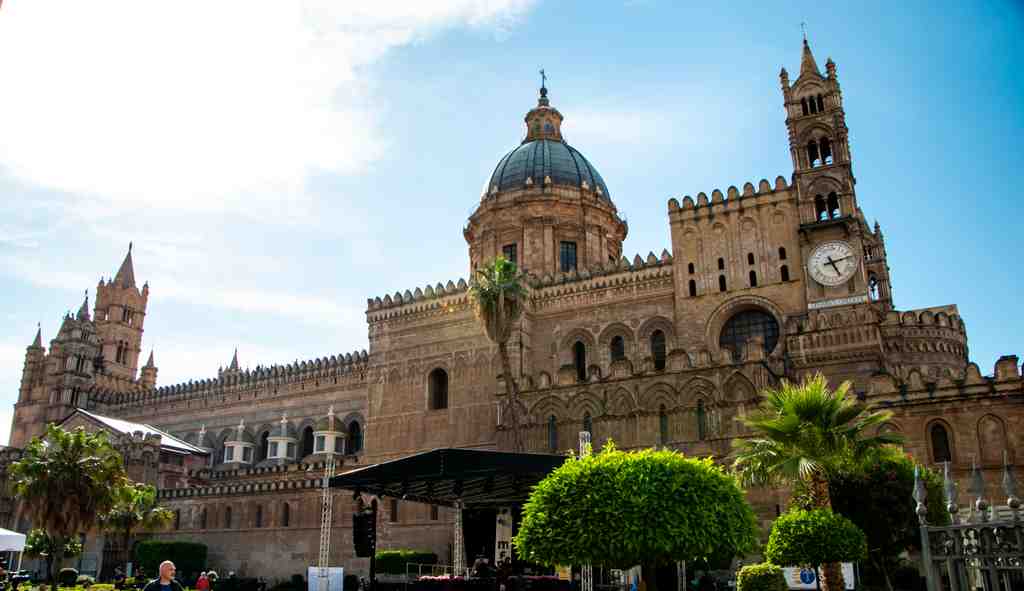
To spot the Palermo Cathedral, just look ahead for an enormous, honey-colored stone building with tall towers, spiky turrets, a giant dome to the right, and a grand triple-arched portico in front-it's impossible to miss towering over the busy square.
Now, let me transport you into the swirling winds of Sicilian history! Imagine standing here back in 1185, when the Norman archbishop Walter Ophamil decided he wanted a cathedral that would make everyone else say, “My church is nice, but have you seen Walter’s?” In fact, he built this stunning cathedral right over the site where a Byzantine basilica-and then a mosque-had once stood, as if the stone itself is a time traveler, keeping secrets tucked beneath its arches. If these walls could talk, they’d probably start in Greek, switch to Arabic, try a little Latin, and wind up with a touch of Italian flair-multilingual, just like Palermo!
Take in the mix of styles: look left, and there are towers that sprouted in the 14th and 15th centuries, so tall and full of sharp angles you’d think they could touch the clouds. The great dome in the center? That’s a relative newcomer, added in the 18th century thanks to the architect Ferdinando Fuga, who decided all cathedrals should wear a fancy hat. Back then, construction sounded like echoing through narrow medieval streets.
Wander along the south side-there’s a wide Gothic-Catalan portico embracing the square, built around 1465. Spot the columns? The one on the left is extra special: it’s survived as a pagan, a Christian, and even a Muslim-just look closely and you’ll find a verse from the Qur’an carved right into it. Palermo’s cathedral doesn’t hide its past, it shows it off like a badge of honor.
Step inside (at least in your imagination), and you’ll find a maze of chapels filled with the mighty dead. Emperor Henry VI rests here, so does his famous son Frederick II, alongside Peter II and Constance of Aragon-all tucked into majestic porphyry sarcophagi, so heavy and red, they probably took a team of Sicilian strongmen (and maybe a few borrowed Roman columns) to hoist them into place. You’ll spot lions at Frederick’s tomb-because every emperor deserves a few feline bodyguards.
High up in the nave, sunlight dances along the altar, filters over the glittering stones and lapis of the Sacrament chapel, and sometimes glints off the golden crown of Constance of Sicily, discovered in her tomb in 1491. Somewhere, there’s the echo of ancient bells ringing through centuries, sometimes calling emperors to their knees, sometimes welcoming kings like Charles III and Victor Amadeus II to their coronation. In fact, King Victor Amadeus II was crowned right here-though he didn't have time for a selfie!
The cathedral’s greatest trick, though, might just be inside its marble floors. Hidden almost in plain sight is a line of thin bronze-the meridiana-built in 1801 by the astronomer Giuseppe Piazzi. Watch for a sunbeam as it slips through a tiny hole in the dome and crawls across that line at high noon. If anyone asks, just say you’re measuring the time of year in the most dramatic way possible, tracking the dance of the zodiac with real Sicilian flair.
If you were to stroll through the crypt, the air would turn cool and still, dust swirling among granite columns as you pass Roman, Byzantine, and Norman tombs-it’s Palermo’s real underground VIP lounge. Down here lies Walter Ophamil, the original church builder, a man so determined to outdo the old mosque he made sure his bones would never leave this spot.
So, whether you came for the artistic treasures, royal drama, spooky crypts, or just to chase a stray beam of Sicilian sunlight, Palermo Cathedral stands as a proud, stubborn survivor-a glorious patchwork built by conquerors, shaped by kings, and polished by the hands of time. Don’t worry, if you feel a little dizzy, it’s just the stories swirling in the air...or maybe the dome is just that impressive!
Fascinated by the overview, 18th and 19th century renovations or the royal and imperial burials? Let's chat about it




