
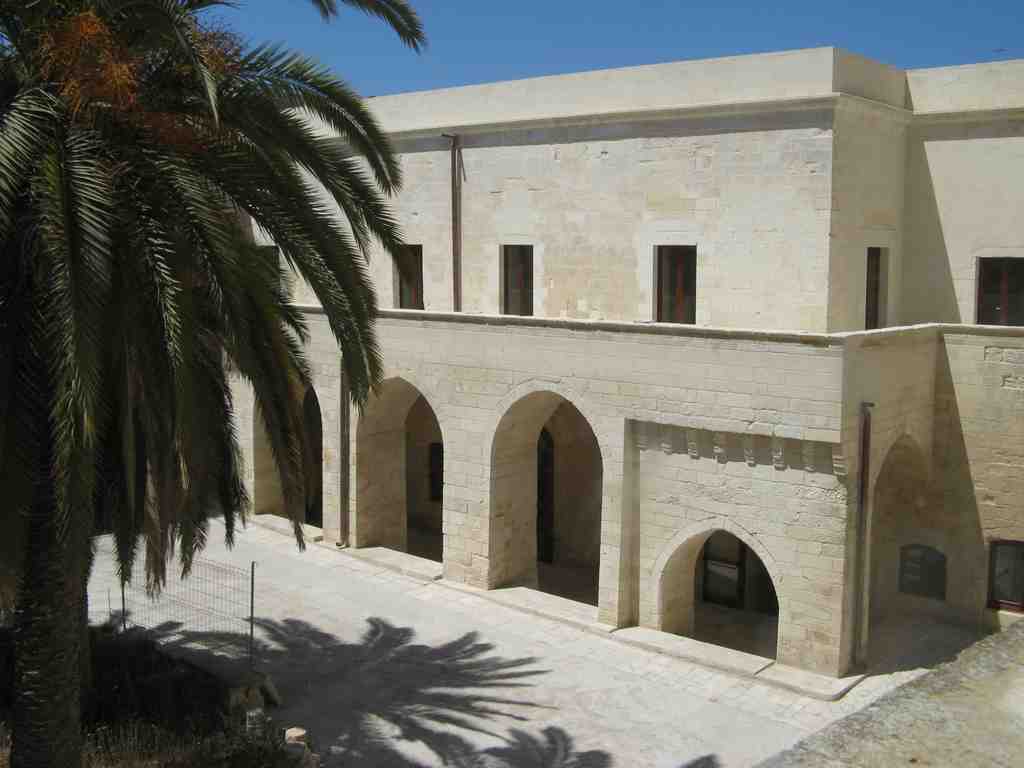
To spot the Castle of Lecce, look just past the sweeping branches of the palm tree in front of you: you’ll see a massive pale limestone building with thick walls and high, squared-off corners, its arched entryways set deep into solid stone.
Standing before the mighty Castle of Lecce, let’s imagine you’re right where countless guards once stood, eyes darting from the city wall to the sea, ready for anything-or at least a good story. The castle is perched just east of the city center, near the lively Piazza Sant’Oronzo. Over almost five hundred years, its pale stone has witnessed everything from royal drama and pirate threats, to-would you believe it-a white bear living in the moat. But let me start at the beginning.
It all began with Emperor Charles V of Habsburg, who in 1539 took one look at the outdated medieval fortress and basically said, “We can do better.” So, the emperor ordered it torn down and replaced with a state-of-the-art fortress, designed to resist the cannons and cunning of the age. The esteemed military engineer Gian Giacomo dell’Acaya was called in, and between 1539 and 1549, he created the quadrangular marvel before you-complete with mighty bastions at every corner, like the Bastion of Santa Croce and Bastion of Saint Martin.
As you walk around the exterior, picture the sounds of masons with their chisels as new walls rose, ready to guard Lecce from attacks coming off the nearby Adriatic coast. The fortress’s job was to keep pirates and invaders at bay, which, let’s be honest, beats handling local parking tickets.
But what about those secret entryways? In its time, at least three gates opened into this stronghold: the stately “Porta Reale” for ceremonies, the “Porta ferrata” facing the city, and the mysterious “Porta falsa”-the so-called “fake gate”-near the main tower. Overhead, the imperial Habsburg coat of arms showed any visitor just who was boss here.
To make space, entire buildings like the old Celestine Convent and Santa Croce Church had to be demolished-though their memory still lingers, if you know where to look. The imposing keep at the northeast, the Magistra Tower to the left, and the “truncated tower” at the southwest all give hints of earlier centuries. And rumors persist that in the 1300s, the noble Orsini Del Balzo family kept a white bear in the moat-not just to impress their friends, but as an early burglar alarm.
The moat was eventually filled in, and the old drawbridges-for both gates-were removed in 1872, though you can still spot some marks where they once rested. Can you imagine the screech as the gate closed up tight, with cannons at the ready in the bastions overhead?
But don’t think this fortress was all doom and artillery. In the 1700s, one grand hall was even used as a theater, where the sounds of applause replaced battle cries. By the 19th and 20th centuries, the castle served as a barracks for the military, then gradually transformed. Since 1983, it’s belonged to the people of Lecce, serving as the city’s cultural headquarters. If you listen closely, you might hear the faint voices of actors, soldiers, and even the occasional bear, echoing through centuries of stone-a fortress full of stories, standing proud beneath the southern sun.




