
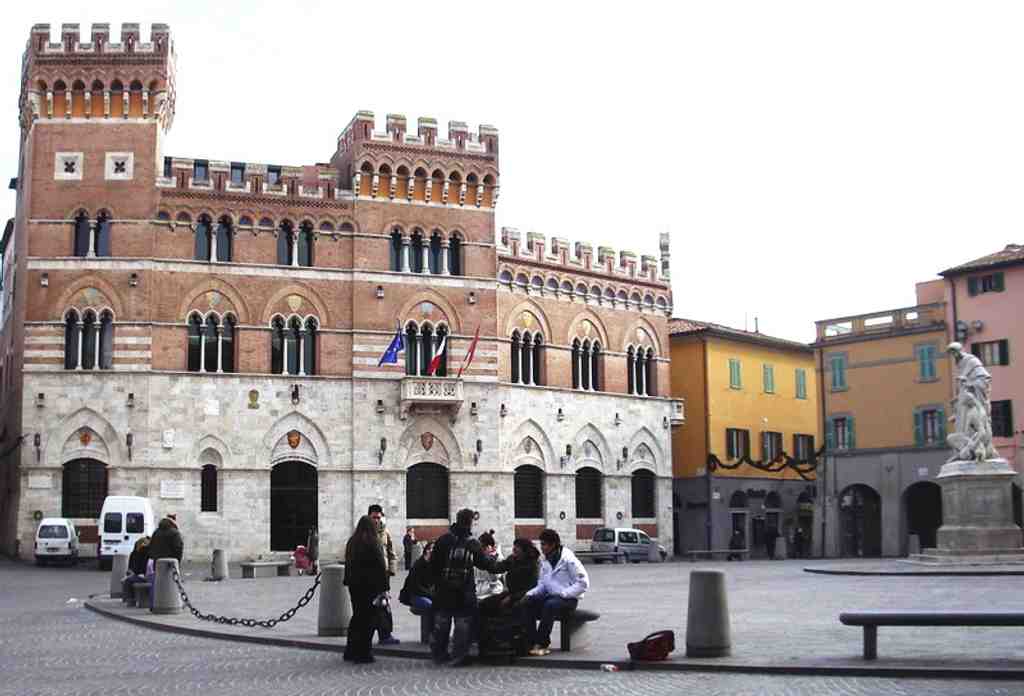
As you walk up, look ahead and just to your left to spot the grand Palazzo Aldobrandeschi with its impressive neo-Gothic facade-all red brick and white stone-standing proudly beside a lively open square, with a dramatic statue right in the center and a chain-linked set of pillars circling it like the city’s own little necklace.
Ah, benvenuto to Piazza Dante-the beating heart of Grosseto! Here you stand in the city’s living room, a place so full of stories, secrets, and maybe a scandal or two, that even the old paving stones might start whispering if you listen closely. Now, take a look around: the square is like a giant, slightly wonky trapezoid, hemmed in by prestigious buildings that look as though they've assembled for a royal portrait. There’s the commanding face of the Palazzo Aldobrandeschi to your left, bustling porticoes, and-towering at the far edge-the proud side of Grosseto’s great Duomo. The square is always alive, with locals chattering, children weaving around the statue, and old-timers keeping a watchful eye out for anyone daring enough to call the piazza by its nickname, “piazza delle Catene.” Yes, those very chains and little columns around the statue! If you ever get lost, just ask for “the square with the chains” and you’ll get pointed straight here.
Picture it: it’s the year 1222, the echo of medieval cloaks swishing and stern monks hurrying across the original piazza, which was much smaller than the one you see today. Bit by bit, the square grew with the city’s ambitions, its borders stretched as grand new buildings rose-especially in the wild days of the 13th and 14th centuries. Imagine the clamor of the markets, the solemn ring of cathedral bells (the very same Cathedral of San Lorenzo whose mighty flank faces you now), and gossip snapping like fresh bread as merchants and town officials argued about everything from salt to who owed whom a favor. During the city’s “Sienese years,” when Grosseto was under the rule of its pushy northern neighbor Siena, the square became the true power center-the place where the most powerful families, the great and the not-so-good, all vied to outdo each other with the height of their palazzos.
As time passed, the square saw its fortunes rise and fall. In the grim centuries of Medici rule-picture tumbleweeds and a lot of long faces-this place went from vibrant public square to little more than a gloomy citadel, with Grosseto serving as a military outpost or, depending on your luck, an oversized prison. The population thinned to barely a handful, but the city’s heart kept beating right here. By the 18th century, with the arrival of the Lorraine dynasty and a breath of fresh urban renewal, the square finally shook off its dusty old coat. The pavements were redrawn under the watchful eyes of the Grand Duke’s engineers-one of whom even complained the piazza was “half broken” and more pothole than paving. Clearly, potholes are a proud Italian tradition!
Look at the center now and meet the star of the show-Grand Duke Leopoldo II, forever immortalized in marble as “Canapone.” Now, this sculpture isn’t just a pretty face. It’s a whole pageant of symbols: the grand duke holds a woman, an allegory for Maremma struck by malaria, and a lively child, representing hope for the future. His foot? Oh, it’s squashing a snake-malaria again! And just behind, a fierce griffin-Grosseto itself-snatches up the serpent. Talk about dramatic! It’s medicine, mythology, and city pride all rolled up in one glorious hunk of marble.
Throughout the centuries, the square acquired more than its share of architectural glory. The palatial Palazzo Aldobrandeschi, built at the dawn of the 1900s, flaunts its neo-Gothic curves and battlements as the headquarters of the provincial government. Look around and spot the whimsical houses: Casa Magagnini, with its flowery stone balconies; Casa Santini, crowned with battlements; the old Palazzo Severi, once home to the Vanni family and now to the local pharmacy (which, by the way, could probably tell a few centuries’ worth of secrets, if only those medicine bottles could talk).
And who could forget the great column in the square? Once used to post public announcements and “bandi” (no, not bands, but old official proclamations), the current monument is actually a real Roman column hauled up from the ancient ruins of Roselle, just to add an extra dash of history to your stroll.
But perhaps the greatest mystery and transformation came after World War II, when the square was, for a while, paved over and even used as a parking lot-sacrilege! Somehow, Grossetani never let go of their affection for the chains, and after decades of clamor, the square reclaimed its classical look. Now, as you stand in the midst of all this grandeur-chains sparkling, statues watching, centuries swirling around you-you can’t help but feel the heartbeat of Grosseto pulsing from the past right into your very feet.
So linger, my friend, soak it in. Piazza Dante is not just a square; it’s the living, laughing soul of the city-always waiting for the next story to walk across its stones.


