
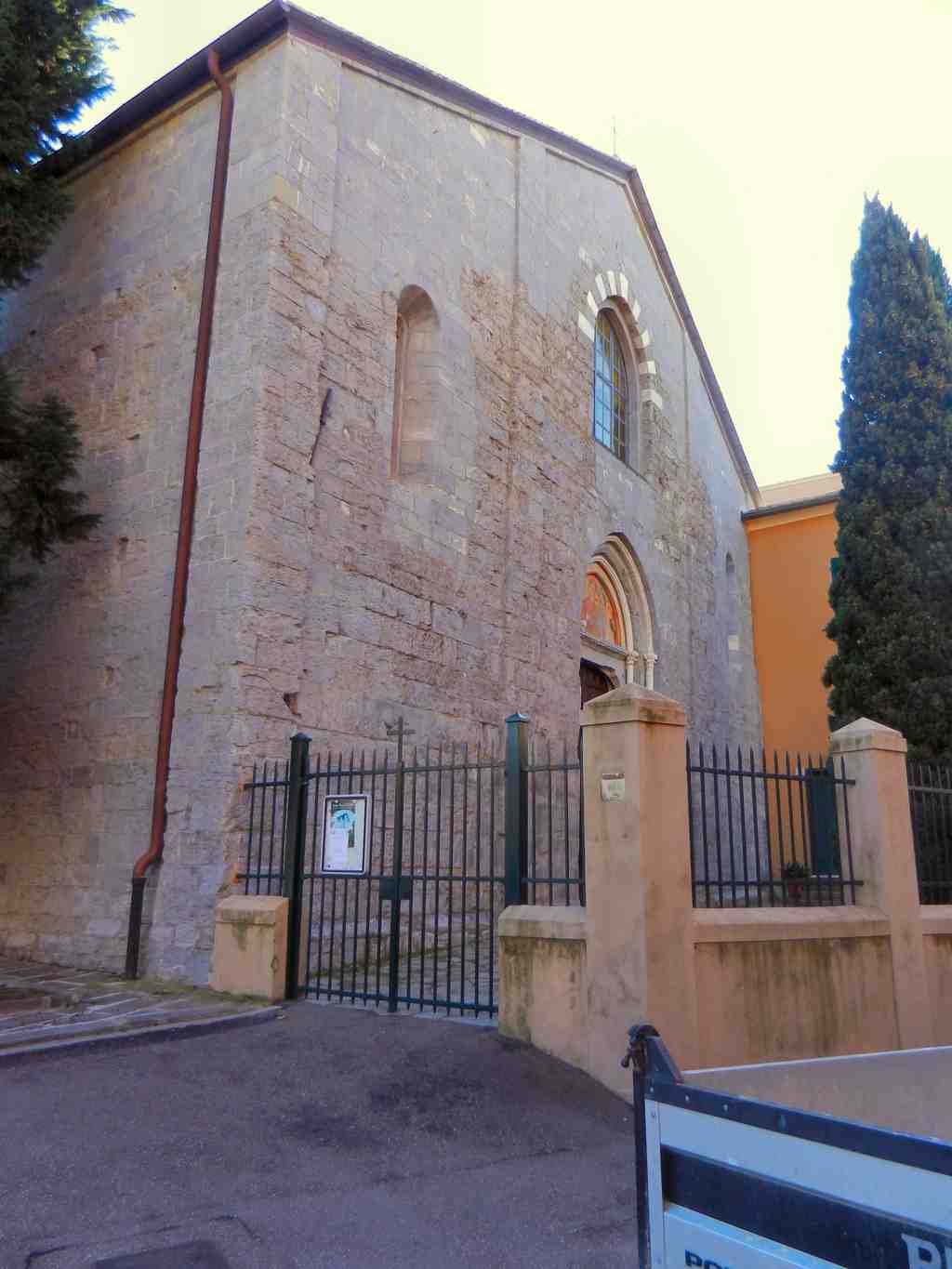
To spot the Chiesa di Santa Maria del Prato, just look for a tall, pale stone building with simple, sturdy walls, a pointed roof, and a narrow gated entrance - it stands quietly at the corner where via Parini meets piazza Leopardi, its rustic Romanesque facade setting it apart from anything else around here.
Imagine you’re stepping back in time, right onto the centuries-old grass of what used to be Genoa’s public field - before the bustle of the city, before cars and gelato shops, this corner was simply called “the big public meadow.” Here stands the Chiesa di Santa Maria del Prato, built in 1172 when Genoa was a very different place. Back then, the city was fractured by feuding families and warring political factions, the kind of place where your neighbors might invite you for pasta or, depending on the day, a sword fight. Into this mix stepped a group known as the Mortariensi - serious-sounding canon priests from the order of Santa Croce di Mortara, who wanted a new church and a peaceful spot to worship (and maybe escape the city’s chaos).
Now, wealthy Genoese citizens, eager for a VIP pass to the afterlife and possibly a premium burial spot, pitched in their coins. The most notable were Sigismondo Muscola and Angelerio Camilla - city bigwigs with enough influence to keep peace between rival families. Then there was Blancardo, a rich merchant who may have thought, “Why not have my soul, and my bones, rest in style?” Thanks to their generosity, the church rose up in the very heart of what must have felt like the countryside.
For centuries, it was simply Santa Maria d’Albaro - but its lonely spot in the middle of the field earned it the nickname “del Prato,” which stuck as the city grew up around it. If you close your eyes for a moment, you can almost hear the wind rustling through the long grass and the bells of distant churches chiming. The place survived all sorts of upheaval: the priests changed hands (literally!), the neighborhood expanded, and the church itself started to show its age. Things got so shabby that, by 1582, visiting bishops were wagging their fingers - and not in a good way.
By 1699, the church was in such rough shape that parts of it were demolished: gone were the choir and the lovely old colonnade. But alongside every crisis, some heroic figure seems to arrive. This time, it was Carlo Maria De Fornari, a bishop with grand plans - and probably an eye for property. He asked the Pope himself for ownership, became the boss, and decided to give the church a radical makeover. Out went the minimalist Romanesque, and in the dazzling, curly world of Baroque! Although that “Baroque-up” might have shocked poor medieval purists, it’s probably what saved the church from total ruin.
Fast forward to 1800 and-plot twist!-the French, under Napoleon, rolled into Genoa. They transformed this tranquil church into…a horse stable. Imagine the elegant arches filled with the sound of whinnying! Thankfully, after things settled down, the De Fornari family promptly booted the horses and brought back the faithful.
But history wasn't done with Santa Maria del Prato. Over the years, fortunes faded and, by 1880, the church was shut and only reopened when a group of nuns, the Clarisses, bought it and moved in next door. For about forty years, you’d see their habits fluttering through the cloisters and maybe hear the soft echo of their prayers at dusk. But nothing in Italy stays still for long! By the 1930s, the nuns left-perhaps looking for a warmer spot or less drafty rooms. Still, hope remained.
A massive restoration project, led by architect Carlo Ceschi and the local heritage bosses, aimed to strip away centuries of add-ons, recapturing the church’s original medieval look-no made-up decorations, just the genuine, chiseled stone. World War II slowed things down, but by 1951, the church was breathing new life and history was back in the stones.
Today, the facade before you reveals that ancient Romanesque simplicity-sterner than some, yet proud: split by upright pilasters, wrapped with worn, pale limestone, and topped by a striking ogival window with two slimmer slits beside it. Look above the portal and you’ll spot a rare fresco-the Madonna and two angels-one of the last artistic treasures clinging to its walls.
The story doesn’t end in the past. These days, this church opens its doors for special occasions and Sunday afternoons. In the crypt, you’ll find the tomb of Saint Agostino Roscelli, hero to the local Immacolatine Sisters, whose general house is here. It’s a place where the echoes of medieval prayers, fresh-cut grass, galloping hooves, and modern footsteps all blend into one unforgettable Genoese tale. And I must say, for a building that’s seen battles, bishops, nuns, and even a few horses come and go, the old meadow church is holding up rather well. Now, that’s what I call a plot with a twist!


