
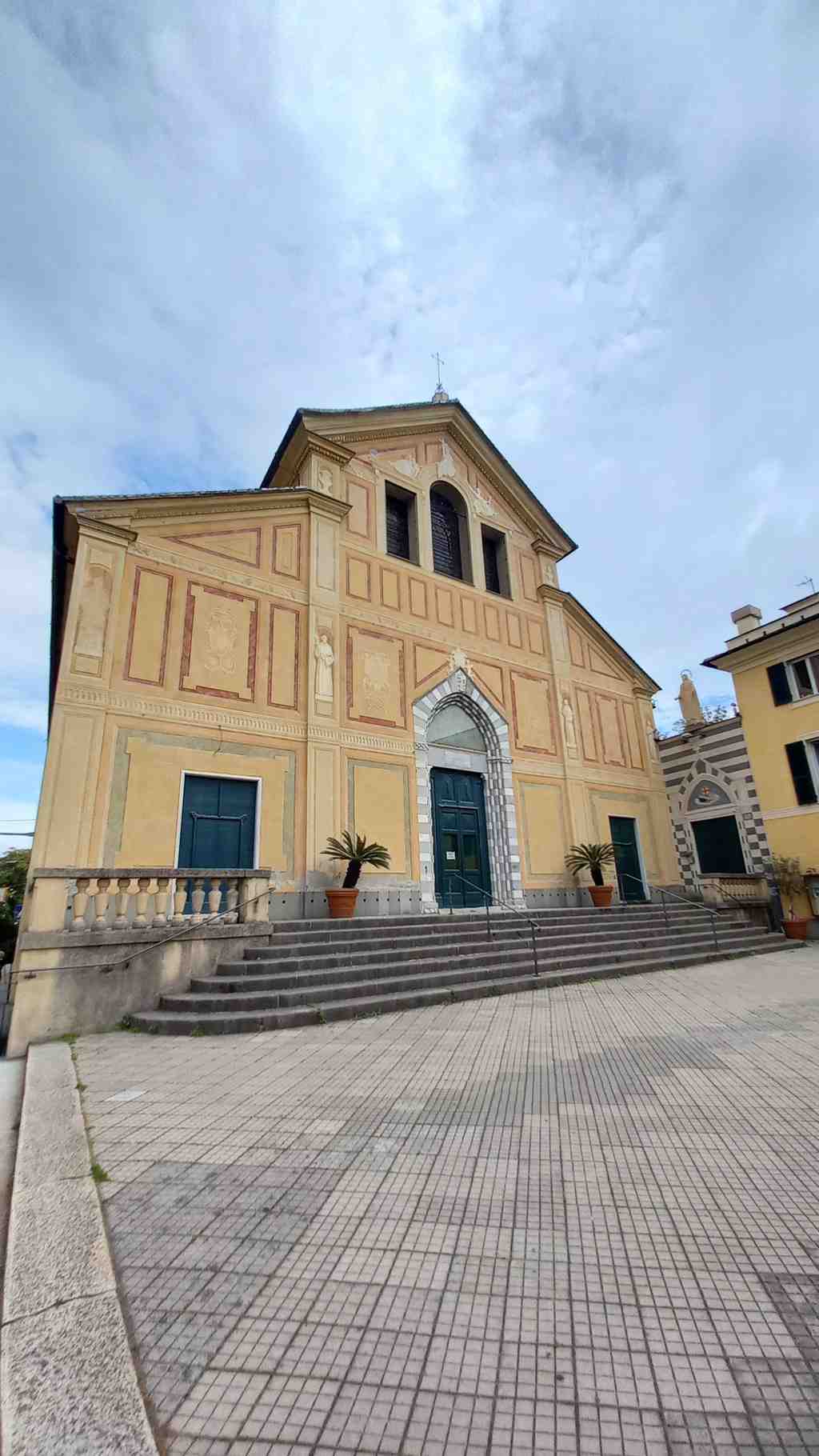
You’ll spot the Chiesa di San Francesco d’Albaro right in front of you by its bright, pale-yellow facade, framed with soft red geometric decorations and a pointed doorway trimmed in white and grey stone-just head up those broad steps and you can’t miss it!
Now, let’s plunge into the swirling mist of history and imagine yourself standing on this very plaza-not just today, but centuries ago, when the air would have been tinged with the salty breath of the Ligurian Sea and the clatter of hooves echoed along the winding medieval roads. Right where you stand, in the heart of Albaro, a church has kept watch over Genoa’s changing fortunes since the 1200s. But before the Franciscans arrived with their sandals and stories, it was a spot dedicated to the Archangel Michael-a heavenly “bouncer,” if you will, at the city’s edge.
Picture the year 1304: monks hustling in brown robes, merchants shouting, families building, and behind them a new chapter unfolding. A noble family named Cebà, probably not strangers to a little civic pride and maybe a pinch of rivalry, donated the land next to the old church, sparking a Franciscan building boom. By 1324, thanks to their deep pockets and the friars’ boundless energy, the new church and convent were up and running, replacing old Michael with the gentle, animal-loving Francis of Assisi as its patron-though I promise, if you have a dog with you, Saint Francis would be thrilled!
Fast forward a bit to the 1400s. The church needed a facelift. Enter the Grimaldi-Cebà, always ready for some restoration action, presiding over a freshening up of the altar and choir. In 1440, the pulpit was reimagined-if walls could talk, I’ll bet it would have some “sermon-worthy” stories from this period! But a true change came in 1476, when the church swapped its old bones for a grand new plan: three naves, a Latin cross floor plan, and enough space to fit every dream, prayer, and local secret. This is more or less what you see today, with only the sturdy Gothic portal outside left to remind us of its medieval roots. Take a moment to touch the stone-think of how many hands, hopeful or weary, have done the same.
The 1500s and 1600s brought both drama and disaster. Out on the coastline nearby stood an ancient church, Saints Nazario and Celso, battered by angry storms until it finally surrendered to the sea. The parishes shifted here. Papal decrees flew from Rome, bringing lofty titles and changing the pecking order-a little ecclesiastical excitement to spice up village life.
By the 1700s, frescoes blossomed on the ceilings and walls, thanks to the master Giuseppe Galeotti, who must have spent a good part of 1754 craning his neck and chasing sunlight across the sanctuary. Walk inside, if you can: there you’ll see a swirl of saints, allegories, and scenes all vying for your attention. On the main vault of the nave, a triumphant Saint Francis floats above, painted by Giovanni Battista Carlone and expanded by Giovanni Agostino Ratti-clearly a competition between the Giovannis!
But the peace of the cloister hasn’t always been so serene. During the Napoleonic era, when the French took over and religious orders were booted out, the cloaked friars had to pack up and leave. You might picture a somber exodus, but also a determined return-by 1817, after Napoleon’s fall, the Franciscan community marched right back in, dusted things off, and set about reclaiming their beloved home. Imagine fourteen Franciscans, a few lay brothers, some busy servants-all sharing stories and chores as the world outside spun through its revolutions.
There’s more: in the convent, tucked away like a hidden treasure, you’d now find masterpieces painted by Alessandro Magnasco-a moody, dramatic “Supper at Emmaus”-and gems by other Genoese painters. Then there’s the music! Take a deep breath and listen, and you might just hear echoes from the grand organ, a true showstopper. The current one came from Bologna in the 1800s, and although it barely fit-being much bigger than expected-it now pours its melodies over the congregation, filling this crossroads of history with song.
And last, if you’re up to a little ghost-hunting, let your imagination linger over the elegant portico-the portal that’s watched generations come and go, through centuries of sun, storm, and the endless parade of Genoa’s ever-curious visitors… like you!


