
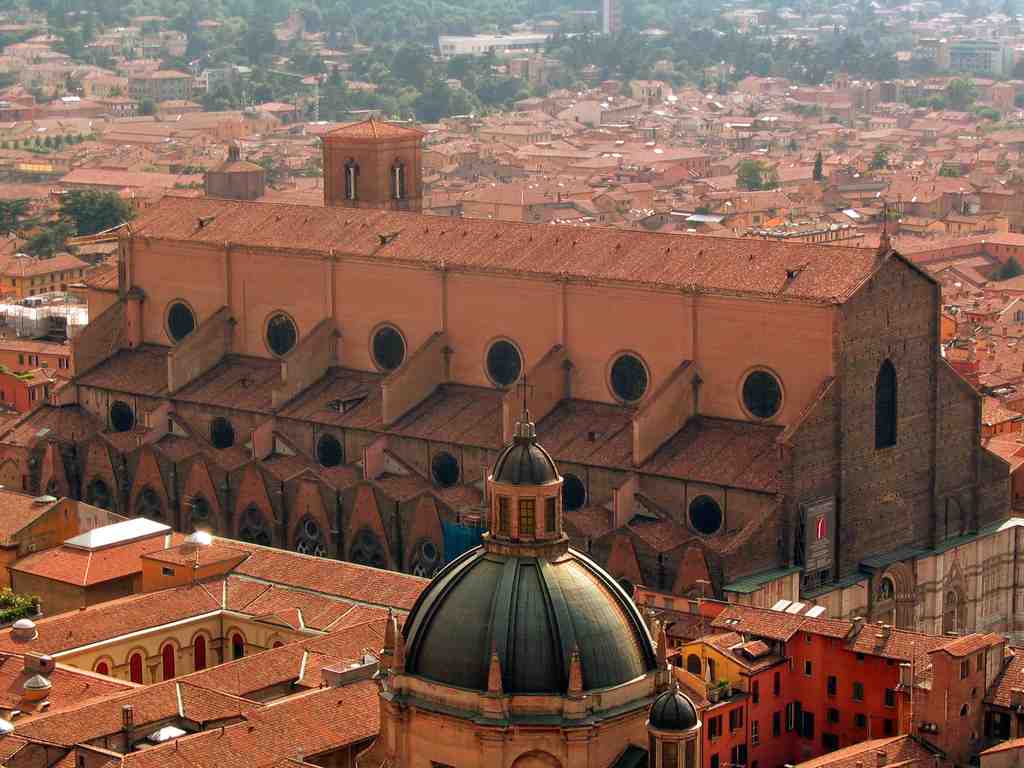
To spot the Basilica of San Petronio, just look for a massive brick church with a roof full of small pointed arches and rows of circular windows, towering above the surrounding buildings in front of you on Piazza Maggiore.
Imagine, as you stand here, it is the late 1300s: the air is thick with excitement and ambition. Right in front of you rises the largest church in all of Bologna, one that was meant to rival the great cathedrals of Florence and Milan! Its walls of reddish brick stretch a jaw-dropping 132 meters in length and 60 meters in width, with a vault soaring overhead to a dizzying 44 meters. That’s almost half a football field-sideways! Now, take a good look at the stark upper facade, left unfinished in warm exposed brick, and let your eye drift down to the lower level clad in creamy white and rosy marble. As you stand outside, it’s easy to picture the original plans: great flying buttresses, a sprawling Latin cross, and four grand bell towers-none of which ever fully materialized. The basilica was started in 1390, and you can almost hear the bustling medieval crowds in the square on the day the first stone was laid, with solemn processions and chants echoing through the city.
But here’s a twist in the tale-this church wasn’t built by bishops or popes, but by the city’s newly powerful citizens. The artisans, merchants, and professionals of Bologna decided they wanted their own grand monument, a symbol of freedom and the self-government of the people. Building San Petronio was both a stroke of civic pride and a bold political statement: “Hey Florence and Milan, move over, Bologna is in the game!” The clerics, left out of the plans, were not exactly thrilled-imagine being the only one not invited to the biggest party of the century.
The basilica was dedicated to Bologna’s patron saint, Petronius, whose reputation for piety and wisdom in the fifth century was legendary. As you glance at the facade, notice those intricate reliefs: saints, biblical scenes, and the famous central portal begun by Jacopo della Quercia. Michelangelo himself admired these carvings; he later “borrowed” some of their poses for his Sistine Chapel. And if you peer at the doors, you’ll spot where legends were literally sculpted in stone-though, much like a good cliffhanger, the work remains unfinished to this day.
Political drama didn’t stop there. Rival popes, warring families, even a would-be world record size-this church saw it all! In fact, there was once an enormous bronze statue of Pope Julius II by none other than Michelangelo sitting right on the facade. Sadly, it was destroyed in a fit of political rebellion, and its fragments were melted down to make a cannon called “Giulia.” Talk about repurposing with style!
Step around the side, and you’ll see the alternating rhythm of buttresses and marble-framed windows-a mixture of brick for strength and marble for beauty, just as the original architect, Antonio di Vincenzo, wanted. He didn’t go in for lots of fussy Gothic pinnacles or spires, preferring instead vast spaces and mysterious, shifting light. Inside, you’d find six cavernous bays, twenty-two chapels, and sunlight streaming in to bathe the rich colors and paintings. But don’t rush in just yet! Let your imagination roam the unfinished corners, the halted transcepts, and the stories whispered by every stone.
Oh, and if you listen carefully on a festival day, you might even hear the bells tolling high above in the 65-meter bell tower-the oldest bells, swinging by hand, with rhythms invented right here as far back as the 1500s. The clang of bronze, the echoes through the city, and somewhere, laughter from the old campanari who still climb up to keep the tradition alive.
Despite being Bologna’s biggest, San Petronio isn’t even the city’s official cathedral! It’s the people’s church-built for the pride and freedom of medieval Bologna, a monument to dreams too large to ever finish. If those ancient bricks could talk, what stories they’d share-political battles, artistic genius, community triumph, and a bit of unfinished business that still hangs in the air today. And yes, standing here, you’re part of its story too.
Curious about the the façade, sides, bell tower and bells or the internal? Don't hesitate to reach out in the chat section for additional details.




