
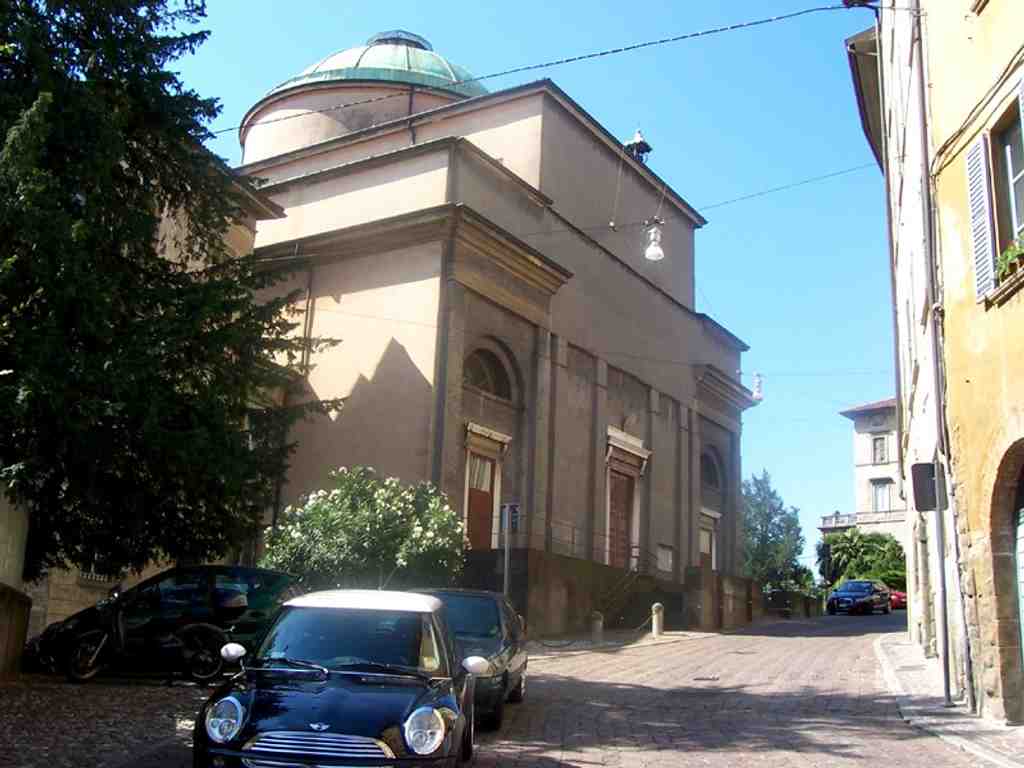
To spot the Church of Sant’Andrea, look ahead for a simple, almost fortress-like building with a plain facade and a telltale rounded green dome peeking up above its square brownish walls, standing firmly at the bend in the cobbled road.
Welcome to Sant’Andrea! It might look a bit shy with its unfinished facade-no grand columns or statues out front-but don’t let appearances fool you. Behind these quiet walls is centuries’ worth of dramatic history, art, and even a dash of mystery. Let’s head back in time: imagine standing here in the year 785, when this spot was barely more than a little basilica surrounded by silence except for the toll of simple church bells. The church would grow up with the city, its story layered brick by brick, rebuilt and reshaped each time fate threw something new its way.
There’s a legend that in 1295, the church revealed hidden treasures: a crown, a chalice, and a silver spoon buried in its walls-maybe ancient gifts to saints who were venerated here. But the real moment of drama came in 1401, when, under the altar, locals discovered bones and a stone carved with ancient names-Domnione and his nieces and nephews, long believed to be martyrs. “BM,” the slab said, and for centuries people whispered it stood for “Blessed Martyrs,” though really it just meant “of good memory.” Simple, right? Historical misunderstanding: 1, Truth: 0.
Now, picture the tension when, in the late 1500s, the mighty Venetian walls went up and accidentally damaged dear Sant’Andrea. The Republic of Venice, probably feeling a bit sheepish, coughed up 300 scudi to help fix things-and the church rose again, finally reopening in 1592, shiny (well, maybe not THAT shiny) and ready for a bigger congregation.
Fast forward to the 1800s, and the city was changing fast, with important families building elegant palaces along this very road. Sant’Andrea needed an upgrade. Enter Ferdinando Crivelli, a young, creative architect who, after a false start by a rival, was picked to design something new right here. He was clearly inspired by a little trip to Russia-he borrowed ideas straight from a chapel in St. Petersburg! Only, Crivelli added a dramatic dome of his own, inspired by Rome’s Pantheon. All this effort, and yet, the church’s impressive facade remained unfinished. Maybe the construction crew ran out of coffee?
Inside, the church is a feast for the eyes. Golden Corinthian columns, playful faces peering from the walls-one with a glowing eye for Faith, another with an anchor for Hope. And above, an oculus crowned with a lantern lets sunlight spill over the checkerboard floor. The main altar, glowing with Carrara marble and golden angels, draws your gaze.
Sant’Andrea is also a treasure chest of paintings. Just inside you’ll find masterpieces by Moretto da Brescia, depicting a Madonna as grand as a Renaissance queen, and Andrea Previtali’s sorrowful “Compianto sul Cristo morto”-enough drama to make a modern soap opera jealous! And don’t miss the works of local favorites like Cavagna, Salmeggia, and Padovanino, recently restored so their colors sing once more.
If you’re up for adventure, peek below: in the crypt, a theater has brought laughter and applause (and maybe a few forgotten stage props) since the 1950s. Today, it’s where students test their acting chops, not unlike Bergamo’s own version of “Shakespeare in the Cellar.” Down here you’ll also discover the MuSA museum, bursting with relics-paintings, carved altars, and even old documents showing how the city and its families grew, squabbled, and celebrated across the centuries.
So next time you spot a plain church with a greenish dome and think “Is that it?”-remember, Sant’Andrea holds more stories, treasures, and a few good laughs than most palaces ever will!




