
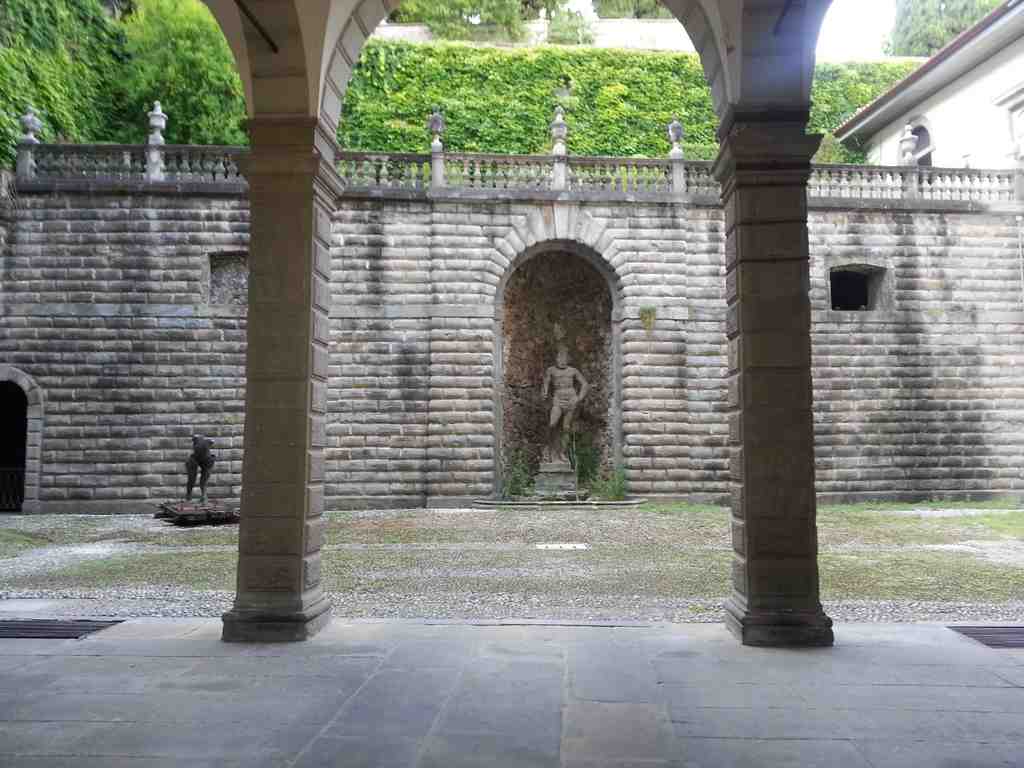
To spot Moroni Palace, look for a grand, stone courtyard with a large arched niche in the back wall housing a statue of Neptune, framed by elegant columns and an upper terrace lined with decorative urns and statues.
Now, as you stand here outside Palazzo Moroni, take a deep breath and imagine yourself stepping into a living storybook of Bergamo’s past. The Moroni Palace might seem humble from the street, but it hides a world of secrets, drama, and family twists behind those stately walls. Picture the Moroni family: rising from the town of Albino, where some ancestors were clever engineers and warriors, and later, successful in the business of silkworms and mulberry trees-a detail so important that the mulberry, called murù in the local dialect, even gave the family its name! And let’s be honest, how many noble families can say they owe their title to a silkworm’s lunch?
The story here kicks off in true “movie-style.” In the early 1600s, after Francesco Moroni married Lucrezia Roncalli, the family bought land from the Pesenti family and decided it was time for a palace worthy of their growing reputation. Though the outside doesn’t shout for attention-thanks to a rival building that blocked the view for years-the interior is pure Italian drama. As you walk under these arches, imagine frescoes and grand staircases, gilded decorations, mysterious symbols, and portraits gazing at you from every corner. These spaces were painted by Gian Giacomo Barbelli, a masterful artist, who filled the ceilings and walls with stories of noble virtues-and more than a few classical legends.
But things weren’t always rosy for the Moroni family! Just across the street once stood Palazzo Marenzi, built apparently out of spite, by neighbors with whom the Moroni had quite a few disagreements. Eventually, the Moroni family demolished it, not only for the view but perhaps for peace of mind-because nobody wants a grumpy neighbor blocking their sunshine!
There’s more dramatic flair inside. Walk up the grand staircase, and you’re surrounded by statues and paintings celebrating the family’s nobility and wisdom. You’ll spot the mighty Jupiter hurling lightning bolts at the giants, and dazzling scenes from Amore and Psyche, all hinting at the Moroni’s hopes for social ascent and a reputation to rival the stars. Each room has its own story: some decorated in the 1600s with scenes of peace and plenty, others updated in the 1800s with exotic styles like the Chinese and Turkish salons. Just imagine guests from long ago, whispering and laughing under these painted ceilings, with fresh flowers from the terraced gardens wafting in through open windows.
And let’s not forget the palace’s collection: priceless paintings by the likes of Giovan Battista Moroni-a local legend! His works, such as “The Knight in Pink,” have traveled to countless art shows and set a high bar for what it meant to look fashionable in Lombardy. Mixed in among the canvases and sculptures you’ll also find pottery from Meissen, Wedgwood, Sèvres, as well as a huge trove of paper treasures. Some documents date all the way back to the 1300s and reveal tales of love and scandal-like the “first divorce” in Bergamo’s history, where the bride was sent home for lack of a proper dowry. Courtroom drama, 1600s style!
Step outside again, and you’ll find yourself in lavish gardens stretching up to Sant’Eufemia’s hill-each terrace lined with flowers, stone putti, and even a little tower for a count to dream in. It’s easy to imagine a Moroni or two enjoying some fresh air, keeping an eye on their beloved mulberry trees and maybe, just maybe, planning another chapter in this amazing family’s story.
So, next time someone says “money doesn’t grow on trees,” you can say “Well, in Bergamo, it kind of did-for the Moronis, anyway!” Welcome to a place where art, nature, and a thousand secrets are waiting to be discovered.




